
UDISE+ Report 2025–26 Released: School Education Records Progress in Retention, Infrastructure and Digital Access
Context
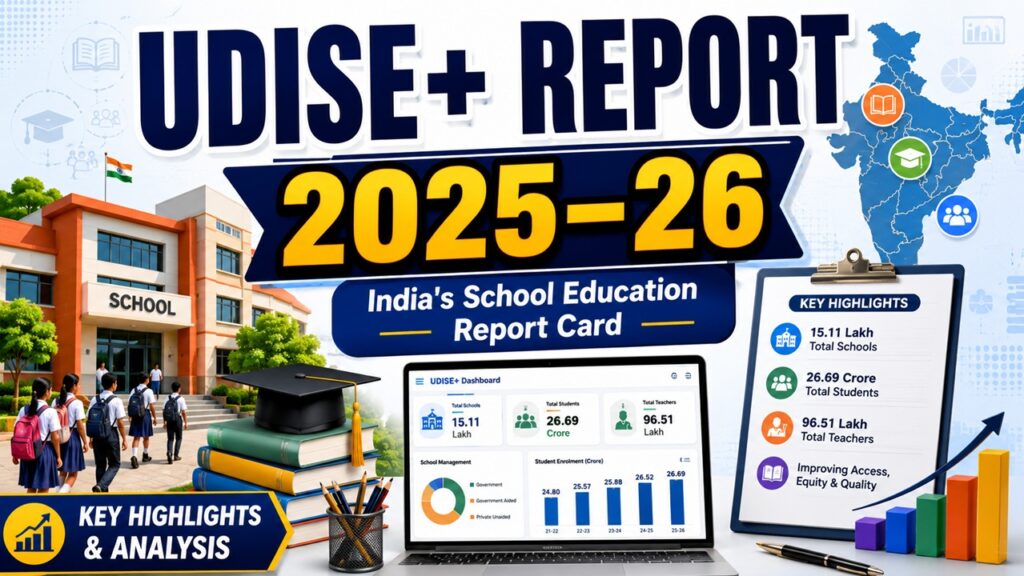
The Union Ministry of Education has released the Unified District Information System for Education Plus (UDISE+) Report 2025–26, providing a comprehensive overview of India’s school education system. The report highlights encouraging improvements in enrolment, retention, infrastructure, and digital connectivity, while also identifying critical areas requiring further policy attention.
UDISE+ Report 2025–26
What is UDISE+?
- The Unified District Information System for Education Plus (UDISE+) is India’s flagship school education database and one of the world’s largest education management information systems.
- It covers more than 14.8 lakh schools, 1.02 crore teachers, and over 26 crore students across the country.
- Managed by the Department of School Education and Literacy, it serves as the primary database for monitoring school education, planning reforms, allocating financial resources, and supporting evidence-based policymaking under the National Education Policy (NEP).
Major Findings of the Report
Decline in School Dropouts
- Dropout rates have declined across major stages of schooling.
- Preparatory-level dropout has fallen to 8%, while secondary-level dropout has reduced to around 7%, reflecting better student retention.
Rise in Enrolment and Retention
- Student retention has improved at the middle and secondary stages.
- The Gross Enrolment Ratio (GER) at the secondary level has increased, indicating wider access to school education.
Better Student Transition
- Transition rates from foundational to preparatory, middle, and secondary education have improved.
- More students are now continuing their education without major interruptions.
Improved Teacher Availability
- Teacher recruitment has strengthened the Pupil-Teacher Ratio (PTR).
- Most schools now maintain PTRs well below the NEP benchmark of 30:1, supporting better classroom learning.
Rationalisation of Schools
- The number of single-teacher schools and zero-enrolment schools has declined due to school rationalisation measures.
- This has improved resource utilisation and administrative efficiency.
Growth in Digital Infrastructure
- More schools now have computers and internet connectivity.
- Digital facilities are supporting online education, smart classrooms, and technology-enabled learning.
Improvement in Basic Facilities
- Nearly all schools now provide electricity, drinking water, and functional toilets.
- Women constitute a majority of the teaching workforce, promoting greater gender representation in school education.
Key Challenges
Weak Retention at the Secondary Stage
- Despite improvements in early education, many students continue to leave school before completing secondary education.
- Improving access to higher classes remains a major challenge.
Declining Playground Availability
- The proportion of schools with functional playgrounds has slightly decreased.
- Limited sports infrastructure may affect students’ physical development and extracurricular participation.
Accessibility Gaps for Children with Special Needs (CWSN)
- More than 40% of schools still lack ramps, accessible toilets, and other barrier-free facilities.
- This limits inclusive education for children with disabilities.
Slow Adoption of Sustainable Infrastructure
- Only around 30% of schools have rainwater harvesting systems.
- Green infrastructure and environmental sustainability need greater emphasis.
Continued Presence of One-Teacher Schools
- More than one lakh schools continue to function with only one teacher.
- This places excessive academic and administrative responsibilities on a single teacher and affects learning quality.
Way Forward
Strengthen Secondary Education
- Expand secondary and senior secondary schools in underserved areas to reduce dropouts after middle school.
Promote Inclusive Education
- Upgrade all remaining schools with ramps, accessible toilets, and barrier-free infrastructure to ensure equal educational opportunities for Children with Special Needs.
Encourage Sustainable School Infrastructure
- Promote rainwater harvesting systems and rooftop solar panels through government schemes and Corporate Social Responsibility (CSR) support.
Ensure Minimum Teacher Availability
- Provide at least two full-time teachers in every operational school to improve teaching quality and reduce workload.
Expand Digital Learning
- Connect internet-enabled schools with digital learning platforms such as the National Digital Library and PM e-VIDYA to maximize technology-based education.
Conclusion
The UDISE+ Report 2025–26 reflects significant progress in improving enrolment, student retention, teacher availability, digital infrastructure, and basic school facilities across India. However, persistent challenges such as secondary-level dropouts, accessibility gaps for Children with Special Needs, inadequate sports infrastructure, sustainability concerns, and the continued existence of one-teacher schools highlight the need for sustained policy interventions. Addressing these issues will be essential to achieving the objectives of the National Education Policy and ensuring equitable, inclusive, and high-quality education for every child.
Source : PIB