
Vehicle Retrofitment: Advancing Affordable and Decentralised Electric Mobility in India
Context
India’s vehicle retrofitment sector offers an opportunity to accelerate the transition to electric mobility by converting existing petrol and diesel vehicles into electric vehicles (EVs). By combining local entrepreneurship, skilled employment and indigenous technology, retrofitment can complement new EV manufacturing and potentially position India as a global hub for affordable conversion solutions.
What is Vehicle Retrofitment?
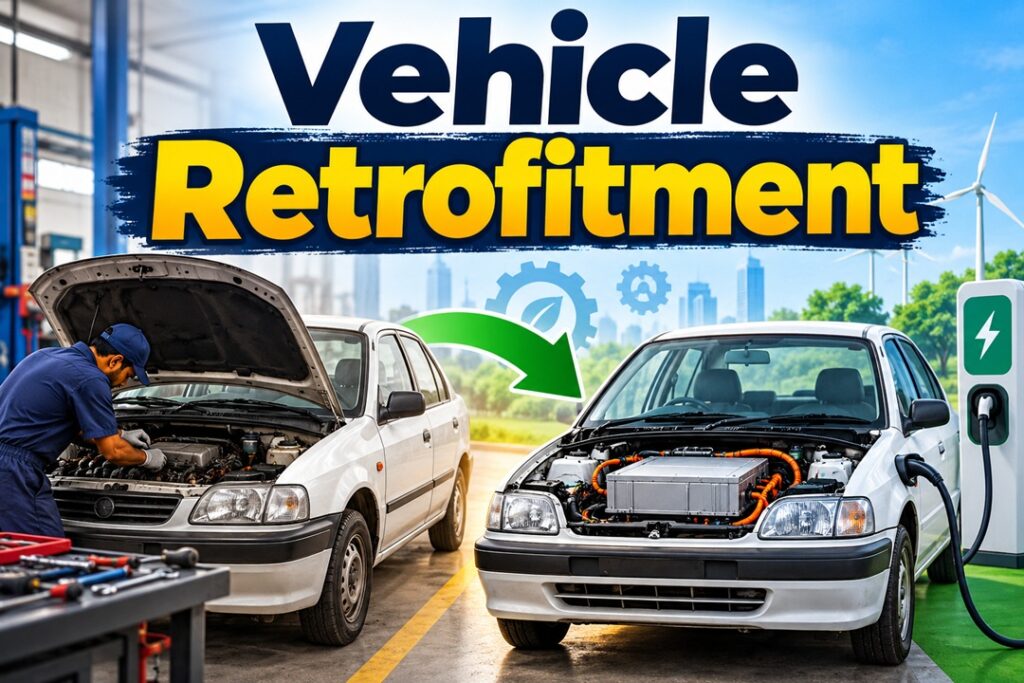
Vehicle retrofitment refers to modifying an existing conventional vehicle by replacing its internal combustion engine and associated powertrain with an electric propulsion system while retaining suitable components, including the chassis and body.
It provides an alternative to purchasing a new EV by extending the useful life of existing vehicles. However, its economic viability depends on conversion costs, vehicle condition, battery performance and regulatory compliance.
Potential of Vehicle Retrofitment in India
- Affordable Electric Mobility: Enables vehicle owners to transition to electric power without purchasing an entirely new vehicle, potentially lowering the initial cost of electrification.
- Reduced Fossil Fuel Dependence: Electrifying existing vehicles can reduce petrol and diesel consumption, strengthening energy security and reducing exposure to international crude oil price fluctuations.
- Circular Economy and Resource Efficiency: Extends vehicle life and reduces waste associated with premature scrapping, although responsible battery disposal and recycling remain essential.
- Employment Generation: Creates opportunities for mechanics, electricians, battery technicians and entrepreneurs through local conversion workshops, testing facilities and maintenance centres.
- Indigenous Technological Development: Encourages Indian enterprises to develop cost-effective motors, battery packs, power electronics and vehicle-specific conversion kits.
- Export Potential: India could supply conversion technologies, technical training and certified retrofitment solutions to developing countries with ageing vehicle fleets.
- Lower Urban Emissions: Replacing conventional powertrains with electric systems can reduce tailpipe emissions and improve local air quality, although the overall environmental benefit depends partly on electricity generation and battery production.
Decentralised Retrofitment as an Employment Strategy
India can develop a distributed retrofitment ecosystem by adapting the decentralised implementation approach used in programmes such as the PM Surya Ghar: Muft Bijli Yojana. The objective would be to combine common national standards with locally accessible services.
- Local Retrofitment Hubs: Establish authorised conversion centres in urban, semi-urban and rural areas to improve access to installation, maintenance and repairs.
- Mechanic Training and Certification: Equip existing automobile mechanics with skills in electric drivetrains, battery management, high-voltage safety and electronic diagnostics.
- Entrepreneurship Development: Support small businesses through technical assistance, access to approved conversion kits and partnerships with EV manufacturers.
- Reliable After-Sales Services: Build local service networks offering maintenance, spare parts, warranties and battery-health assessments.
- Standardised Quality Assurance: Ensure that decentralised operations follow consistent technical, safety and performance requirements.
Such an approach can distribute economic opportunities beyond major automobile manufacturing centres while building consumer confidence in converted vehicles.
Legal and Regulatory Framework in India
Vehicle retrofitment operates within India’s motor vehicle regulatory framework, which governs vehicle alterations, technical compliance and roadworthiness.
- Motor Vehicles Act, 1988 — Section 52: Regulates alterations to motor vehicles, subject to statutory conditions and applicable requirements.
- Central Motor Vehicles Rules, 1989: Provide the regulatory framework for vehicle construction, equipment, testing and compliance. Rule 115D addresses specified requirements relating to hybrid and electric vehicles, including applicable retrofitment provisions.
Conversions must comply with the relevant approval procedures, technical standards and registration requirements. The precise requirements depend on the vehicle category and the nature of the proposed modification.
Key Challenges to Scaling Up
- High Conversion Costs: Batteries, motors, controllers and installation expenses may make retrofitment uneconomical for certain vehicle categories.
- Safety Concerns: Poorly engineered conversions can compromise braking, structural integrity, electrical insulation and battery safety.
- Limited Standardisation: Differences in vehicle models and conversion technologies complicate certification, maintenance and the availability of compatible components.
- Financing Constraints: Small workshops may struggle to obtain capital, while vehicle owners may lack affordable credit for conversions.
- Battery Management: Battery degradation, replacement costs, recycling and end-of-life disposal require reliable systems.
- Consumer Confidence: Uncertainty about vehicle performance, warranty coverage, resale value and access to repairs can discourage adoption.
Way Forward
- Develop a National Retrofitment Framework: Establish clear and uniform requirements for approved conversion kits, vehicle testing, certification, inspections and post-conversion compliance.
- Introduce Targeted Financial Support: Explore concessional credit, suitable insurance products and carefully designed incentives for viable vehicle categories.
- Strengthen Skill Development: Integrate retrofitment training into recognised vocational programmes and collaborate with automobile manufacturers, technical institutions and industry bodies.
- Promote Research and Development: Encourage domestic innovation in battery systems, lightweight components, motors, power electronics and vehicle-specific conversion technologies.
- Create Accredited Testing Facilities: Expand access to recognised testing and certification centres to maintain safety without imposing disproportionate burdens on small enterprises.
- Launch Pilot Projects: Prioritise suitable commercial fleets, delivery vehicles and other high-utilisation vehicles where operating-cost savings could justify conversion expenditure.
- Build Battery Recycling Systems: Establish traceability, collection, reuse and recycling mechanisms consistent with applicable battery waste regulations.
- Explore International Partnerships: Develop export-ready technologies and training programmes tailored to the requirements of countries seeking affordable transport electrification.
Conclusion
Vehicle retrofitment can complement India’s transition to electric mobility by extending the life of existing vehicles, reducing fuel dependence and generating decentralised employment. Its long-term success will depend on economic viability, reliable technology, affordable financing and rigorous safety standards. With a supportive regulatory ecosystem and strong domestic capabilities, India can develop retrofitment into a sustainable mobility industry with potential global relevance.
Source : The Hindu