
Youth Delaying Family Formation in India: Emerging Demographic Trends and Policy Implications
Context
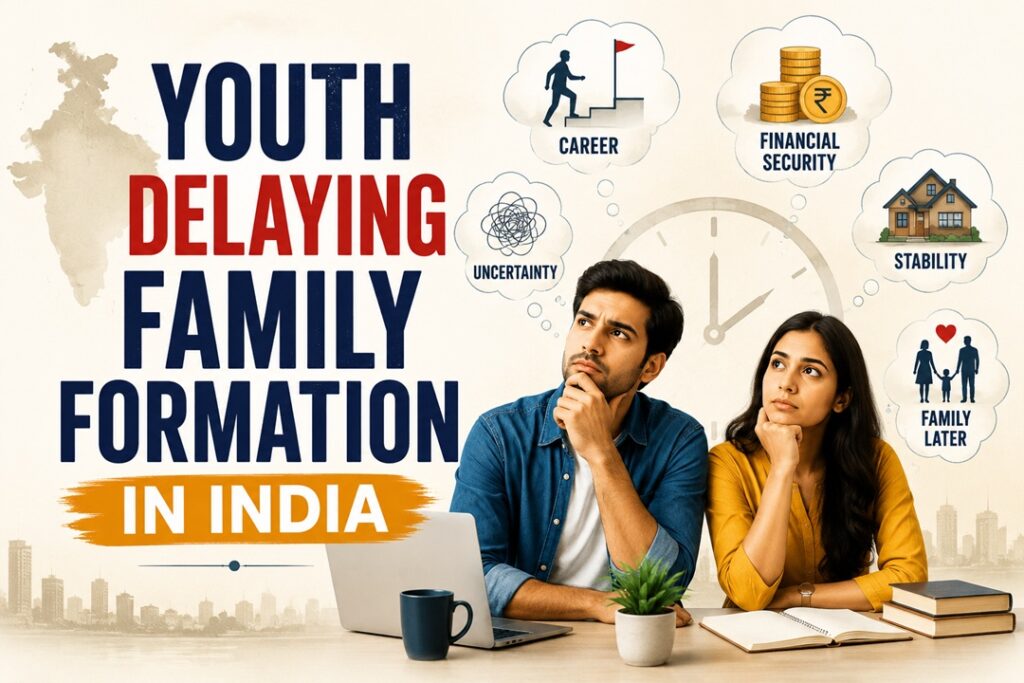
India’s Total Fertility Rate (TFR) has declined to 2.0, falling below the replacement level of 2.1. According to the UNFPA State of World Population Report 2025, young Indians continue to value marriage and parenthood, but increasing economic pressures, career aspirations, urban living challenges, mental health concerns, and future uncertainties are leading many to postpone marriage and childbirth. The trend reflects delayed family formation rather than declining aspirations for family life, making it an important issue in India’s demographic transition.
Why are Young Indians Postponing Family Formation?
Economic Challenges and Financial Uncertainty
Economic stability has become the primary prerequisite before marriage and parenthood.
Major factors include:
- Rising cost of living and persistent inflation
- Job insecurity and contractual employment
- Increasing housing and childcare expenses
- Difficulty in achieving financial independence
Example: Nearly 40% of young respondents in the UNFPA Survey identified financial constraints as the biggest obstacle to starting a family.
Result: Marriage and childbirth are increasingly delayed until stable incomes are achieved.
Higher Education and Career Aspirations
Greater access to education has significantly reshaped the priorities of young Indians.
Key developments:
- Rising educational attainment, particularly among women
- Increased participation in professional careers
- Preference for financial independence before marriage
- Delayed acceptance of family responsibilities
Positive Outcomes
- Better human capital formation
- More skilled workforce
- Greater women’s empowerment
- Improved economic productivity
Unequal Distribution of Care Responsibilities
Despite higher female education levels, household and caregiving responsibilities remain largely unequal.
Consequences:
- Difficulty balancing career and family
- Lower female labour force participation
- Delayed motherhood
- Smaller family size
As a result, many women view motherhood as a barrier to career advancement.
Urbanisation and Housing Pressures
Rapid urbanisation has increased the financial burden of raising children.
Key concerns:
- High housing and rental costs
- Limited living space
- Migration away from traditional family support systems
- Rising childcare expenses
Consequently, many urban nuclear families postpone parenthood until they attain housing and financial stability.
Climate Anxiety and Future Uncertainty
The UNFPA 2025 Report identifies growing uncertainty about the future as an emerging determinant of reproductive decisions.
Young people are concerned about:
- Climate change
- Environmental degradation
- Economic instability
- Armed conflicts
- Natural disasters
Nearly half of respondents expressed concerns that these uncertainties could negatively affect future family life.
Mental Health and Emotional Readiness
Modern youth face unprecedented psychological and emotional pressures.
Major causes include:
- Academic competition
- Employment-related stress
- Financial burdens
- Social media pressure
- Climate-related anxiety
Many young adults now prioritise emotional stability before becoming parents.
Positive Dimensions of India’s Demographic Transition
Improvement in Women’s Education
Higher educational attainment enables women to:
- Marry later
- Join the workforce
- Make informed reproductive choices
- Improve household decision-making
Better Maternal and Reproductive Healthcare
Government initiatives under the National Health Mission (NHM) have expanded:
- Institutional deliveries
- Maternal healthcare services
- Family planning programmes
- Access to contraceptives
These improvements have enhanced maternal and child health outcomes.
Declining Child Marriage
The proportion of girls marrying before 18 years has declined significantly.
Benefits:
- Better women’s health
- Higher educational attainment
- Greater workforce participation
- Improved socio-economic status
Greater Reproductive Autonomy
Young couples increasingly exercise informed choices regarding:
- Timing of marriage
- Number of children
- Birth spacing
This reflects a shift towards a rights-based and voluntary approach to family planning.
Major Challenges in India’s Demographic Transition
Regional Demographic Differences
States are progressing through demographic transition at different speeds.
Therefore, uniform national population policies cannot adequately address diverse regional demographic realities.
Low Female Labour Force Participation
Many women leave employment after marriage or childbirth due to:
- Limited childcare facilities
- Workplace discrimination
- Unequal caregiving responsibilities
This constrains economic growth and weakens gender equality.
Risk of Population Ageing
Persistently low fertility may eventually result in:
- Shrinking working-age population
- Rising old-age dependency ratio
- Greater pressure on pension systems
- Increased healthcare expenditure
India must prepare before its demographic dividend begins to decline.
Way Forward
Generate Quality Employment
Prioritise:
- Quality job creation
- Skill development
- Formal employment opportunities
- Entrepreneurship support
Economic security remains the strongest driver of family formation.
Expand Affordable Childcare
Strengthen:
- Community childcare centres
- Workplace crèches
- Early childhood care facilities
Affordable childcare reduces the burden on working parents.
Promote Shared Parenting Responsibilities
Encourage:
- Paternity leave
- Equal sharing of household work
- Gender-sensitive social norms
Balanced caregiving enables women to remain in education and employment.
Develop Family-Friendly Workplaces
Adopt policies such as:
- Flexible working hours
- Hybrid work arrangements
- Paid parental leave
- Employer-supported childcare
These measures improve work-life balance and encourage family formation.
Strengthen Youth Mental Health Services
Expand:
- Counselling services
- Campus mental health programmes
- Climate anxiety interventions
- Community awareness initiatives
Emotional well-being is increasingly becoming a key factor in family planning decisions.
Adopt State-Specific Population Policies
Policy interventions should reflect the demographic stage of each state.
- High-fertility states: Focus on education, healthcare, women’s empowerment and family planning.
- Low-fertility states: Prioritise elderly care, workforce participation, productivity enhancement and active ageing policies.
Source : The Hindu