
Access and Benefit Sharing Under the Nagoya Protocol
Context
The Union Ministry of Environment, Forest and Climate Change released insights from India’s First National Report on the Nagoya Protocol on Access and Benefit Sharing. The report highlights India’s progress in biodiversity governance, fair benefit-sharing, and protection of traditional knowledge through a decentralized institutional framework.
Introduction
Biodiversity conservation has become a crucial global priority due to increasing threats from climate change, habitat destruction, and biopiracy. The Nagoya Protocol under the Convention on Biological Diversity provides an international framework to ensure fair and equitable sharing of benefits arising from the use of biological resources. India’s First National Report demonstrates the country’s efforts to combine biodiversity conservation with local community empowerment and sustainable development.
What is the Nagoya Protocol
Definition: The Nagoya Protocol is a supplementary international agreement under the Convention on Biological Diversity adopted to regulate access to genetic resources and ensure fair sharing of benefits arising from their utilization.
Objective: It seeks to create a transparent and legally binding framework for the use of biological materials and Digital Sequence Information.
Global Importance: The protocol aims to prevent biopiracy and safeguard the rights of countries and indigenous communities over biological resources and traditional knowledge.
Key Features of the Nagoya Protocol
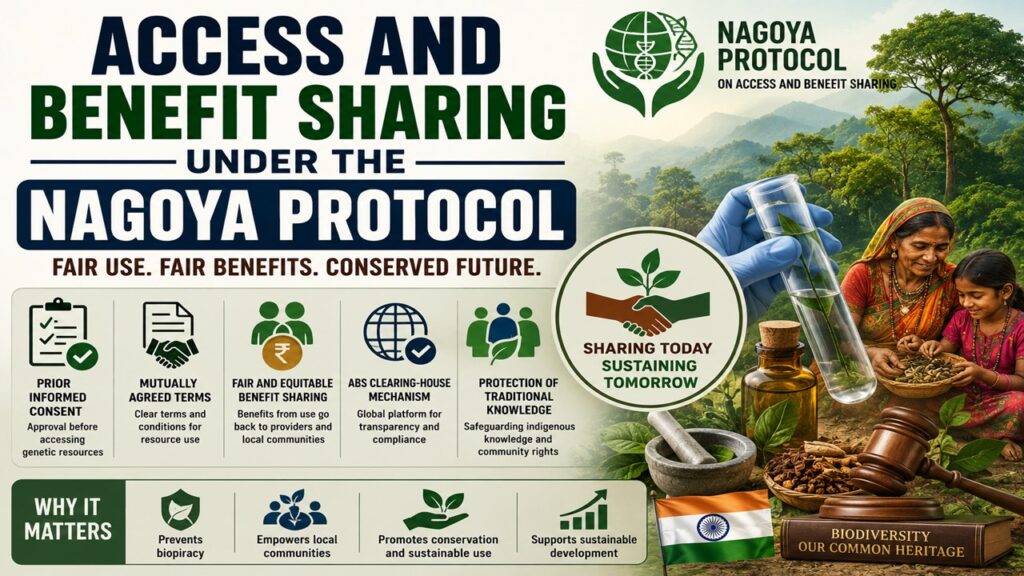
Prior Informed Consent: Researchers and companies must obtain approval from the concerned national authority before accessing biological resources.
Mutually Agreed Terms: Resource users and provider countries enter formal agreements specifying conditions of use and benefit-sharing arrangements.
Fair Benefit Sharing: Financial and non-financial benefits such as royalties, technology transfer, and research collaboration must reach local communities and conservers.
ABS Clearing-House Mechanism: A global digital platform tracks permits and compliance certificates to ensure transparency and prevent illegal exploitation.
Protection of Traditional Knowledge: The protocol safeguards indigenous knowledge systems and cultural practices associated with biological resources.
Key Findings of India’s First National Report
Large Number of Approvals: Between 2017 and 2025, India granted 12,830 approvals under the Access and Benefit Sharing framework through the National Biodiversity Authority, State Biodiversity Boards, and Union Territory Biodiversity Councils.
Global Leadership in Compliance: India issued 3,556 Internationally Recognized Certificates of Compliance, accounting for more than 60 percent of all such certificates issued globally.
Revenue Generation and Distribution: The ABS mechanism enabled the realization of more than ₹216 crore, of which nearly ₹140 crore was distributed to local communities and biodiversity conservers.
Strong Institutional Framework: India established a three-tier biodiversity governance structure consisting of the National Biodiversity Authority, State Biodiversity Boards, and more than 2.76 lakh Biodiversity Management Committees.
Extensive Capacity Building: Thousands of workshops and training programs were conducted to strengthen awareness and institutional capabilities at the grassroots level.
Important Case Studies
Medicinal Plant Access Project in Madhya Pradesh: Sun Pharmaceutical Industries accessed the medicinal plant Cocculus hirsutus through a benefit-sharing arrangement, with most of the revenue transferred for conservation and local welfare activities.
Bioethanol Research Project in Uttar Pradesh: Indian Oil Corporation contributed benefit-sharing fees for using agricultural residues in bioethanol research, supporting biodiversity governance initiatives at the state level.
Significance of the Report
Strengthening Biodiversity Governance: The report demonstrates India’s commitment to transparent and accountable biodiversity management.
Empowerment of Local Communities: Benefit-sharing mechanisms provide economic incentives for conservation and support rural livelihoods.
Protection Against Biopiracy: Legal safeguards help prevent unauthorized exploitation of India’s biological resources and traditional knowledge.
Support for Sustainable Development: The framework aligns biodiversity conservation with economic growth and environmental sustainability.
Global Leadership Role: India’s achievements position it as a leading example of implementing the Nagoya Protocol effectively.
Challenges in Implementation
Difficulty in Resource Traceability: Biological resources often pass through intermediaries, making it difficult to identify the original source communities.
Complex Administrative Procedures: Differences between domestic and international documentation standards create delays and verification challenges.
Low Awareness at Grassroots Level: Technical legal terminology and limited regional language outreach restrict effective participation by local communities.
Absence of Centralized Data Repository: Lack of a unified digital platform limits access to historical agreements and monitoring information.
Way Forward
Development of Digital ABS Platforms: Establish integrated online systems for applications, approvals, and certificate management.
Scientific Valuation Mechanisms: Introduce transparent methods for determining fair compensation for biological resources.
Regional Language Outreach: Translate legal provisions and agreement formats into local languages to improve participation.
Digital Monitoring of Trade Chains: Ensure traceability through mandatory digital transaction records for traders and intermediaries.
Clear Guidelines for Digital Sequence Information: Formulate robust rules for equitable sharing of benefits arising from genetic data usage.
Conclusion
India’s First National Report on the Nagoya Protocol reflects the country’s growing leadership in biodiversity conservation and equitable benefit-sharing. By integrating conservation with local economic empowerment, India has demonstrated that sustainable use of biological resources can support both environmental protection and inclusive development. Strengthening digital systems, awareness, and institutional coordination will further enhance the effectiveness of the Access and Benefit Sharing framework.
Source : DownToEarth