
Demographic Changes and National Security Concerns in India
Context
The Union Home Minister recently announced the formation of a high-level committee to examine the challenges arising from unnatural demographic changes in different parts of India. The committee has been constituted to study issues linked to illegal immigration, demographic imbalance, border security, and their socio-economic implications.
Introduction
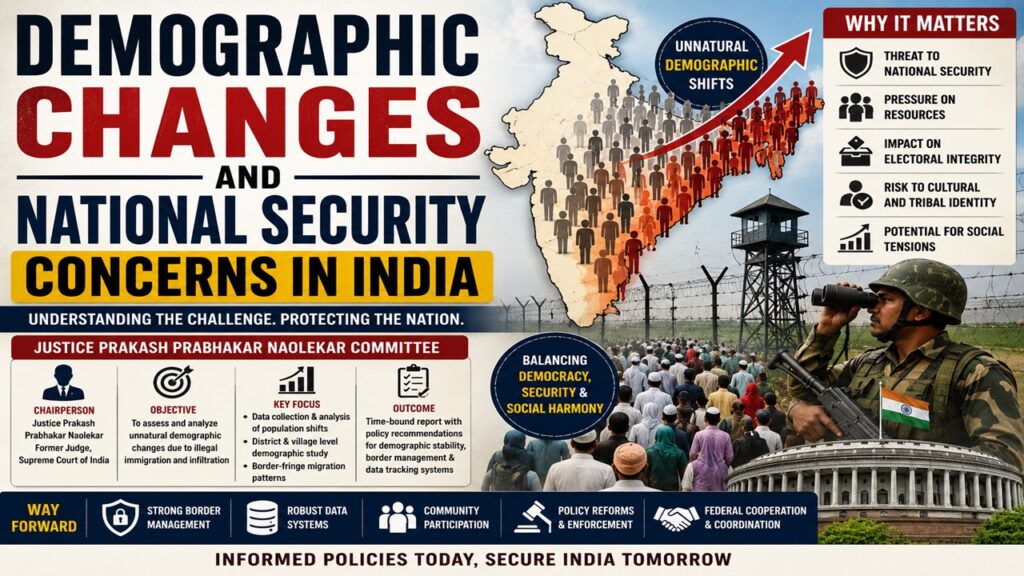
Demographic changes have significant implications for national security, governance, resource distribution, and social stability. In recent years, concerns regarding illegal immigration and abnormal population shifts in certain regions of India have gained policy attention. To address these concerns through a systematic and evidence-based approach, the Government of India has established the Justice Prakash Prabhakar Naolekar Committee.
What is the Justice Prakash Prabhakar Naolekar Committee
Definition: The committee is a specialized high-level panel constituted by the Ministry of Home Affairs to investigate issues related to illegal immigration and unusual demographic changes across India.
Chairperson: The committee is headed by Justice Prakash Prabhakar Naolekar, former Judge of the Supreme Court of India.
Composition of the Committee
Census Commissioner of India: Provides demographic and census-related expertise.
Durga Shankar Mishra: Former IAS officer contributing administrative and governance experience.
Balaji Srivastava: Former IPS officer bringing expertise in internal security and policing.
Shamika Ravi: Economist contributing insights on population trends and socio-economic analysis.
Member Secretary: Joint Secretary handling Foreigners Division in the Ministry of Home Affairs.
Objectives of the Committee
Assessment of Demographic Changes: To conduct a comprehensive study of unnatural demographic shifts occurring in different regions of India.
Examination of Illegal Immigration: To analyze the impact of long-term illegal immigration and infiltration on population patterns.
Data-Based Analysis: To study demographic variations among different social and religious communities using empirical and statistical methods.
Policy Recommendations: To develop structured and time-bound recommendations for addressing demographic imbalance and related governance challenges.
Key Features of the Committee
Origin in Government Policy Vision: The committee’s formation follows policy concerns raised at the highest political level regarding demographic stability and national security.
Comprehensive Investigative Powers: The panel is empowered to collect field-level data, study migration trends, and analyze census records at district and village levels.
Localized Demographic Analysis: Focuses on identifying regions experiencing rapid demographic shifts rather than relying only on national averages.
Time-Bound Functioning: The committee is expected to submit a detailed report within a specified timeline with recommendations on governance, border management, and monitoring systems.
Significance of the Committee
Strengthening National Security: Helps address security concerns arising from illegal border infiltration and undocumented migration.
Protection of Electoral Integrity: Accurate demographic assessment is important for maintaining fairness in electoral processes and governance structures.
Preservation of Tribal and Indigenous Identity: Supports protection of tribal communities in regions such as the Northeast and Jharkhand from cultural and demographic imbalance.
Better Resource Management: Enables more effective planning and allocation of public resources based on accurate demographic data.
Improved Border Governance: Can contribute to stronger border management and monitoring systems in vulnerable regions.
Challenges Associated with the Issue
Complexity of Migration Patterns: Differentiating between legal migration, internal migration, and illegal infiltration remains difficult.
Data Reliability Concerns: Accurate identification of undocumented population changes requires robust and updated data systems.
Social Sensitivities: Demographic issues are often politically and socially sensitive, requiring balanced and evidence-based handling.
Border Management Constraints: Porous borders and difficult geographical conditions complicate enforcement mechanisms.
Way Forward
Strengthening Border Surveillance: Use advanced technologies such as drones, AI-based monitoring, and smart fencing systems.
Improving Population Databases: Enhance coordination between census systems, local administrations, and identity databases.
Community Participation: Encourage local community involvement in monitoring and reporting irregular migration patterns.
Balanced Policy Approach: Ensure that national security concerns are addressed while upholding constitutional values and humanitarian considerations.
Institutional Coordination: Promote coordination among central agencies, state governments, and local authorities for effective implementation.
Conclusion
The Justice Prakash Prabhakar Naolekar Committee represents an important institutional step toward understanding and addressing the challenges posed by unnatural demographic changes in India. By combining data-driven analysis with policy recommendations, the committee can contribute to national security, social stability, and balanced regional development. Effective implementation of its recommendations will require transparency, institutional coordination, and a balanced approach rooted in constitutional principles.