
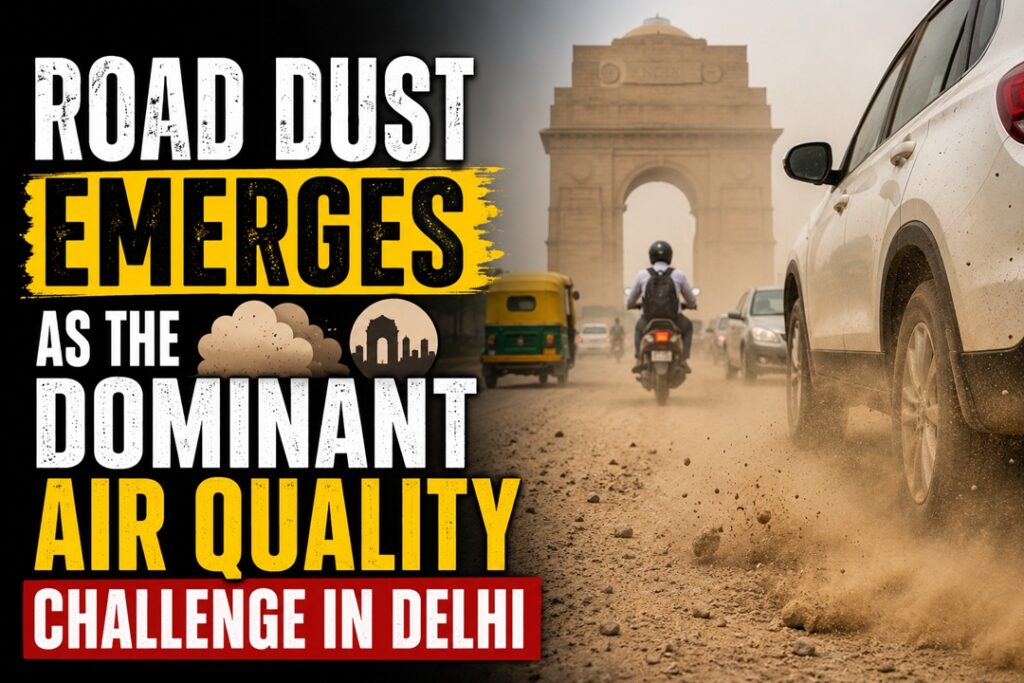
Road Dust Emerges as the Dominant Air Quality Challenge in Delhi
Context
Recent assessments conducted by expert panels under the Commission for Air Quality Management (CAQM), along with collaborative research by CSIR-NEERI and CRRI, have identified road dust as the most persistent and significant contributor to Delhi’s air pollution burden.
Road Dust Becomes Delhi’s Most Persistent Air Pollutant
Understanding Road Dust Pollution
Road dust is a widespread non-exhaust source of air pollution generated along transportation corridors. Unlike construction-related dust that originates from specific sites, road dust consists of loose soil from unpaved road edges, eroded median surfaces, tyre and brake wear particles, construction material spillage, and accumulated debris that is repeatedly re-suspended by moving vehicles.
Key Findings on Delhi’s Dust Pollution Burden
Dominant Contributor to Particulate Pollution: Road dust, construction activities, and wind-driven soil collectively account for more than half of Delhi’s PM₁₀ emissions and nearly one-third of PM₂.₅ concentrations during dry periods.
Exceptionally High Pollution Levels: Monitoring studies have observed PM₁₀ concentrations reaching nearly 1,700 µg/m³ near busy traffic corridors, significantly exceeding the prescribed safety threshold.
Elevated Surface Silt Deposits: Delhi records an average road surface silt load of approximately 14.47 g/m², substantially higher than many other urban centres in India.
Significant Public Health Burden: Prolonged exposure to dust-related pollution and non-tailpipe emissions contributes to thousands of premature deaths and severe respiratory illnesses across urban India annually.
Major Drivers Behind Rising Road Dust Levels
Unpaved Road Margins and Shoulders: Large stretches of service roads, road shoulders, and peripheral areas remain unpaved, leaving loose soil vulnerable to vehicular disturbance.
Inadequate Median Management: Soil erosion from uncovered medians and excessive irrigation practices often transport mud onto road surfaces, which later dries and becomes airborne dust.
Deteriorating Road Infrastructure: Potholes, damaged road edges, and delayed maintenance gradually break down road surfaces into fine particulate matter that can easily be re-suspended.
Weakening Natural Environmental Buffers: Degradation of the Aravalli ecosystem and continued mining activities have reduced the region’s ability to block dust-laden winds originating from arid areas of Rajasthan.
Consequences of Road Dust Pollution
Adverse Effects on Children’s Lung Growth: Continuous exposure to fine dust particles can impair lung function, hinder respiratory development, and increase the prevalence of childhood asthma and wheezing disorders.
Example: Children residing near heavily trafficked corridors exhibit higher rates of respiratory ailments and reduced pulmonary capacity.
Toxic Heavy Metal Exposure: Road dust contains harmful substances released from brake pads, tyres, and engine wear, including lead, cadmium, chromium, and nickel.
Example: Scientific analysis indicates that inhaled dust particles can introduce heavy metals into the bloodstream, raising long-term risks of organ damage and cancer.
Worsening Chronic Respiratory Diseases: Fine mineral particles trigger inflammation within the respiratory tract and aggravate conditions such as Chronic Obstructive Pulmonary Disease (COPD).
Example: Hospitals often report increased respiratory emergencies among elderly citizens during dry and dusty seasons.
Reduced Visibility and Persistent Smog Formation: Suspended dust particles interact with other pollutants, contributing to dense smog episodes and poor visibility.
Example: During winter months, dust accumulation combined with atmospheric stagnation can disrupt transportation and increase road accident risks.
Obstacles in Effective Dust Mitigation
Limited Impact of Water-Based Suppression Measures: Anti-smog guns and water sprinkling systems provide only short-lived relief as dust quickly reappears after surfaces dry.
Improper Mechanical Sweeping Practices: Mechanical sweeping without adequate vacuum technology can inadvertently stir up fine particles instead of removing them.
Example: Poorly managed sweeping operations may generate visible dust plumes behind cleaning vehicles.
Encroachments and Illegal Parking: Obstructed road shoulders prevent cleaning equipment from accessing dust-prone areas where silt accumulates.
Example: Unauthorized roadside parking often leaves large sections of road edges untouched during municipal cleaning operations.
Climatic and Geographical Constraints: Delhi’s semi-arid climate, limited rainfall, and frequent dust storms create naturally favourable conditions for dust generation and resuspension.
Example: Seasonal heatwaves and dust-laden winds continuously replenish surface dust deposits even after cleaning efforts.
Recommended Measures for Long-Term Dust Control
Developing Multi-Layer Green Buffers: Establish dense vegetation belts comprising drought-resistant trees, shrubs, and ground cover plants to capture airborne dust particles naturally.
Improving Road Engineering Standards: Introduce scientifically designed kerbs and retaining structures that prevent loose soil from migrating onto road surfaces.
Promoting Efficient Irrigation Systems: Replace conventional hose-based watering methods with drip irrigation and treated wastewater systems to minimize soil erosion and mud formation.
Technology-Driven Monitoring of Sweeping Operations: Deploy GPS-enabled monitoring systems and data-driven cleaning schedules aligned with local silt accumulation patterns.
Conclusion
Scientific evidence increasingly suggests that controlling vehicular exhaust alone will not be sufficient to resolve Delhi’s air quality crisis. Road dust has emerged as a major yet often overlooked contributor to particulate pollution. Sustainable improvements will require structural interventions such as better road design, ecological restoration, scientific cleaning mechanisms, and stricter dust management practices rather than reliance on temporary measures like water spraying and anti-smog guns.
Source : The Indian Express