
India’s Land Restoration Drive Records Major Progress Under Bonn Challenge
Context
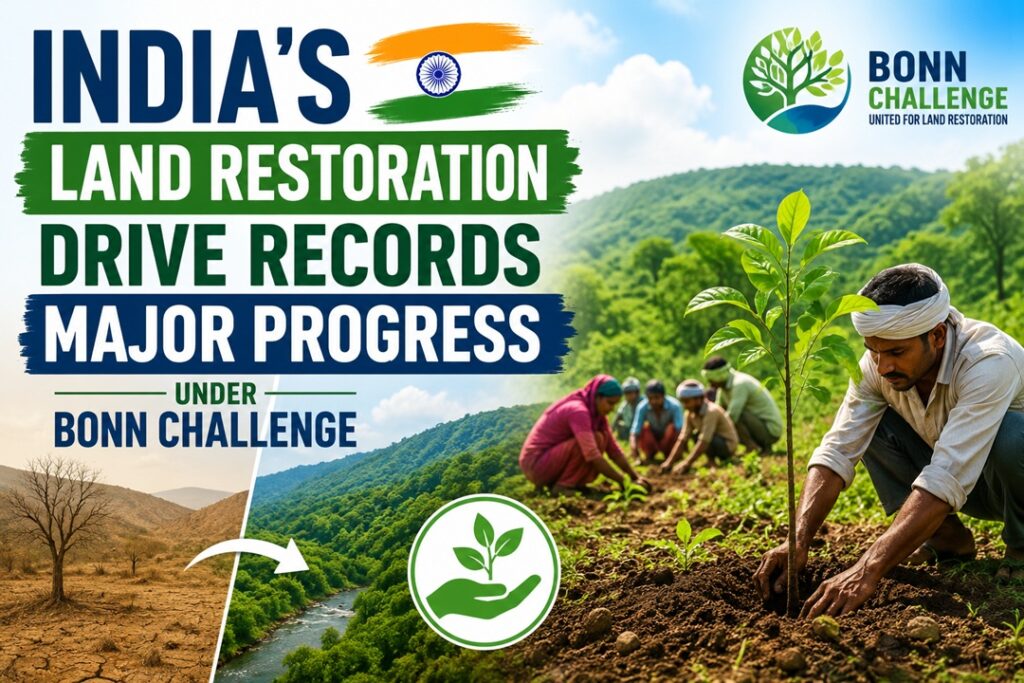
India has restored 21.7 million hectares of degraded and deforested land between 2011 and 2020, according to the country’s second progress report submitted under the global Bonn Challenge framework. The achievement highlights India’s growing commitment to ecosystem restoration, climate action, and sustainable land management.
Bonn Challenge: Global Mission for Ecosystem Recovery
Overview
The Bonn Challenge is an international restoration initiative launched in 2011 by the Government of Germany and the International Union for Conservation of Nature (IUCN) to reverse land degradation and forest loss across the world.
Primary Targets
- Restore 150 million hectares of degraded landscapes by 2020.
- Expand restoration efforts to 350 million hectares by 2030.
Core Areas of Action
- Reforestation and afforestation
- Natural forest regeneration
- Agroforestry development
- Mangrove ecosystem restoration
- Carbon capture and storage
- Sustainable livelihood enhancement
Forest Landscape Restoration (FLR) Approach
The Bonn Challenge is based on the concept of Forest Landscape Restoration (FLR), jointly promoted by IUCN and WWF in 2000.
Key principles include:
- Restoring ecological functions of landscapes
- Conserving biodiversity
- Supporting local communities and livelihoods
- Promoting sustainable land-use practices
Connection with International Environmental Goals
The initiative contributes directly to:
- Sustainable Development Goals (SDGs)
- Convention on Biological Diversity (CBD) Targets
- Paris Climate Agreement
- UN Decade on Ecosystem Restoration
India’s Second Bonn Challenge Progress Assessment
Report Publication
The report was jointly prepared by the Ministry of Environment, Forest and Climate Change (MoEFCC) and IUCN, using data from State Forest Departments and the Department of Land Resources.
India’s Restoration Commitment
- Initial pledge: 13 million hectares
- Revised target: 26 million hectares by 2030
- Enhanced commitment announced during UNCCD COP-14 (2019).
Restoration Achievements
- 2011–2017: 9.8 million hectares restored.
- 2011–2020: 21.7 million hectares restored.
Major Drivers Behind Success
The progress has been supported by:
- Compensatory Afforestation Fund (CAF)
- Green India Mission (GIM)
- National Afforestation Programme
- MGNREGS
- State-level plantation and restoration initiatives
Key Findings of the Report
Leading States in Restoration Efforts
- Telangana emerged as the top performer with 4.18 million hectares restored.
- Agroforestry accounted for nearly 3.6 million hectares of Telangana’s achievement.
- Other leading contributors:
- Madhya Pradesh
- Odisha
- Gujarat
- Andhra Pradesh
Employment Creation
Land restoration activities generated approximately 1,224.51 million person-days of employment, providing significant support to rural livelihoods.
Carbon Sequestration Benefits
- Restoration efforts sequestered approximately 461.14 million tonnes of carbon.
- After accounting for plantation mortality, effective sequestration stood at 343.66 million tonnes.
Extent of Land Degradation
- Nearly 97.85 million hectares (29.77% of India’s geographical area) remain affected by land degradation and desertification.
- Around 1.45 million hectares experienced additional degradation between 2011-13 and 2018-19.
Major Causes of Degradation
- Habitat destruction
- Unsustainable resource extraction
- Invasive alien species
- Climate change impacts
- Desertification
- Pollution
Government Initiatives Supporting Land Restoration
Green India Mission (GIM)
Launched in 2014 under the National Action Plan on Climate Change (NAPCC).
Objectives:
- Expand forest and tree cover
- Restore degraded ecosystems
- Strengthen climate resilience
- Improve livelihoods of forest-dependent communities
Ek Ped Maa Ke Naam Campaign
A nationwide plantation movement encouraging citizens to plant trees in honour of their mothers while promoting environmental conservation.
Aravalli Green Wall Programme
Introduced in 2025 to:
- Combat desertification
- Restore degraded ecosystems across four states
- Develop a 5-km green buffer zone around the Aravalli range covering approximately 6.45 million hectares
Compensatory Afforestation Fund (CAF) Act, 2016
Mandates compensation for diversion of forest land for development projects.
Recent Achievement:
- Afforestation activities conducted over nearly 3.20 lakh hectares through CAMPA-supported projects during the last five years.
Watershed Development Component of PMKSY
Focuses on:
- Soil conservation
- Rainwater harvesting
- Groundwater recharge
- Vegetation regeneration
- Prevention of soil erosion
Importance of the Bonn Challenge for India
Strengthening Rural Livelihoods
Large-scale restoration activities have created over 1.22 billion person-days of employment, generating income opportunities in rural areas.
Addressing Land Degradation
With nearly 30% of India’s land area affected, restoration efforts are crucial for:
- Agricultural productivity
- Water security
- Livestock sustainability
- Ecological stability
Climate Change Mitigation
Enhanced forest cover and ecosystem restoration improve carbon sequestration and support India’s climate commitments.
Enhancing Global Environmental Leadership
Participation reinforces India’s contribution to:
- Paris Agreement goals
- Sustainable Development Goals
- UN Decade on Ecosystem Restoration
- Global biodiversity conservation efforts
Conclusion
India’s restoration of 21.7 million hectares of degraded land demonstrates substantial progress toward achieving its Bonn Challenge commitments. Through integrated afforestation programmes, watershed management, agroforestry expansion, and community participation, the country is advancing environmental sustainability while generating livelihoods and strengthening climate resilience. Continued efforts will be crucial to achieving the ambitious target of restoring 26 million hectares by 2030.
Source : The Indian Express