
India’s Weak Monsoon and Preparedness
Context
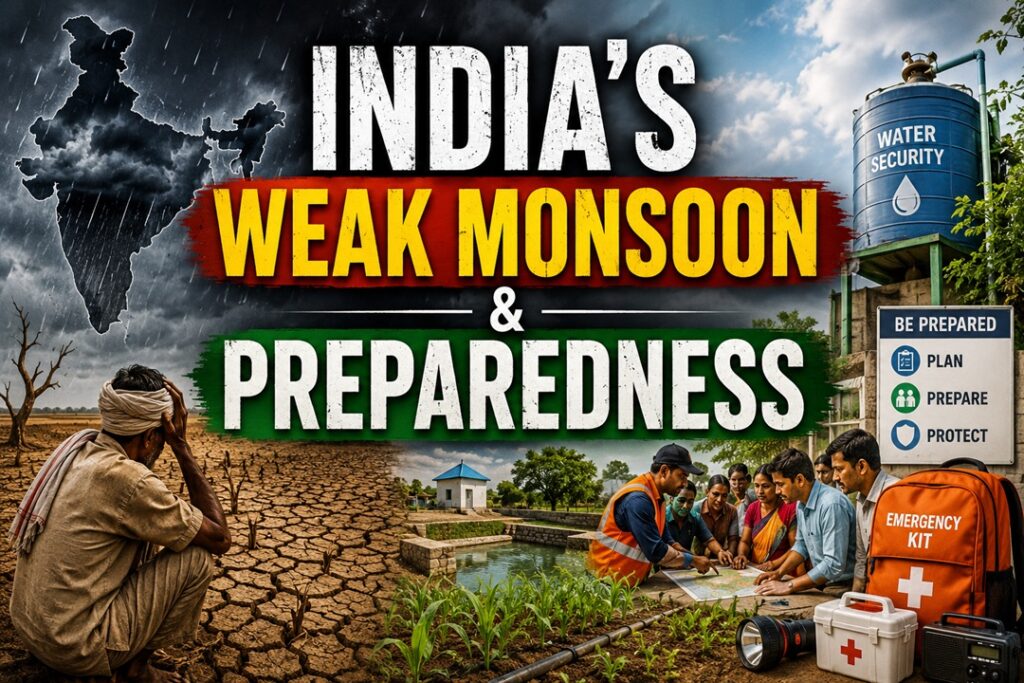
Despite a modest revival in rainfall activity during the last week of June 2026, the southwest monsoon has remained significantly weaker than normal in its initial phase. The delayed advance and uneven distribution of rainfall have raised concerns over agricultural productivity, water availability, and overall economic activity. According to the India Meteorological Department (IMD), nearly 75% of India’s land area is currently experiencing a rainfall deficiency of more than 20%.
About India’s Weak Monsoon and Preparedness
What is it?
Climate change has made India’s monsoon increasingly erratic over the past decade, resulting in highly uneven rainfall across regions. To reduce the risks associated with such variability, India has strengthened its resilience through improved water conservation, groundwater recharge programmes, renewable energy expansion, and advanced weather forecasting systems.
Current Monsoon Situation: Key Highlights
Sharp Rainfall Deficit
India recorded an overall rainfall deficit of nearly 40% during June 2026, making it one of the weakest starts to the southwest monsoon in recent years. Meteorologists believe that recovering this shortfall before July will be difficult.
Delayed Monsoon Progress
The southwest monsoon has advanced across only about half of India’s geographical area, whereas under normal conditions it covers almost the entire country by the end of June.
Large Areas Facing Rainfall Deficiency
Nearly 75% of India’s landmass is experiencing rainfall that is 20% or more below the seasonal average, affecting agriculture and water resource planning.
Major Reasons Behind the Weak Monsoon
Emergence of El Niño
The development of El Niño, marked by unusually warm sea surface temperatures in the equatorial Pacific Ocean, has weakened India’s monsoon circulation and reduced rainfall activity.
Delayed Atmospheric Response
Although El Niño conditions appeared in early June, their full influence on India’s weather generally develops after several weeks, increasing the possibility of weaker rainfall during July and August.
Unfavourable Madden-Julian Oscillation (MJO)
For most of June, the active rainfall-producing phase of the Madden-Julian Oscillation (MJO) remained away from the Indian region, limiting cloud formation and moisture transport.
Weak Low-Pressure Systems
The low-pressure systems that developed over surrounding seas lacked sufficient intensity to carry moisture inland and sustain widespread rainfall.
Reduced Strength of Monsoon Winds
The cross-equatorial monsoon winds remained weaker than normal, slowing the seasonal advance of the southwest monsoon over the country.
Likely Impacts of a Weak Monsoon
Stress on Kharif Agriculture
Delayed or inadequate rainfall may affect sowing operations and reduce the productivity of major kharif crops such as rice, pulses, cotton, and oilseeds.
Lower Rural Income and Demand
Reduced agricultural output can lower farmers’ incomes, resulting in weaker rural consumption and slower economic activity.
Food Inflation Concerns
Declining crop production may increase food prices, compelling the government to rely on buffer stocks or adopt trade measures to stabilise markets.
Pressure on Water Resources
Poor rainfall limits groundwater recharge and reduces water levels in reservoirs, affecting irrigation as well as drinking water availability.
Reduced Hydropower Generation
Lower reservoir storage can decrease electricity generation from hydroelectric projects, increasing dependence on thermal and renewable energy sources.
India’s Preparedness to Face a Weak Monsoon
Comfortable Reservoir Storage
Above-normal rainfall during the previous two years has ensured that many major reservoirs currently possess adequate storage to meet agricultural and drinking water requirements.
Growing Renewable Energy Capacity
Rapid expansion of solar and wind power has reduced dependence on hydroelectric generation, allowing reservoir water to be conserved for essential purposes.
Strengthened Water Conservation Measures
Government programmes have promoted the construction of check dams, farm ponds, rainwater harvesting structures, and watershed development projects to improve water security.
Improved Groundwater Recharge
Scientific assessments indicate gradual improvement in groundwater levels across several regions due to sustained conservation efforts and better watershed management.
Weather-Based Agricultural Planning
Timely weather forecasts issued by the India Meteorological Department (IMD) have enabled farmers to adjust sowing schedules and make efficient use of available rainfall.
Conclusion
Although the southwest monsoon has started weakly, India’s improved reservoir storage, expanding renewable energy sector, enhanced groundwater management, and widespread water conservation infrastructure provide an important buffer against rainfall variability. Going forward, sustained investment in climate-resilient agriculture, scientific forecasting, and efficient water management will be essential to minimise the impact of increasingly unpredictable monsoon patterns.
Source : The Indian Express