
Right to Walk as a Fundamental Right
Context
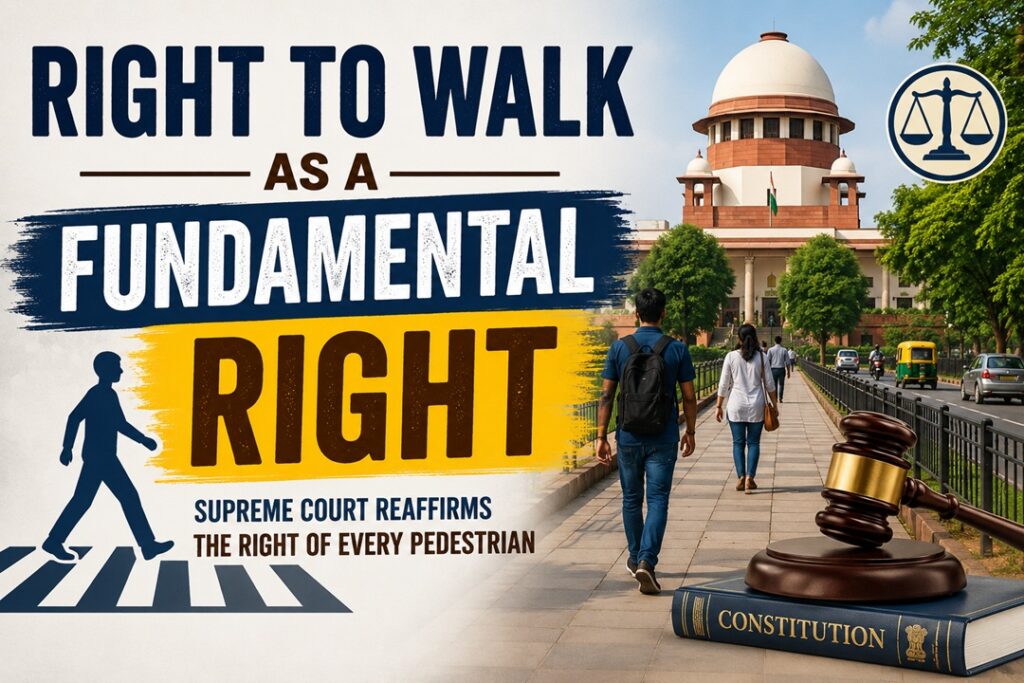
The Supreme Court of India has recently recognised the Right to Walk safely on footpaths as an integral part of the fundamental rights guaranteed under Articles 19(1)(d) (Freedom of Movement) and Article 21 (Right to Life and Personal Liberty) of the Constitution. The judgment emphasises that pedestrian safety is not merely an issue of urban planning but a constitutional obligation, reaffirming that public spaces are meant primarily for people and promoting inclusive, accessible, and sustainable cities.
Evolution of the Right to Walk
People-Centred Urban Development
Rapid urbanisation and the growth of motor vehicles have gradually reduced space for pedestrians. The judgment restores the principle that cities and public roads should prioritise people over vehicles.
More than a Mode of Transport
Walking is not simply a means of travelling. It represents:
- Liberty
- Equality
- Human dignity
- Democratic participation
- Inclusive development
Historical and Cultural Legacy
Throughout Indian history, walking has influenced political movements, spiritual journeys, literature, and social reforms, making it an important part of India’s civilisational heritage.
Constitutional Recognition
Fundamental Rights Involved
The Supreme Court held that the Right to Walk safely forms part of:
- Article 19(1)(d) – Freedom to move freely throughout India.
- Article 21 – Right to Life and Personal Liberty.
Significance of the Judgment
The ruling:
- Converts pedestrian safety into a constitutional responsibility.
- Recognises safe footpaths as essential for mobility and dignity.
- Promotes a shift from vehicle-centric to people-centric infrastructure.
- Strengthens citizens’ access to public spaces.
Importance of the Right to Walk
Automobile-Oriented Cities
Modern cities increasingly prioritise vehicles over pedestrians, reducing safe walking spaces.
Common Problems
Pedestrians often face:
- Encroached footpaths
- Unsafe road crossings
- Broken or missing sidewalks
- Poor street lighting
- Lack of accessibility for persons with disabilities
- Unsafe traffic conditions
Mobility as a Human Right
Safe walking enables access to:
- Education
- Employment
- Healthcare
- Markets
- Public institutions
Thus, pedestrian-friendly infrastructure promotes substantive freedom and equal opportunity.
Walking and Constitutional Values
Expression of Personal Liberty
Walking allows individuals to move independently, participate in society, and exercise freedom of movement.
Equality
Unlike private transport, walking requires no financial resources. Therefore, safe public infrastructure benefits every citizen regardless of economic status.
Human Dignity
The judgment recognises that constitutional rights include everyday conditions necessary for a dignified life.
Walking in India’s Literary Heritage
Walking has occupied a special place in Indian literature.
Rabindranath Tagore
His famous works portray walking as a symbol of courage and independent thought.
Examples include:
- Ekla Chalo Re – Walking alone in pursuit of truth.
- Kothao Amar Hariye Jawar Nei Mana – Symbolising limitless human freedom.
Jibanananda Das
In Banalata Sen, walking becomes a metaphor for civilisation, memory, and the search for peace.
These literary traditions present walking as a journey of reflection, creativity, and self-discovery.
Walking in India’s Freedom Struggle
Dandi March (1930)
Mahatma Gandhi transformed walking into a peaceful weapon against colonial rule through the historic Salt March.
Democratic Protest
Walking remained central to:
- Freedom movements
- Protest marches
- Civil rights campaigns
- Democratic demonstrations after Independence
It continues to represent peaceful public participation.
Walking in India’s Spiritual Traditions
Many spiritual leaders spread their teachings while travelling on foot, including:
- Gautama Buddha
- Guru Nanak
- Sri Chaitanya Mahaprabhu
Religious Symbolism
In Hindu traditions, the footprints of Goddess Lakshmi represent prosperity and auspiciousness.
Classical Knowledge Systems
The Sanskrit word “Pada” means both “foot” and a unit of poetic metre, highlighting the deep relationship between movement, language, and knowledge.
Walking and Democratic Citizenship
Role of Public Spaces
Footpaths, parks, and streets enable:
- Social interaction
- Civic engagement
- Democratic participation
- Community life
Inclusive Cities
Pedestrian-friendly infrastructure especially benefits:
- Children
- Senior citizens
- Women
- Persons with disabilities
- Economically weaker sections
Environmental Sustainability
Encouraging walking helps:
- Reduce carbon emissions
- Improve air quality
- Lower traffic congestion
- Promote healthier lifestyles
Philosophical Perspective
Charles Baudelaire
Introduced the idea of the flâneur, who experiences and understands modern cities by walking through them.
Michel de Certeau
In The Practice of Everyday Life, he argued that pedestrians reshape cities through their daily movements and interactions.
William Wordsworth
His poetry portrays walking as a means of contemplation, emotional renewal, and connection with nature.
Challenges
Major barriers to realising the Right to Walk include:
- Encroachment of footpaths
- Poor pedestrian infrastructure
- Lack of universal accessibility
- Vehicle-centric urban planning
- Weak enforcement of traffic laws
- Limited public awareness
Way Forward
To realise the constitutional Right to Walk:
- Adopt pedestrian-first urban planning.
- Build continuous, obstruction-free footpaths.
- Improve road crossings and street lighting.
- Ensure universal accessibility.
- Include walkability in Smart City planning.
- Strengthen public transport and non-motorised transport.
- Remove illegal encroachments.
- Strictly enforce road safety laws.
- Promote awareness of pedestrian rights.
Urban development should place people before vehicles.
Conclusion
The Supreme Court’s recognition of the Right to Walk under Articles 19(1)(d) and 21 reinforces the constitutional principles of freedom, equality, dignity, and inclusive development. Walking is deeply connected with India’s cultural heritage, democratic traditions, and sustainable future. Protecting pedestrian rights will be crucial for creating safe, accessible, environmentally sustainable, and people-centric cities, ensuring that constitutional freedoms are experienced in everyday life.
Source : The Hindu