
RBI’s Polymer Banknote Initiative: Opportunities and Challenges
Context
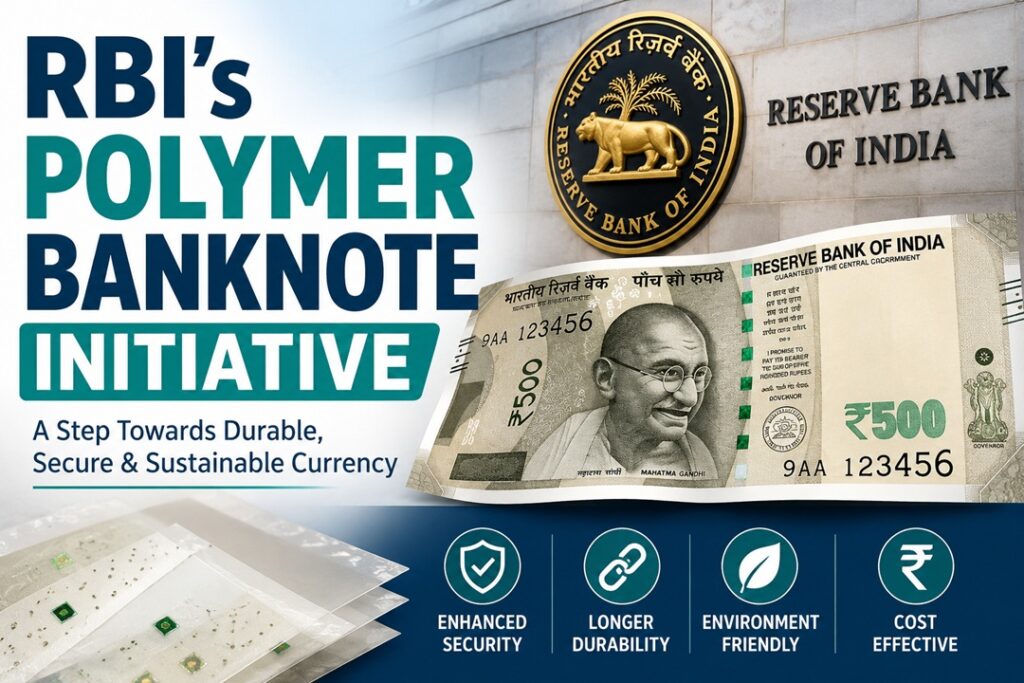
The Reserve Bank of India (RBI), through its currency-printing subsidiary Bharatiya Reserve Bank Note Mudran Private Limited (BRBNMPL), has invited global Expressions of Interest (EoI) for the supply of opacified polymer substrate sheets with embedded security features. The move signals RBI’s renewed efforts to assess the feasibility of introducing polymer banknotes in India for improving currency durability, security, and cost efficiency.
What are Polymer Banknotes?
Polymer banknotes are currency notes manufactured using biaxially oriented polypropylene (BOPP) instead of conventional cotton-based paper. First introduced by Australia, they are now used in more than 60 countries due to their longer lifespan, superior security, and greater resistance to moisture, dirt, and wear. Polymer notes are intended to modernise currency management by reducing replacement frequency and enhancing counterfeit protection.
Key Facts & Statistics
- Longer Lifespan: Polymer banknotes generally remain in circulation 2.5–4 times longer than conventional paper notes.
- Higher Production Cost: Manufacturing polymer notes initially costs around 30–60% more than paper currency.
- Cash Still Plays a Major Role: Although UPI processes over 24,000 crore transactions annually, accounting for nearly 85% of retail digital payments, India’s Currency-to-GDP ratio remains above 11%, indicating sustained demand for physical cash.
- Import Dependence: Around 20% of India’s polypropylene requirement is imported, exposing polymer note production to external supply risks.
Advantages of Polymer Banknotes
Enhanced Durability
Polymer notes are resistant to moisture, dirt, sweat, oils, and tearing. They remain cleaner and last much longer, particularly for frequently used denominations such as ₹10 and ₹20.
Strong Anti-Counterfeiting Features
Polymer substrates enable advanced security features including:
- Transparent windows
- Colour-shifting inks
- Holographic and metallic security strips
- Micro-printing and complex embedded designs
These features make counterfeiting significantly more difficult.
Lower Lifecycle Costs
Although the initial manufacturing cost is higher, the longer circulation life reduces the overall expenditure on printing, transportation, storage, and destruction of worn-out notes.
Better Environmental Performance
Research indicates that fewer replacement cycles and reduced transportation lower the overall carbon footprint of polymer banknotes throughout their lifecycle compared to conventional paper notes.
Challenges of Polymer Currency
High Initial Manufacturing Cost
Specialised polymer substrates and sophisticated printing technologies substantially increase production costs, especially for low-value denominations.
Dependence on Petrochemical Raw Materials
Polymer notes are made from polypropylene, making production costs vulnerable to fluctuations in global crude oil prices and international supply chain disruptions.
Infrastructure Upgradation
ATMs, note-sorting machines, vending machines, and cash-handling equipment require modifications and recalibration to process polymer banknotes efficiently.
Expanding Digital Payment Ecosystem
Rapid growth of UPI, digital wallets, and the Central Bank Digital Currency (e₹) raises questions about future demand for physical cash, requiring balanced investment decisions.
Way Forward
Phased Pilot Implementation
Initially introduce polymer notes in lower denominations such as ₹10 and ₹20 across regions with diverse climatic conditions to evaluate durability and lifecycle savings.
Expand Domestic Polypropylene Production
Strengthen domestic manufacturing capacity through public and private investment to reduce dependence on imported polymer substrates.
Develop Recycling Infrastructure
Create specialised recycling facilities to convert withdrawn polymer banknotes into reusable industrial plastic products, supporting a circular economy.
Balance Physical and Digital Currency
Ensure polymer banknotes complement India’s expanding digital payment ecosystem, including UPI and the Digital Rupee, for efficient and sustainable currency management.
Conclusion
The RBI’s renewed initiative on polymer banknotes reflects India’s broader effort to modernise currency management by improving durability, strengthening security, and reducing long-term operational costs. While higher production costs, import dependence, and infrastructure upgrades remain important challenges, phased implementation, domestic manufacturing, and effective recycling can make polymer currency economically viable. Combined with India’s rapidly growing digital payment ecosystem, polymer banknotes can contribute to a more secure, efficient, and future-ready monetary system.
Source : The Hindu