
Global Mining and Metals Water Dataset: Rising Water Risks for Critical Mineral Supply Chains
Context
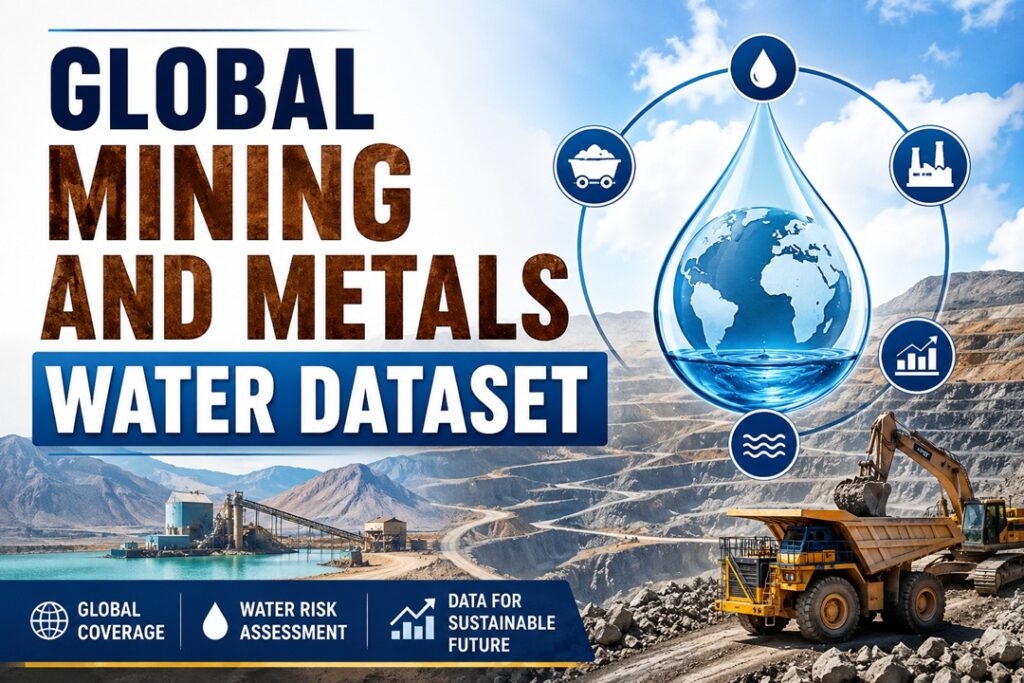
The International Council on Mining and Metals (ICMM) has released the Global Mining and Metals Water Dataset, revealing that nearly two-thirds of global mining and metals processing facilities are exposed to significant physical water risks. The report highlights that increasing water scarcity, droughts, floods, and climate variability could disrupt the supply of critical minerals essential for the global clean energy transition.
Global Mining and Metals Water Dataset
About the Report
What is it?
The Global Mining and Metals Water Dataset is the first global, cross-commodity assessment of the mining industry’s exposure to physical water risks. Prepared by the International Council on Mining and Metals (ICMM) in collaboration with research partners, it combines location data from nearly 12,000 mining and metals facilities across 148 countries and regions with internationally recognized water-risk datasets to evaluate risks such as water scarcity, drought, flooding, and supply variability.
Key Findings of the Report
1. High Exposure to Water Stress
- About 38% of mining and metals facilities are located in regions experiencing high or extremely high water stress or arid climatic conditions.
- More than 70% of these facilities also face severe groundwater depletion.
2. Increasing Drought Risk
- Nearly 27% of mining facilities are exposed to high drought risk.
- In Africa and the Middle East, this rises to over 80%.
- Countries such as Zambia, Ghana, and Uzbekistan have almost all mining operations exposed to severe drought conditions.
3. Flood Risk in Processing Facilities
- Around 14% of mining facilities face significant flood risk globally.
- Higher exposure is observed in:
- Steel production
- Alumina refining
- Molybdenum processing
- Aluminium smelting
4. Variable Water Availability
- Nearly 16% of facilities experience large year-to-year fluctuations in water supply.
- Australia and Oceania show the highest levels of variability, making long-term water planning more difficult.
5. Multiple Water Hazards
- Around 5% of global mining facilities simultaneously face three or more major water-related risks.
- High-risk regions include:
- Chile
- Peru
- Western United States
- Southern Africa
- Northern China
- Central India
- Western Australia
6. Critical Minerals Under Threat
Minerals essential for renewable energy technologies face above-average water risks, including:
- Copper
- Lithium
- Platinum Group Metals
- Manganese
7. Chile’s Water Challenge
Chile, the world’s largest producer of copper and a major supplier of lithium, faces severe water stress alongside unpredictable annual water availability, creating challenges for future mineral production.
How Mining Affects Water Resources
Large-Scale Water Consumption
Mining requires substantial volumes of water for mineral processing, dust suppression, slurry transportation, drilling, and cooling operations.
Groundwater Depletion
Continuous groundwater pumping lowers local water tables, reducing water availability for agriculture, ecosystems, and nearby communities.
Water Pollution
Tailings storage facilities, acid mine drainage, and chemical residues can contaminate rivers and groundwater with heavy metals and toxic substances.
Disruption of Natural Hydrology
Mining activities alter drainage patterns, increase soil erosion, and heighten the risks of flooding and sedimentation.
Implications of Water Risks
Threat to Clean Energy Transition
Water shortages may restrict the production of critical minerals required for electric vehicles, batteries, wind turbines, solar panels, and other renewable technologies.
Supply Chain Disruptions
Droughts, floods, and water shortages can interrupt mining operations, resulting in production losses and increased global commodity prices.
Greater Social and Environmental Conflicts
Competition for limited freshwater resources may intensify disputes between mining companies, farmers, indigenous communities, and local residents.
Financial Risks
Mining companies may face higher operational costs, stricter environmental regulations, insurance losses, and the possibility of stranded assets.
Recommendations
Adopt Integrated Water Stewardship
Shift from isolated mine-level water management to catchment-based planning involving governments, industries, local communities, and environmental stakeholders.
Integrate Water Security into Mineral Policies
Governments should include long-term water availability while planning critical mineral production and energy transition strategies.
Promote Alternative Water Sources
Expand wastewater recycling, closed-loop water systems, desalination, and the use of seawater to reduce dependence on freshwater.
Strengthen Water Planning Before Mining Approvals
Assess basin-level water availability and ecological requirements before granting new mining leases in water-stressed regions.
Enhance Water Data Transparency
Improve public reporting of facility-level water withdrawal, consumption, recycling, and discharge to support informed policymaking and risk management.
Conclusion
The Global Mining and Metals Water Dataset demonstrates that water-related risks have become a major operational challenge for the global mining industry. As demand for critical minerals grows with the expansion of clean energy technologies, ensuring sustainable water management, climate resilience, and integrated watershed governance will be essential for securing future mineral supplies while protecting ecosystems and local communities.
Source : Down To Earth