
Cloudburst Events in India: Growing Extreme Rainfall Risks in the Himalayas
Context
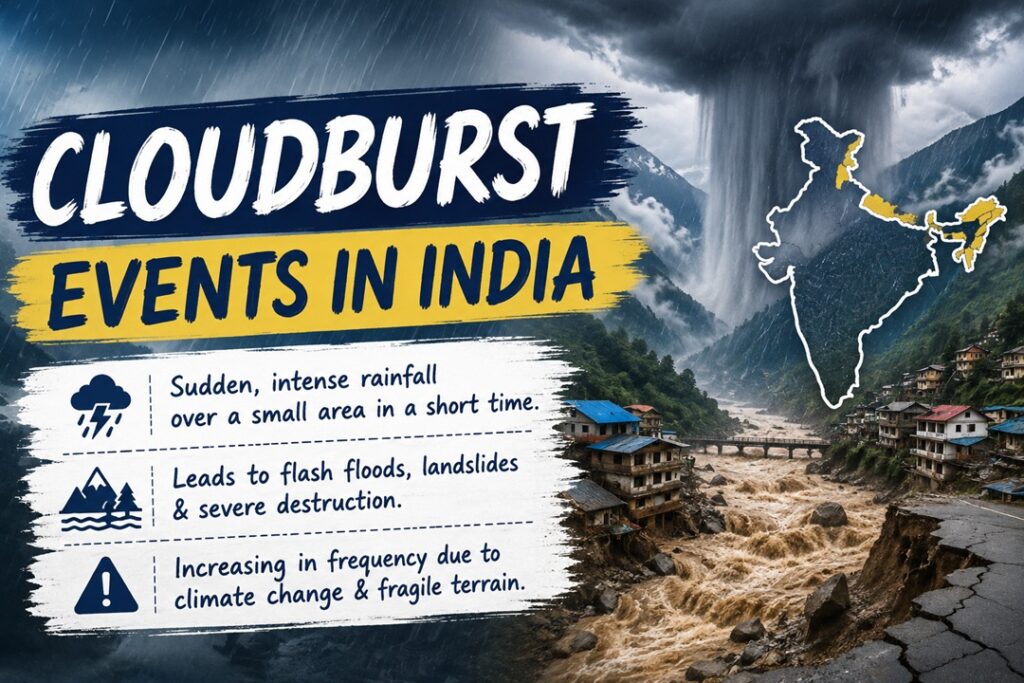
Persistent monsoon rainfall over Uttarakhand, Himachal Pradesh, and Jammu & Kashmir has recently triggered multiple flash floods, landslides, and road collapses. These incidents have once again highlighted the increasing occurrence of cloudburst-related disasters and the need for improved mountain disaster preparedness.
Cloudburst Events in India
Understanding Cloudbursts
What is a Cloudburst?
The India Meteorological Department (IMD) defines a cloudburst as an intense and highly localized rainfall event in which 100 mm (10 cm) or more rainfall occurs within one hour over an area of nearly 20–30 square kilometres. Such rainfall far exceeds the land’s capacity to absorb water, resulting in sudden flash floods and landslides.
Meteorologists have also suggested recognizing mini-cloudbursts, where approximately 50 mm rainfall within one hour over a similar area can still trigger severe disasters, particularly in fragile Himalayan terrain.
Formation of Cloudbursts
Moisture-Laden Air Meets Mountains
Warm monsoon winds carrying abundant moisture rise rapidly after encountering steep Himalayan slopes. This process, known as orographic uplift, promotes rapid cloud formation.
Strong Vertical Air Currents
Powerful upward-moving air currents keep water droplets suspended within towering cumulonimbus clouds, allowing enormous quantities of moisture to accumulate.
Collapse of Cloud System
As the clouds become overloaded or the upward currents weaken, the trapped water is suddenly released within a very short duration over a limited area.
Intense Rainfall
The concentrated release of water produces extremely heavy rainfall that rapidly flows downhill, often resulting in flash floods and debris movement.
Distribution and Trends in India
Limited Historical Documentation
Official observations recorded only a limited number of cloudburst incidents over previous decades. However, experts believe many events remained undocumented due to inadequate weather monitoring stations in remote mountain regions.
Climate Change Influence
Rising global temperatures have increased atmospheric moisture content, making localized extreme rainfall events more frequent during the southwest monsoon.
Himalayan Vulnerability
The Himalayan states—including Uttarakhand, Himachal Pradesh, Jammu & Kashmir, and Ladakh—remain the most susceptible because of steep terrain, unstable slopes, and intense orographic rainfall.
Observation Challenges
Several cloudbursts occur in areas beyond the coverage of Doppler weather radars and automatic weather stations, resulting in underreporting of such events.
Major Cloudburst-Related Incidents (Recent Years)
Pahalgam–Anantnag Disaster (Jammu & Kashmir, 2026)
Extremely intense localized rainfall triggered flash floods and debris flows, damaging roads, bridges, and communication links.
Dharali–Uttarkashi Floods (Uttarakhand, 2025)
Although initially attributed to a cloudburst, later assessments indicated that poor drainage systems, riverbed encroachments, and road construction significantly aggravated the flooding.
Amarnath Flash Flood (Jammu & Kashmir, 2022)
Sudden heavy rainfall near the pilgrimage site generated destructive flash floods that swept away camps and severely affected pilgrims.
Himachal Pradesh Flood Events (2023)
Several localized extreme rainfall episodes caused landslides, bridge failures, riverbank erosion, and extensive damage across mountain districts.
Impacts of Cloudbursts
Flash Floods and Debris Movement
Rapid runoff carries rocks, mud, trees, and sediments downhill, creating destructive debris flows.
Damage to Infrastructure
Roads, bridges, hydropower facilities, houses, and communication networks can be destroyed within minutes.
Human and Economic Losses
Mountain communities, tourists, agriculture, and livestock suffer significant losses due to sudden flooding and landslides.
Secondary Flood Hazards
Temporary blockages in rivers may create unstable lakes that later burst, generating additional floods downstream.
Role of Human Activities
Unregulated construction, deforestation, blocked drainage channels, and encroachment along riverbeds often intensify the impacts of extreme rainfall.
NDMA Measures for Risk Reduction
Hazard Mapping
Identify vulnerable valleys, unstable slopes, and flood-prone catchments while restricting construction in high-risk areas.
Strengthening Weather Monitoring
Expand networks of Doppler Weather Radars (DWRs) and Automatic Weather Stations (AWS) under initiatives such as Mission Mausam to improve rainfall detection.
Improved Nowcasting
Use AI-supported forecasting and localized weather alerts to provide advance warnings several hours before extreme rainfall events.
Sustainable Mountain Infrastructure
Develop scientifically designed drainage systems, slope stabilization measures, afforestation programmes, and eco-friendly engineering solutions.
Community Preparedness
Strengthen village-level early warning systems, install automated sirens, and conduct disaster preparedness training in vulnerable Himalayan regions.
Conclusion
Cloudbursts are becoming increasingly significant in India’s Himalayan region due to changing climate patterns and rising atmospheric moisture. However, their impacts are often worsened by poor land-use planning, environmental degradation, and inadequate infrastructure. Strengthening weather observation networks, expanding early warning systems under Mission Mausam, enforcing sustainable development practices, and improving community preparedness remain essential for reducing future disaster risks.
Source : The Hindu