
Western Ghats Conservation: Balancing Ecology and Development
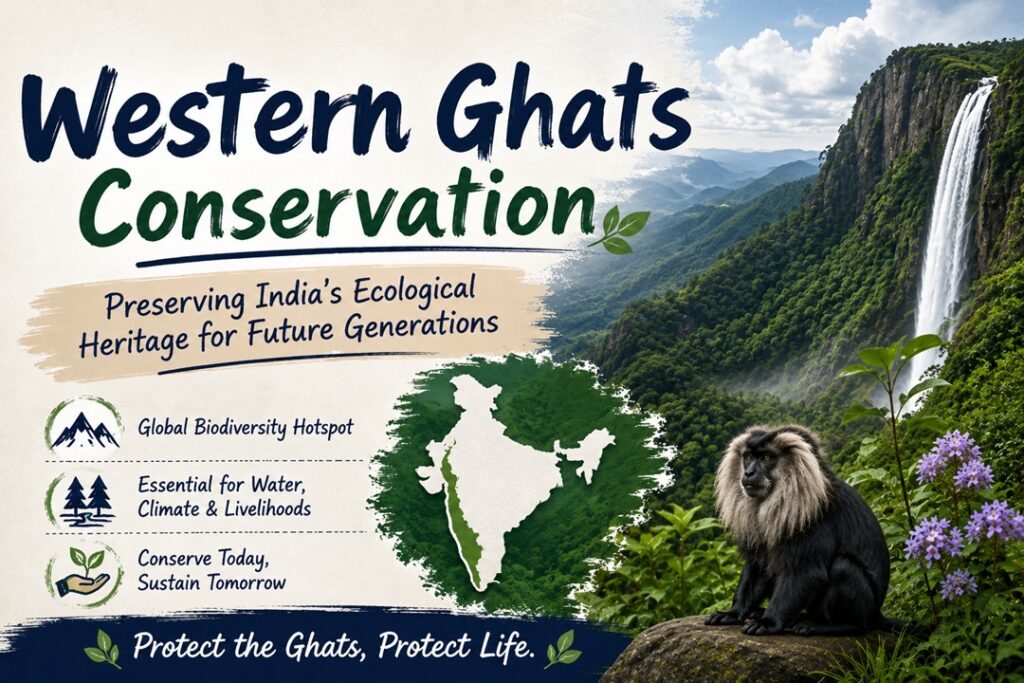
Context
Recent discussions on environmental protection have intensified as conservation groups, local communities, and ecological experts have urged stronger safeguards for the Western Ghats to address increasing developmental pressures, habitat degradation, and biodiversity loss.
Understanding the Western Ghats
About the Western Ghats
What are they?
- The Western Ghats are one of India’s longest mountain systems, stretching parallel to the country’s western coastline.
- States covered – The range extends across Gujarat, Maharashtra, Goa, Karnataka, Kerala, and Tamil Nadu.
- It is internationally recognized as one of the world’s eight “hottest” biodiversity hotspots due to its exceptional concentration of endemic flora and fauna.
- Altitude – The northern section generally ranges between 3,000–5,000 feet, while elevations gradually decline south of Goa before rising sharply again in the southern region.
- The highest summit is Anamudi (Anai Peak) in Kerala, reaching approximately 8,842 feet (2,695 metres).
- The Western Ghats are also designated as a UNESCO World Heritage Site and play a vital role in regulating India’s climate and rainfall.
Major River Systems Originating from the Western Ghats
East-Flowing Rivers (Towards the Bay of Bengal)
- Godavari
- Krishna
- Kaveri (Cauvery)
- Tungabhadra
- Bhima
West-Flowing Rivers (Towards the Arabian Sea)
- Periyar
- Sharavathi
- Netravati
- Bharathappuzha
- Mandovi
Why are the Western Ghats Ecologically Important?
Climate Regulator
- The mountain chain intercepts moisture-bearing southwest monsoon winds, resulting in abundant rainfall over the western coastal belt and influencing rainfall across peninsular India.
Natural Carbon Sink
- Extensive forests store significant quantities of carbon, helping reduce atmospheric greenhouse gases and mitigate climate change.
Water Security
- The Ghats act as one of India’s most important watershed regions, sustaining nearly 40% of the country’s perennial rivers.
Source of Lifeline Rivers
- Several major rivers originating here provide drinking water, irrigation, and hydropower for millions of people.
Exceptional Biodiversity
- The region supports thousands of endemic plant and animal species, many of which are found nowhere else in the world.
Major Threats Facing the Western Ghats
Loss of Wildlife Habitat
- Species such as the Nilgiri Tahr and Lion-tailed Macaque depend on intact forest ecosystems that are increasingly under pressure.
Forest Degradation
- Expansion of plantations, commercial agriculture, and monoculture forestry has replaced large stretches of native forests.
Unsustainable Mining Activities
- Quarrying, mineral extraction, and sand mining contribute to landslides, soil erosion, and contamination of rivers.
Fragmentation Due to Infrastructure
- Roads, railways, dams, and urban expansion divide continuous forest landscapes, disrupting wildlife movement.
Spread of Invasive Plants
- Exotic species such as Lantana camara and Senna spectabilis suppress native vegetation and alter ecosystems.
Increasing Human–Wildlife Encounters
- Expansion of settlements near forests has increased crop damage and conflicts between humans and wild animals.
Policy and Governance Challenges
- Differences between conservation priorities and developmental interests have delayed the implementation of Ecologically Sensitive Area (ESA) regulations.
Conservation Initiatives for the Western Ghats
Western Ghats Ecology Expert Panel (Gadgil Committee, 2011)
- Recommended declaring the entire Western Ghats as an Ecologically Sensitive Area with varying levels of environmental regulation.
High-Level Working Group (Kasturirangan Committee, 2013)
- Suggested protecting nearly 37% of the Western Ghats while permitting sustainable development in densely populated regions.
ESA Draft Notifications
- The Ministry of Environment has issued multiple draft notifications under the Environment (Protection) Act, 1986, to legally safeguard ecologically fragile zones.
Restrictions on Mining
- Proposed prohibition of new mining, quarrying, and sand extraction within notified Ecologically Sensitive Areas.
Control of Polluting Industries
- Restriction on thermal power plants and highly polluting “Red Category” industries in environmentally fragile landscapes.
Environmental Clearance for Infrastructure
- Major construction projects, highways, railways, and township developments require stricter environmental scrutiny.
Forest Restoration Programmes
- Initiatives such as the National Afforestation Programme and Green India Mission support afforestation, habitat restoration, and forest fire management.
Wildlife Conservation Schemes
- Programmes including Project Tiger and the Integrated Development of Wildlife Habitats strengthen biodiversity conservation across protected areas.
CAMPA Funding
- Compensatory Afforestation Fund resources are utilized for forest regeneration, habitat improvement, and wildlife conservation.
Way Forward for Sustainable Conservation
Finalize Ecologically Sensitive Area Notifications
- Expedite implementation of legally enforceable ESA boundaries based on scientific assessment.
Curb Environmentally Harmful Activities
- Strengthen action against illegal mining, quarrying, sand extraction, and highly polluting industries.
Adopt Sustainable Infrastructure Planning
- Ensure development projects follow ecological carrying-capacity assessments and minimize habitat fragmentation.
Protect Watersheds
- Conserve river catchments, wetlands, and natural drainage systems essential for long-term water security.
Strengthen Law Enforcement
- Improve implementation of forest and wildlife protection laws to prevent encroachment and illegal activities.
Promote Nature-Friendly Livelihoods
- Encourage organic farming, sustainable agroforestry, community forestry, and responsible eco-tourism.
Increase Community Participation
- Empower local communities, Gram Sabhas, and indigenous groups to participate in conservation planning and decision-making.
Enhance Inter-State Coordination
- Foster cooperation among all six states to harmonize conservation objectives with sustainable regional development.
Future Outlook
The long-term conservation of the Western Ghats requires integrating ecological preservation with inclusive economic development. Scientific planning, restoration of degraded ecosystems, effective monitoring through GIS and remote sensing, stronger enforcement against environmental violations, and active participation of governments, researchers, local communities, and civil society will be essential to protect this globally significant biodiversity landscape for future generations.
Source : The Hindu