
Public Examinations (Prevention of Unfair Means) Amendment Bill, 2026
Context
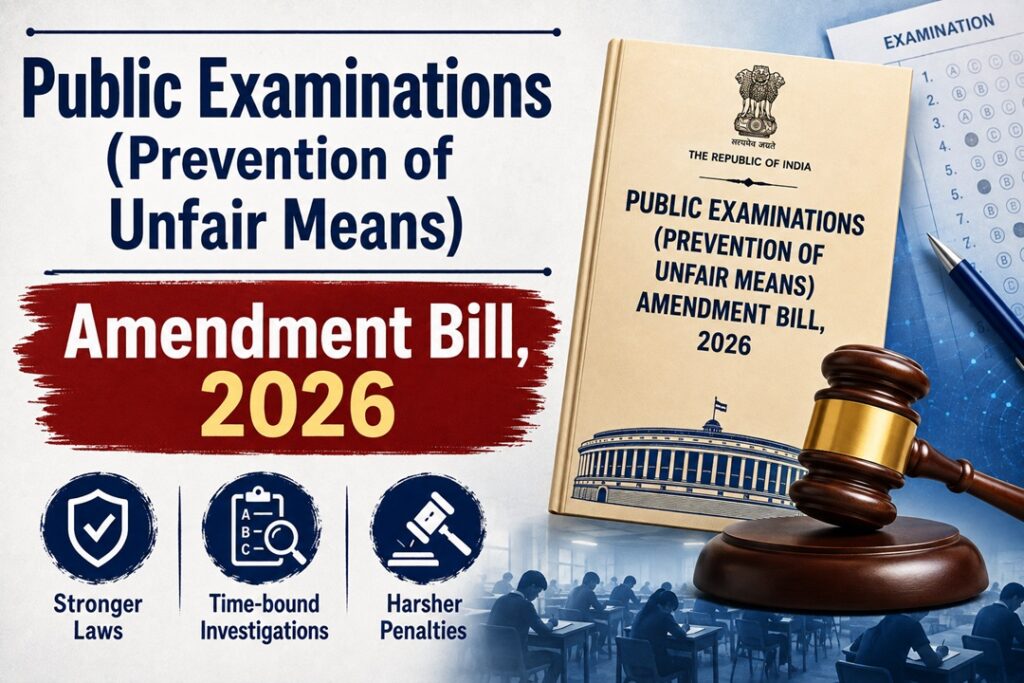
Recently, the Lok Sabha introduced the Public Examinations (Prevention of Unfair Means) Amendment Bill, 2026 to tighten legal provisions against examination paper leaks, strengthen penalties against organised malpractice, and ensure time-bound investigation and speedy trial of offences related to public examinations.
About the Public Examinations (Prevention of Unfair Means) Amendment Bill, 2026
About the Amendment Bill
- The Bill proposes amendments to the Public Examinations (Prevention of Unfair Means) Act, 2024.
- It seeks to reinforce the legal framework against cheating in public examinations and improve transparency in recruitment and admission processes.
- The legislation aims to introduce stricter punishment, faster investigation, and dedicated judicial mechanisms for exam-related offences.
- The broader objective is to dismantle organised examination fraud networks and protect the credibility of merit-based selection systems.
Institutions Covered Under the Bill
The provisions apply to examinations conducted by:
- Union Public Service Commission (UPSC)
- Staff Selection Commission (SSC)
- Railway Recruitment Boards (RRBs)
- Institute of Banking Personnel Selection (IBPS)
- National Testing Agency (NTA)
- Ministries of the Central Government and their attached offices
- Any other authority notified by the Central Government.
Major Provisions of the Amendment
Protecting Merit-Based Selection
- Ensures that deserving candidates are not deprived of opportunities because of paper leaks or unfair practices.
Stricter Action Against Organised Fraud
- Introduces higher imprisonment terms and substantially enhanced monetary penalties to discourage organised cheating syndicates.
Speedier Investigation and Trial
- Provides for Special Fast Track Courts and mandatory timelines for investigations and judicial proceedings.
Liability of Service Providers
- Extends accountability to examination agencies, technology vendors, printing firms, and other service providers involved in conducting examinations.
Improving Institutional Credibility
- Strengthens public confidence in competitive examinations used for government recruitment and higher education admissions.
Protecting Youth Aspirations
- Reinforces the integrity of examinations that determine access to employment and educational opportunities.
Important Amendments Proposed
- Tougher punishment for examination-related offences.
- Higher financial penalties for organised malpractice.
- Mandatory completion of investigations within a fixed timeline.
- Time-bound disposal of cases by Special Fast Track Courts.
- Enhanced legal responsibility for institutions and private vendors participating in examination processes.
Benefits of the Amendment
Greater Deterrence
- Increasing imprisonment terms and financial penalties raises the cost of engaging in examination fraud.
- The maximum fine for unfair means is proposed to increase from ₹10 lakh to ₹50 lakh, while penalties for organised crime may rise from ₹1 crore to ₹10 crore.
Quicker Delivery of Justice
- Investigations must be completed within two months.
- Trials should conclude within three months after filing of the chargesheet.
Shared Accountability
- Liability extends beyond candidates to include examination agencies, management, technology providers, and organised criminal groups.
Protection of Honest Candidates
- Stronger enforcement safeguards deserving candidates by maintaining fairness in recruitment and admission.
Higher Public Confidence
- A transparent examination system improves trust in public recruitment, higher education admissions, and government institutions.
Development of Specialised Expertise
- Special prosecutors, Fast Track Courts, and dedicated investigation teams can build expertise in handling technologically sophisticated examination crimes.
Concerns Associated with the Bill
Punishment Alone Cannot Eliminate Fraud
- Strong penalties must be supported by effective detection, investigation, and conviction mechanisms.
Possibility of Wrongful Prosecution
- Broad legal provisions may unintentionally affect innocent candidates or service providers unless supported by proper safeguards and judicial oversight.
Challenges in Time-Bound Investigation
- Complex cyber-enabled examination fraud often requires digital forensic analysis, financial tracking, inter-state coordination, and evidence collection from multiple technology platforms.
Cybersecurity Risks Continue
- Legal punishment alone cannot prevent hacking, insider threats, malware attacks, AI-assisted impersonation, or cloud security breaches.
Implementation Challenges
- Successful enforcement requires close coordination among the Centre, States, examination agencies, and law-enforcement authorities.
Impact on Private Service Providers
- Increased compliance obligations may raise operational costs and discourage qualified technology partners from participating.
Need for Broader Examination Reforms
- Paper leaks are also driven by structural issues such as high competition, limited employment opportunities, infrastructure gaps, and uneven digital preparedness.
Way Forward
- Shift from punishment-oriented measures to a preventive and secure examination ecosystem.
- Strengthen end-to-end cybersecurity through encryption, multi-factor authentication, zero-trust architecture, blockchain audit trails, anomaly detection, and independent security audits.
- Develop a common National Examination Security Framework for all major recruiting agencies.
- Encourage confidential whistle-blower mechanisms for officials, vendors, technical staff, and candidates.
- Conduct mandatory cybersecurity and compliance audits of service providers before awarding contracts.
- Build specialised task forces with expertise in cybercrime, digital forensics, financial investigation, and examination processes.
- Ensure that fast-track justice preserves due process, judicial scrutiny, and defence rights.
- Reduce dependence on single high-stakes examinations through multiple recruitment cycles, computer-based testing, secure question banks, and transparent score normalisation.
- Promote an ethical culture of examination integrity to strengthen public administration and merit-based governance.
Source : The Hindu