
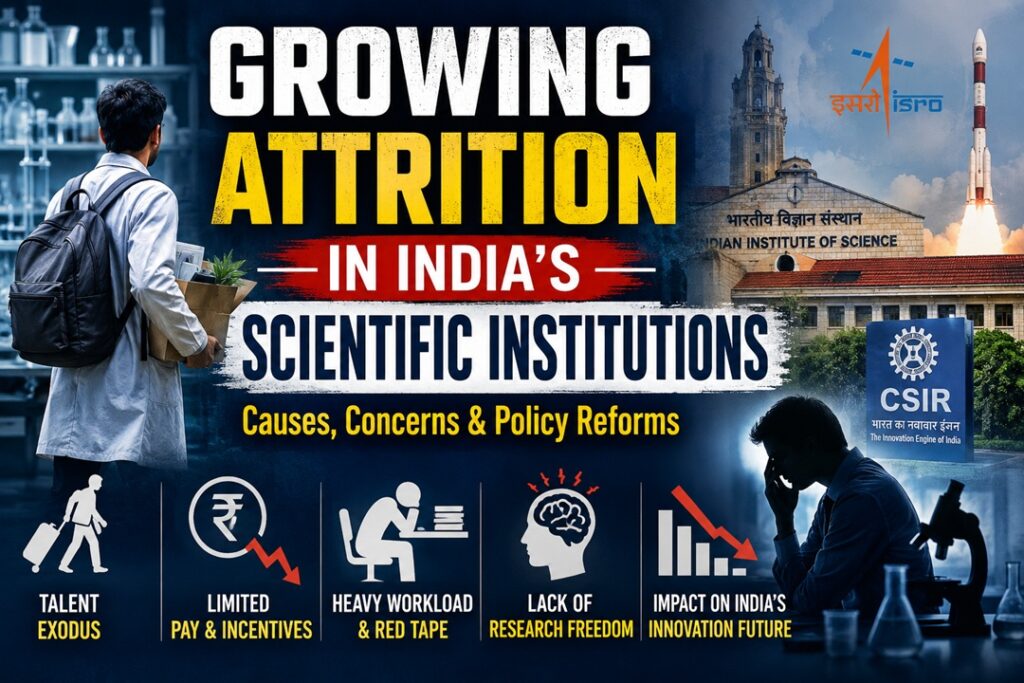
Growing Attrition in India’s Scientific Institutions: Causes, Challenges & Policy Reforms
Context
Recent reports highlighted that a significant number of scientists have reportedly resigned from major Indian scientific establishments, including centres of the Indian Space Research Organisation (ISRO), raising concerns over talent retention in the country’s public research ecosystem.
Growing Attrition in India’s Scientific Institutions: Causes, Challenges & Policy Reforms
About the Scientific Talent Retention Challenge
India has developed a strong scientific workforce through premier institutions such as IITs, IISc, and national research organisations. However, an increasing number of experienced scientists are leaving government research institutions or seeking opportunities abroad due to professional, institutional, and administrative constraints. This has renewed concerns about India’s ability to sustain scientific excellence and technological leadership.
Important Facts & Statistics
Resignations from Research Institutions
- Reports indicate that nearly 100–120 scientists recently resigned from important ISRO centres, including the UR Rao Satellite Centre (URSC) and Vikram Sarabhai Space Centre (VSSC), impacting several strategic research programmes.
Brain Drain of Skilled Researchers
- Around 60–70% of PhD graduates and nearly 30% of engineering graduates from leading Indian institutions eventually pursue careers overseas.
Low Investment in Research
- India’s Gross Expenditure on Research and Development (GERD) remains close to 0.7% of GDP, considerably below innovation-driven economies such as South Korea, Israel, and the United States.
Economic Cost
- The outflow of highly skilled researchers and innovators is estimated to cause an annual economic loss of nearly $35–50 billion through reduced innovation and knowledge creation.
What Factors are Driving Scientific Attrition?
Administrative Constraints
- Excessive administrative procedures often limit scientists’ flexibility in planning research, managing projects, and making scientific decisions.
Hierarchical Institutional Structure
- Rigid organisational systems may discourage young researchers from proposing new ideas or challenging conventional scientific approaches.
Merit Recognition Gaps
- Career advancement and institutional recognition may at times depend more on seniority than research quality, innovation, or scientific contributions.
Limited Grievance Redressal
- Scientists may hesitate to raise workplace concerns due to fears regarding promotions, research grants, or future career prospects.
Attractive Global Opportunities
- International universities, private R&D laboratories, and technology companies provide better salaries, cutting-edge infrastructure, higher research funding, and greater academic freedom.
What are the Implications of Rising Attrition?
Decline in Institutional Expertise
- The departure of experienced scientists weakens institutional memory and affects continuity in long-term scientific programmes.
Weak Mentorship Ecosystem
- Senior researchers play a critical role in guiding young scientists, and their exit reduces opportunities for knowledge transfer.
Impact on Strategic National Missions
- Programmes related to space technology, artificial intelligence, quantum computing, semiconductor manufacturing, and defence research may face delays and capability gaps.
Reduced Innovation Potential
- Persistent attrition can slow scientific breakthroughs, technology development, and India’s global research competitiveness.
What Policy Measures Can Improve Scientist Retention?
Expand Research Autonomy
- Provide scientists greater freedom in selecting research priorities, managing laboratories, and implementing projects.
Promote Merit-Based Career Progression
- Ensure transparent recruitment, performance evaluation, and promotions based on research output, innovation, and scientific excellence.
Strengthen Institutional Accountability
- Establish independent, confidential, and effective grievance redressal mechanisms to resolve workplace concerns.
Encourage Participative Leadership
- Train research administrators in collaborative leadership, mentorship, and modern research management practices.
Improve the Research Ecosystem
- Increase public investment in R&D, modernise laboratory infrastructure, expand research funding, and create an innovation-friendly work environment.
Conclusion
Retaining scientific talent is essential for India’s long-term technological advancement and strategic self-reliance. Along with expanding research infrastructure, reforms that promote autonomy, meritocracy, accountability, and a supportive research culture will be crucial for strengthening India’s public scientific institutions and sustaining global competitiveness.
Source : The Hindu