
SHANTI Framework: India’s New Maritime Cooperation Vision for the Indo-Pacific
Context
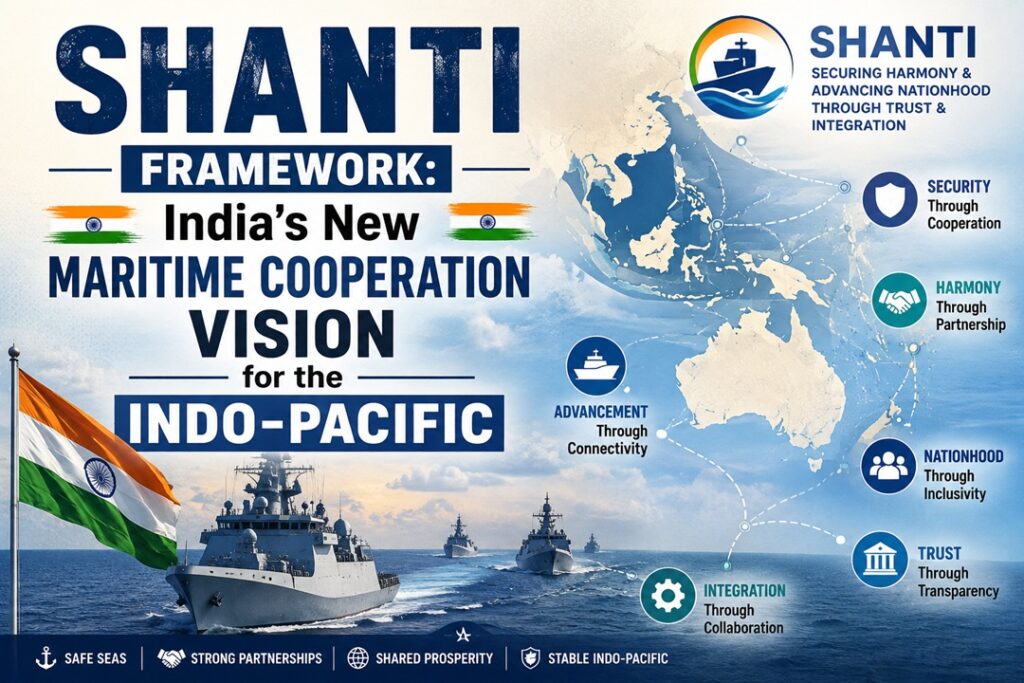
Recently, the External Affairs Minister introduced the SHANTI Framework (Securing Holistic Advancement through Norms, Trust and Integrity) while announcing India’s candidature for a non-permanent seat in the United Nations Security Council (UNSC) for the 2028–29 term. The framework reflects India’s vision of promoting an inclusive, rules-based, and cooperative maritime order by strengthening regional partnerships, maritime resilience, and sustainable security across the Indo-Pacific.
What is the SHANTI Framework?
Overview
- SHANTI stands for Securing Holistic Advancement through Norms, Trust and Integrity.
- It is a maritime governance and regional cooperation framework aimed at strengthening peace, security, and sustainable development in the Indo-Pacific.
- The initiative focuses on collaborative security, institution-building, and capacity enhancement rather than military alliances.
- It seeks to create an environment where countries cooperate to address common maritime challenges through trust, transparency, and shared responsibility.
Evolution of SHANTI
- Builds upon SAGAR (Security and Growth for All in the Region) announced in 2015.
- Expands the vision of MAHASAGAR (Mutual and Holistic Advancement for Security and Growth Across Regions) introduced in 2025.
- Represents India’s transition from being primarily a security provider to becoming a comprehensive maritime development partner.
Core Philosophy
The SHANTI Framework promotes a strategic transition:
- From geopolitical competition to collaborative security.
- From power projection to partnership-driven development.
- From military deterrence to resilience and preparedness.
- From crisis management to long-term institution building.
- From strategic rivalry to collective regional responsibility.
Note: SHANTI is primarily a maritime cooperation framework, not a military alliance. Joint naval exercises under organisations like BIMSTEC are envisioned as tools for implementing its objectives.
What are the Pillars of the SHANTI Framework?
Rules-Based Maritime Governance
- Reaffirms commitment to the United Nations Convention on the Law of the Sea (UNCLOS).
- Supports freedom of navigation, peaceful dispute settlement, and respect for international maritime law.
Trust-Centred Regional Cooperation
- Encourages consultation, transparency, and confidence-building among maritime nations.
- Promotes voluntary partnerships rather than coercive arrangements.
Respect for Sovereignty
- Supports equal partnerships while respecting the sovereignty and territorial integrity of all participating countries.
- Rejects domination-based regional security models.
Demand-Oriented Capacity Building
- Maritime assistance programmes are designed according to the needs of partner countries.
- Includes training, technology transfer, infrastructure support, and institutional development.
Comprehensive Maritime Security
The framework addresses both traditional and non-traditional maritime threats such as:
- Disaster management
- Maritime terrorism
- Illegal fishing
- Marine pollution
- Cybersecurity
- Port security
- Protection of submarine communication cables
What are the Major Benefits of SHANTI?
Common Regional Framework
- Harmonises maritime cooperation among different regional organisations.
- Creates common principles for coordinated action.
Addressing Emerging Maritime Challenges
Provides collaborative solutions for:
- Climate-induced disasters
- Illegal, Unreported and Unregulated (IUU) Fishing
- Marine pollution
- Cyber attacks on maritime infrastructure
- Maritime trafficking
Strengthening India’s Maritime Leadership
- Reinforces India’s role as a trusted regional partner.
- Enhances India’s position as a first responder during regional emergencies.
Disaster Risk Reduction
Supports:
- Joint disaster response exercises
- Early warning systems
- Humanitarian Assistance and Disaster Relief (HADR)
- Regional emergency logistics
Improved Maritime Domain Awareness
- Vessel tracking
- Information sharing
- Anti-piracy operations
- Protection of ports and sea lanes
- Monitoring illegal maritime activities
Confidence Building
- Promotes regular dialogue.
- Reduces strategic mistrust.
- Strengthens regional institutional cooperation.
Balanced Regional Architecture
- Offers a transparent and cooperative alternative to infrastructure-based geopolitical competition.
- Encourages inclusive regional development.
Model for the Global South
- Demonstrates an affordable and replicable framework for maritime governance.
- Supports South-South cooperation across the Indo-Pacific.
Why is the Bay of Bengal Central to SHANTI?
Shared Maritime Region
The Bay of Bengal is an interconnected maritime ecosystem where:
- Shipping routes intersect.
- Fish stocks are shared.
- Environmental challenges spread across national boundaries.
- Natural disasters affect multiple countries simultaneously.
Major Regional Challenges
Countries around the Bay commonly face:
- Cyclones and storm surges
- Tsunamis
- Coastal erosion
- Floods
- Illegal, Unreported and Unregulated (IUU) Fishing
- Marine pollution
- Piracy
- Human trafficking
- Drug smuggling
- Cyber threats targeting ports
- Vulnerable undersea communication cables
- Supply-chain disruptions
- Energy security concerns
These challenges require collective regional action rather than isolated national responses.
What makes the Bay of Bengal Strategically Important?
Historic Maritime Gateway
- Has connected South Asia and Southeast Asia through trade and cultural exchanges for centuries.
Gateway to Southeast Asia
- Supports India’s Act East Policy.
- Connects the Indian Ocean with the Malacca Strait, one of the world’s busiest maritime chokepoints.
Natural Platform for Cooperation
Shared maritime resources encourage:
- Joint fisheries management
- Disaster preparedness
- Maritime environmental protection
- Shipping cooperation
Relatively Stable Strategic Environment
Compared with the western Indian Ocean, the Bay offers greater scope for cooperative maritime security.
Strategic Importance of Andaman & Nicobar Islands
- Located near the western entrance of the Malacca Strait.
- Enable monitoring of vital Sea Lines of Communication (SLOCs).
- Enhance India’s maritime surveillance capabilities.
Blue Economy and Connectivity Hub
The Bay supports several strategic initiatives:
- India–Myanmar–Thailand Trilateral Highway
- Kaladan Multimodal Transit Transport Project
- BIMSTEC Connectivity Master Plan
- Coastal shipping initiatives
- Port-led economic development
What are the Major Challenges?
Strategic Mistrust
Different threat perceptions limit deeper regional cooperation.
Institutional Overlap
Multiple regional organisations often perform similar functions, reducing coordination efficiency.
Capability Gaps
Many smaller coastal nations face shortages of:
- Naval assets
- Financial resources
- Maritime technology
- Skilled manpower
Growing Geopolitical Competition
External strategic rivalries complicate regional consensus-building.
Domestic Political and Economic Constraints
Political instability and economic challenges reduce long-term commitment to regional initiatives.
Way Forward
Institutionalise BIMSTEC Maritime Exercises
Conduct regular joint exercises involving navies, coast guards, and disaster management agencies focusing on:
- Humanitarian Assistance and Disaster Relief (HADR)
- Search and Rescue (SAR)
- Anti-piracy
- Pollution response
Expand White Shipping Information Sharing
Create real-time commercial shipping information-sharing mechanisms to improve maritime domain awareness.
Develop Regional Disaster Response Architecture
- Common Standard Operating Procedures (SOPs)
- Shared logistics hubs
- Emergency stockpiles
- Integrated early warning systems
Strengthen Blue Economy Cooperation
Promote:
- Sustainable fisheries
- Marine pollution control
- Climate-resilient ports
- Coastal livelihood protection
Promote Rule-Based Maritime Governance
Strengthen cooperation on:
- UNCLOS implementation
- Marine environmental protection
- Cyber resilience
- Undersea cable security
- Peaceful dispute settlement
Build an Inclusive Maritime Partnership
Ensure that SHANTI remains:
- Transparent
- Consensus-driven
- Sovereignty-respecting
- Open and inclusive
- Focused on delivering regional public goods instead of geopolitical dominance.
Source : The Hindu