
Europe Wildfires: Climate Whiplash, PyroCb Fire Storms & Causes Explained
Context
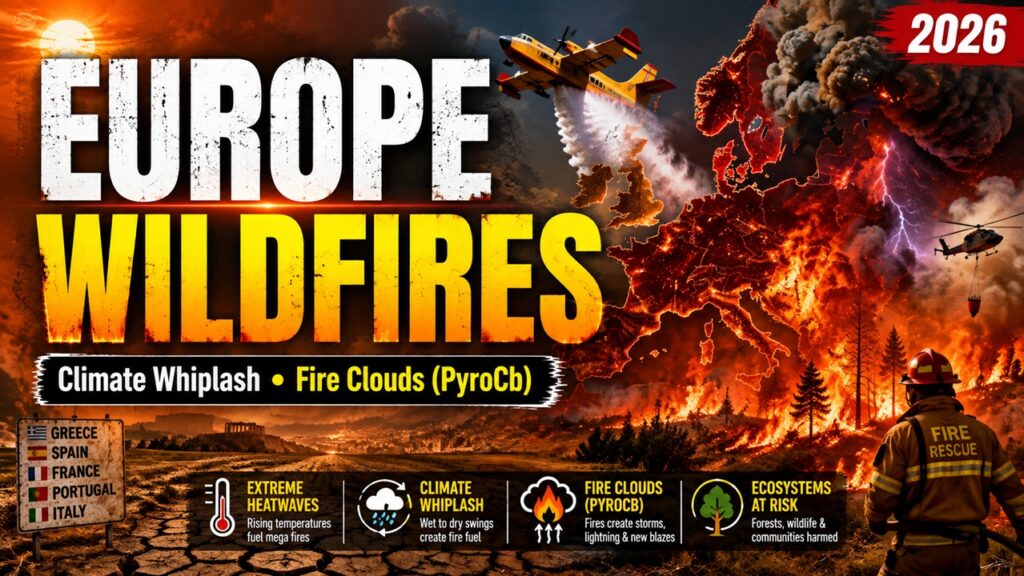
A series of devastating wildfires spread across southern Europe—particularly Greece, Spain, France, Portugal, and Italy—burning hundreds of thousands of hectares of forests, damaging settlements, disrupting transport, and triggering one of Europe’s largest peacetime evacuation efforts. The disaster has once again highlighted how climate change, prolonged heatwaves, and changing land-use patterns are increasing the frequency and intensity of extreme wildfires.
Europe Wildfires: Climate Whiplash, PyroCb Fire Storms & Causes Explained
Understanding Europe’s Escalating Wildfire Crisis
What are Europe’s New-Generation Wildfires?
European wildfires are becoming larger, faster-spreading, and more intense due to the combined effects of climate change, prolonged droughts, extreme heatwaves, and inadequate landscape management.
Unlike traditional seasonal forest fires, many recent fires have evolved into sixth-generation (mega) wildfires that generate enormous heat, spread unpredictably, and even create their own weather systems. These fires destroy biodiversity, release massive amounts of carbon dioxide, and are increasingly difficult to control using conventional firefighting methods.
Climate Whiplash & Fire Clouds (Pyrocumulonimbus – PyroCb)
What is Climate Whiplash?
Climate whiplash refers to the rapid transition between opposite weather extremes within a short period.
For wildfires, this generally involves:
- Above-normal rainfall leading to rapid vegetation growth.
- Followed by prolonged heatwaves and severe drought.
- The lush vegetation quickly dries out.
- The dried grasses, shrubs, and young trees become a continuous layer of combustible fuel, making forests highly vulnerable to large fires.
Thus, wetter conditions paradoxically increase wildfire risk when followed by extreme heat.
What are Fire Clouds (Pyrocumulonimbus or PyroCb)?
A Pyrocumulonimbus (PyroCb) is a thunderstorm produced directly by the enormous heat generated from an intense wildfire.
These clouds behave like ordinary thunderstorms but originate from fire rather than atmospheric instability.
Formation of PyroCb
- Intense Heat Generation
- Massive wildfires produce enormous heat.
- Hot air carrying smoke, ash, and moisture rises rapidly into the atmosphere.
- Cooling and Cloud Formation
- As the air ascends nearly 10–15 km, it cools.
- Water vapour condenses around microscopic ash and smoke particles.
- Thunderstorm Development
- Towering cumulonimbus clouds develop.
- These clouds generate lightning, strong winds, turbulence, and localized rainfall.
- Self-Intensifying Fire Cycle
- Lightning produced by the PyroCb can ignite new fires many kilometres away.
- Strong downdrafts and unpredictable winds rapidly change fire direction, trapping firefighters and accelerating fire spread.
Factors Intensifying Europe’s Wildfires
Climate-Induced Drivers
- Global Warming
- Rising temperatures increase atmospheric moisture-holding capacity.
- This intensifies both heavy rainfall events and prolonged droughts.
- More Frequent Heatwaves
- Europe is experiencing longer, hotter summers.
- Extreme temperatures rapidly dry forests and vegetation.
- Climate Variability
- Rapid shifts between unusually wet and unusually dry conditions increase fire susceptibility.
- Vegetation Growth
- Wet years encourage dense growth of grasses, shrubs, and saplings.
- During droughts these become abundant wildfire fuel.
Land Management Factors
- Declining Agriculture
- Rural depopulation has reduced traditional farming and livestock grazing.
- Fuel Accumulation
- Unmanaged forests accumulate thick undergrowth and dry vegetation.
- Continuous fuel beds allow fires to spread rapidly over large areas.
- Fire Suppression Paradox
- Decades of successfully extinguishing small fires have prevented natural fuel reduction.
- As combustible material accumulates, occasional fires become much larger and hotter than before.
Impacts of Europe’s Wildfires
Economic Damage
- Destruction of homes, infrastructure, power networks, farms, and tourism facilities.
- Annual wildfire losses in the European Union are estimated at around €2.5 billion.
Environmental Consequences
- Large-scale destruction of forests and wildlife habitats.
- Soil erosion and long-term ecosystem degradation.
- Massive release of stored carbon, accelerating climate change.
Public Health Impacts
- Dense smoke reduces air quality across large regions.
- Fine particulate pollution travels hundreds to thousands of kilometres.
- Respiratory illnesses increase, while mass evacuations strain emergency services.
Europe vs India: Wildfire Characteristics
Primary Causes
Europe
- Climate change.
- Heatwaves.
- Lightning.
- Climate whiplash.
- PyroCb-generated fires.
- Accumulated forest fuel.
India
- Mostly human-induced.
- Agricultural residue burning.
- Collection of forest produce.
- Careless campfires and accidental ignitions.
- Controlled burning that escapes into forests.
Major Fire-Prone Areas in India
Forest fires frequently occur in:
- Northeastern States
- Odisha
- Chhattisgarh
- Madhya Pradesh
- Uttarakhand
- Himachal Pradesh
- Parts of Maharashtra and Telangana
Peak fire season generally extends from February to June before the southwest monsoon arrives.
Strategies for Wildfire Risk Reduction
Scientific Forest Management
- Remove excessive dry biomass.
- Create strategic firebreaks.
- Encourage controlled grazing to reduce combustible vegetation.
Advanced Monitoring
- Satellite-based fire detection.
- AI-assisted fire prediction.
- Real-time weather forecasting.
- Early warning systems for vulnerable communities.
Community Preparedness
- Improve evacuation planning.
- Conduct awareness campaigns.
- Strengthen local disaster response mechanisms.
Revitalising Rural Landscapes
- Promote sustainable agriculture.
- Encourage livestock grazing.
- Prevent abandonment of forest-fringe lands.
Climate-Resilient Afforestation
- Restore forests using diverse native species.
- Avoid highly flammable monoculture plantations.
Conclusion
Europe’s recent wildfire disasters demonstrate that modern forest fires are no longer merely seasonal natural hazards but increasingly climate-driven extreme events. The interaction of climate whiplash, prolonged heatwaves, unmanaged vegetation, and fire-generated thunderstorms (PyroCb) has fundamentally changed wildfire behaviour. Reducing future risks will require integrated climate adaptation, scientific forest management, resilient rural landscapes, improved early warning systems, and stronger community preparedness to safeguard lives, ecosystems, and economies.
Source : The Indian Express