
Critical Minerals Security: Building India’s Strategic Resource Base
Context
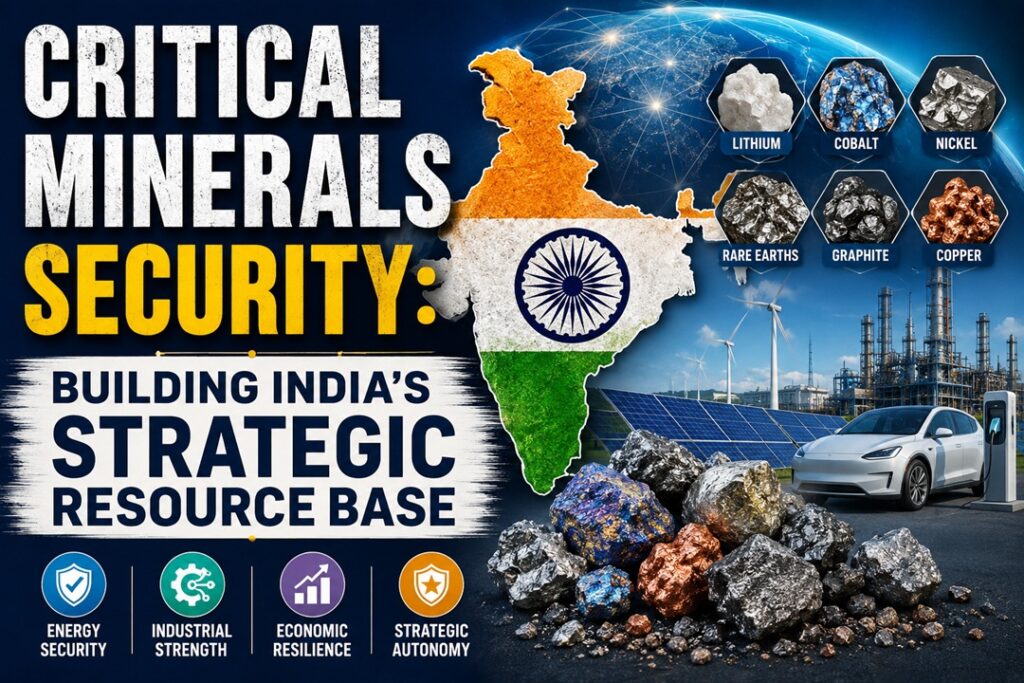
Recent policy discussions have underscored that critical minerals are emerging as indispensable strategic resources, underpinning clean energy systems, advanced manufacturing, digital infrastructure, and national security. As global competition intensifies over access to these minerals, countries are prioritizing resilient supply chains and domestic processing capabilities.
Critical Minerals: Powering the Future Economy
Understanding Critical Minerals
What are Critical Minerals?
Critical minerals are strategically important mineral resources that serve as essential inputs for electric mobility, renewable energy technologies, semiconductor manufacturing, telecommunications equipment, aerospace components, and advanced defence platforms.
Since the extraction and processing of many of these minerals are concentrated in a handful of countries, secure access has evolved into a strategic necessity rather than merely a trade issue. Reliable supplies now influence industrial competitiveness, technological leadership, and geopolitical influence.
Important Facts & Figures
- Global Processing Concentration: Nearly 86% of global refining capacity for major critical minerals—including lithium, cobalt, nickel, graphite, copper, and rare earth elements—is controlled by the top three refining nations, with China dominating processing across most strategic minerals.
- China’s Processing Leadership: China refines more than 90% of rare earth elements and graphite while accounting for around 75% of cobalt refining and nearly 70% of lithium chemical processing worldwide.
- Future Supply Risks: Global projections indicate a significant copper supply gap by 2035, while demand for lithium and rare earth elements is expected to outpace supply due to the accelerating clean energy transition.
- India’s Growing Demand: Under India’s Net-Zero 2070 pathway, cumulative demand for critical minerals is projected to reach nearly 169 million tonnes, substantially exceeding demand under existing policy trajectories.
Why Critical Minerals Matter for India
Supporting the Green Energy Transition
Critical minerals form the backbone of electric vehicles, battery storage systems, solar photovoltaic modules, wind turbines, and modern electricity grids essential for achieving India’s climate objectives.
Enabling Advanced Manufacturing
Semiconductors, consumer electronics, telecommunications equipment, and emerging digital technologies depend heavily on secure supplies of refined critical minerals.
Enhancing Defence Preparedness
Rare earth magnets, specialty alloys, and high-performance metals are vital for missile systems, satellites, fighter aircraft, radar technologies, and other strategic defence platforms.
Reducing Strategic Supply Risks
Diversified sourcing helps protect India against export restrictions, geopolitical disruptions, and excessive dependence on a limited number of foreign suppliers.
Expanding Domestic Value Addition
Developing refining industries and downstream manufacturing can reduce import dependence while generating employment and strengthening industrial competitiveness.
Major Challenges
Limited Domestic Processing Infrastructure
Although India possesses reserves of several important minerals, refining and purification capacities remain inadequate for producing high-grade materials required by advanced industries.
Exploration Bottlenecks
Slow geological exploration, lengthy environmental approvals, and limited private investment continue to delay the development of new mineral resources.
Dependence on Imports
India remains highly dependent on imported lithium, cobalt, nickel, and several other battery minerals needed for domestic manufacturing.
Underdeveloped Recycling Ecosystem
Recovery of valuable minerals from electronic waste and used batteries remains limited due to fragmented collection systems and evolving recycling technologies.
High Development Costs
Many prospective mineral deposits are located in remote or environmentally sensitive regions where infrastructure development remains expensive and logistically challenging.
Government Measures
National Critical Mineral Mission (NCMM)
The Government has launched the National Critical Mineral Mission to strengthen exploration, overseas acquisitions, domestic processing, and recycling while targeting around 1,200 exploration projects by 2030–31.
Overseas Mineral Partnerships through KABIL
Khanij Bidesh India Limited (KABIL) has secured lithium exploration rights in Argentina to diversify India’s overseas mineral assets.
MMDR Reforms
Amendments to the Mines and Minerals (Development and Regulation) Act have empowered the Central Government to directly auction critical mineral blocks, improving resource development.
Promoting Recycling and Processing
Financial incentives have been introduced to support critical mineral recycling, alongside proposals for specialized rare earth processing clusters in mineral-rich states.
International Cooperation
India has strengthened cooperation with trusted partners through bilateral agreements and multilateral initiatives such as the Quad Critical Minerals Initiative to develop resilient global supply chains.
The Road Ahead
Strengthen Domestic Refining
Expanding high-purity refining, chemical processing, and smelting facilities through targeted incentives can significantly improve India’s self-reliance.
Build Strategic Mineral Reserves
Maintaining national stockpiles of essential processed minerals can protect industries from sudden global supply disruptions.
Encourage Private Investment
Providing better geological data, faster approvals, and investment risk-sharing mechanisms can accelerate exploration and mining activities.
Promote Circular Economy
Expanding battery recycling, urban mining, and efficient e-waste management will reduce dependence on primary imports while conserving resources.
Deepen International Partnerships
Greater collaboration in technology transfer, joint exploration, and mineral processing with trusted partner countries will enhance India’s long-term resource security.
Conclusion
Critical minerals are rapidly becoming strategic assets that shape economic competitiveness, technological advancement, and national security. While India has initiated important reforms through the National Critical Mineral Mission and international partnerships, sustained investment in exploration, refining, recycling, and resilient supply chains will be crucial for achieving long-term resource security and technological self-reliance.
Source : The Hindu