
Government School Rationalisation in India: Declining Public Schools and Educational Equity
Context
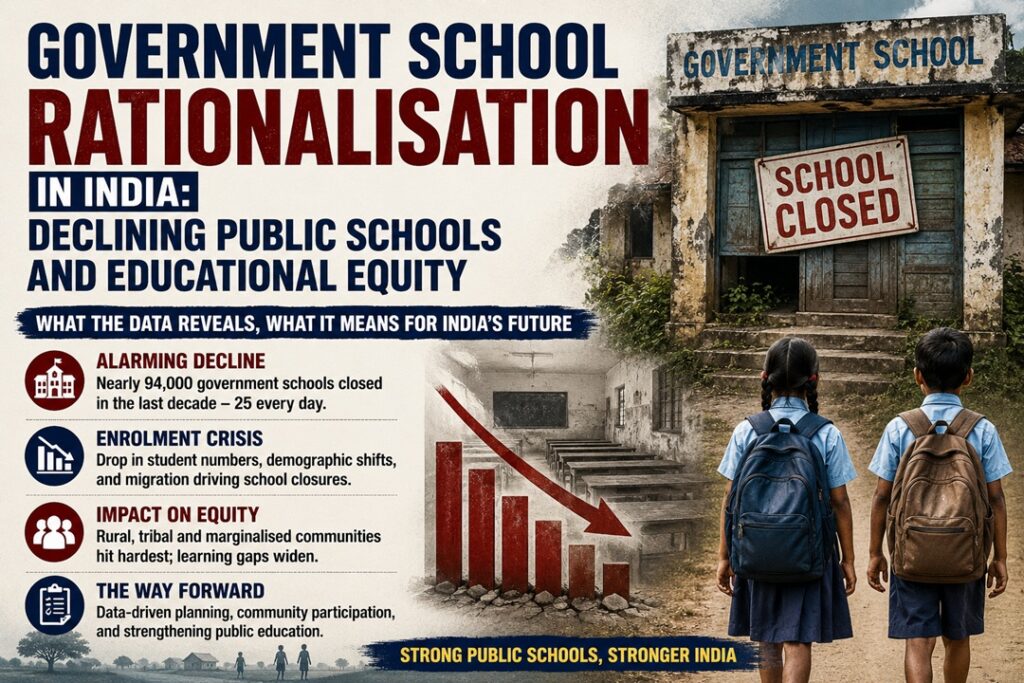
A recent policy assessment and government education data have highlighted the sharp decline in India’s government school network over the past decade. Large-scale school closures and mergers undertaken under school rationalisation policies have raised concerns over declining enrolment, reduced access to neighbourhood schools, widening educational inequality, and their disproportionate impact on children from economically and socially disadvantaged communities.
Government School Rationalisation in India: Declining Public Schools and Its Impact on Educational Equity
About Government School Rationalisation
What is Government School Rationalisation?
Government school rationalisation is the process of merging, closing, relocating, or reorganising government schools with low enrolment to improve administrative efficiency, optimise infrastructure, and ensure better utilisation of teachers and financial resources. The National Education Policy (NEP) 2020 supports rationalisation but also stresses that the principle of neighbourhood schools should not be compromised.
Key Data & Statistics
- Nearly 94,000 government schools have reportedly been closed or merged across India during the last decade.
- Government school enrolment has declined by around 2.26 crore students.
- The share of students studying in government schools has fallen from 71% (2005) to 49.24% (2024–25).
- According to UDISE+, the number of government schools declined from 11.07 lakh (2014–15) to 10.17 lakh (2023–24), a reduction of nearly 89,000 schools.
- During the same period, private schools increased from 2.88 lakh to 3.31 lakh, indicating continued expansion of private education.
Why are Government Schools Being Rationalised?
Declining Student Enrolment
Many government schools have experienced continuous declines in student enrolment because of:
- Falling birth rates in several regions.
- Rising preference for private schools.
- Urbanisation and migration.
- Seasonal migration of families for employment.
- Low enrolment in remote rural schools.
Schools with very low student strength have therefore been merged with nearby institutions.
Implementation of National Education Policy (NEP) 2020
The NEP 2020 recommends:
- Creation of school complexes or clusters.
- Better deployment of teachers.
- Improved educational infrastructure.
- Efficient utilisation of public expenditure.
- Consolidation of schools wherever necessary while protecting neighbourhood access.
Administrative Efficiency
State governments argue that maintaining thousands of schools with only a few students is financially unsustainable. Consolidation enables:
- Better infrastructure.
- Improved teacher availability.
- Efficient utilisation of government funds.
- Enhanced learning facilities.
National Trends in School Education
According to UDISE+:
- Government schools declined substantially over the past decade.
- Private schools continued expanding.
- Government school enrolment reduced steadily.
- Several States witnessed large-scale school mergers under rationalisation programmes.
States Most Affected by School Closures
Madhya Pradesh
Madhya Pradesh has witnessed one of India’s largest school rationalisation exercises.
Major Findings
- Around 7.37 lakh children had no active school records.
- Nearly 29,000 children in districts such as Jhabua and Shivpuri were identified as being at immediate risk of dropping out.
- More than 3,500 government schools recorded zero admissions.
- Around 6,500 schools admitted fewer than 10 students.
Children Outside School
- Around 11.38 lakh children were placed in the vulnerable category.
- Approximately 1.23 lakh children were already school dropouts.
- Nearly 1.55 lakh children discontinued education because of migration.
The State launched programmes such as:
- School Chalen Hum.
- Home Contact Campaign.
However, official reviews found that many vulnerable children remained unreached.
Uttar Pradesh
Uttar Pradesh also experienced substantial school consolidation.
- Thousands of government schools were merged.
- The State recorded one of the country’s largest reductions in government schools.
- Several rural schools with very low enrolment were consolidated into larger institutions.
Jammu & Kashmir
School rationalisation has significantly affected educational accessibility.
Major Developments
- More than 4,300 schools were merged or closed.
- Many children now travel 4–6 kilometres daily to attend school.
- The number of schools declined from 23,167 (2020–21) to 18,785 (2022–23).
- Nearly 13,000 teacher posts remain vacant.
These developments have raised concerns regarding compliance with the neighbourhood school provisions under the Right to Education Act.
Major Impacts of Government School Closures
Reduced Educational Access
Government schools mainly serve children belonging to:
- Scheduled Castes (SCs).
- Scheduled Tribes (STs).
- Economically weaker OBC families.
- Poor rural households.
Closure of nearby schools increases travel distance and educational barriers.
Growing Educational Inequality
Marginalised communities face greater difficulty accessing nearby schools following consolidation, increasing the risk of exclusion from education.
Higher Risk of Girls Dropping Out
Longer travel distances often discourage families from sending girls to school because of:
- Safety concerns.
- Household responsibilities.
- Social norms.
Consequently, girls are more vulnerable to leaving school.
Teacher Shortages and Multi-grade Classrooms
Many consolidated schools experience:
- Teacher shortages.
- Multi-grade teaching.
- Overcrowded classrooms.
- Reduced individual attention for students.
These factors negatively affect learning outcomes.
Pressure on Rural Education
Closure of neighbourhood schools particularly affects:
- Tribal regions.
- Hilly areas.
- Remote villages.
- Migrant populations.
Students often spend more time travelling than studying.
Debate over Centre–State Responsibility
States’ Position
States argue that:
- Education is on the Concurrent List.
- School management and rationalisation fall within State administration.
Union Government’s Role
The Centre continues to influence school education through:
- National Education Policy implementation.
- Centrally Sponsored Schemes.
- Education funding.
- Enforcement of the Right to Education Act.
Therefore, both the Union and States share responsibility for ensuring universal access to education.
Limitations of the Right to Education (RTE) Act
Limited Focus on Learning Outcomes
The Act guarantees admission and access but provides limited enforceable provisions regarding classroom learning quality.
Weak Enforcement of Rights
Children and poor families often lack:
- Legal awareness.
- Institutional support.
- Financial resources.
Consequently, educational rights remain difficult to enforce.
Persistent Social Inequalities
The Act assumes equal participation by parents, schools, and government authorities. In reality, disadvantaged communities often possess limited bargaining power.
Inactive School Management Committees (SMCs)
Although SMCs were established to strengthen community participation, many remain inactive, reducing accountability in school governance.
Limited Accountability Mechanisms
The Act provides limited penalties for failure to maintain educational quality or neighbourhood access, making implementation uneven across States.
About the Right to Education (RTE) Act
- Enacted in 2009 and implemented from 1 April 2010.
- Guarantees free and compulsory education for children aged 6–14 years.
- Makes elementary education a fundamental right under Article 21A of the Constitution.
- Prescribes norms relating to infrastructure, teacher qualifications, pupil-teacher ratio, and neighbourhood schools.
Key Challenges Ahead
- Balancing administrative efficiency with educational accessibility.
- Preventing further decline in government school enrolment.
- Filling teacher vacancies.
- Strengthening rural educational infrastructure.
- Protecting neighbourhood schools.
- Reducing dropout rates among girls and vulnerable communities.
- Improving learning quality after school consolidation.
- Strengthening School Management Committees.
Way Forward
Government school rationalisation should focus on improving educational quality without weakening universal access. Future reforms should ensure that consolidation is guided by local needs rather than administrative convenience alone. Strengthening neighbourhood schools, filling teacher vacancies, improving infrastructure, expanding digital learning support, tracking out-of-school children, empowering School Management Committees, and ensuring effective coordination between the Centre and States will be essential to achieving equitable, inclusive, and quality education for every child while fulfilling the constitutional vision of the Right to Education.
Source : The Hindu