
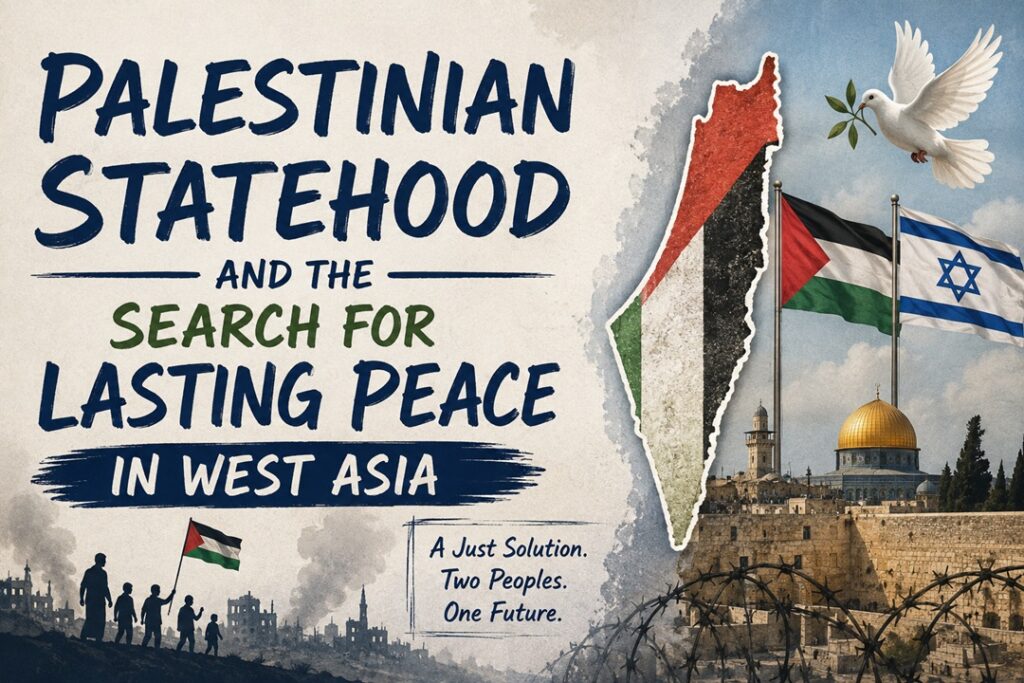
Palestinian Statehood and the Search for Lasting Peace in West Asia
Context
A sovereign, independent, viable and geographically connected Palestinian state existing alongside Israel remains essential for achieving sustainable peace and long-term stability in West Asia.
Understanding the roots of the conflict
- Persistent instability in West Asia – The region continues to face prolonged tensions involving the Israel-Palestine conflict, the Gaza war, Israel-Iran hostilities and the activities of non-state groups such as Hezbollah and the Houthis.
- Although these crises have distinct historical, political and strategic dimensions, the unresolved Palestinian issue remains a major driver of regional instability.
- Birth of Israel and the unresolved Palestinian question – The establishment of Israel in 1948 fundamentally altered the political order of West Asia, while the question of Palestinian statehood remained unsettled.
- Balfour Declaration, 1917 – British policies during the Mandate period, followed by the partition proposals for Palestine, produced competing Jewish and Arab national aspirations.
- UN Partition Plan, 1947 – The plan proposed separate Jewish and Arab states, but it was never implemented in its original form.
- Subsequent Arab-Israeli wars, Israeli occupation of Palestinian territories and settlement expansion further complicated efforts to achieve a negotiated political settlement.
- The failure of earlier negotiations should not be regarded as evidence that Palestinian statehood is unattainable, particularly given the historical context of displacement, occupation, unequal power and competing security concerns.
Why a Palestinian state is important for regional stability
- A wider geopolitical impact – The Palestinian question extends beyond the immediate Israeli-Palestinian dispute and influences the strategic calculations of Iran, Arab countries and non-state actors.
- Iran’s confrontation with Israel has long been intertwined with the Palestinian issue, especially since the 1979 Islamic Revolution.
- Role of Hezbollah and Hamas – Hezbollah’s backing of the Palestinian cause combines ideological, political and strategic motivations. Hamas has also received support from Iran and Hezbollah, showing that the issue can cross the traditional Sunni-Shia divide.
- A credible pathway towards Palestinian statehood could reduce the political space and popular justification available to armed groups while creating opportunities for improved Israel-Arab relations.
- Humanitarian and security concerns – The October 7, 2023 attacks by Hamas, including deliberate attacks on Israeli civilians, sharply heightened Israel’s security concerns and weakened domestic support for Palestinian statehood among sections of Israeli society.
- Israel’s subsequent military operations in Gaza have resulted in extensive civilian casualties, displacement and destruction.
- The continuing cycle of violence and retaliation has deepened radicalisation and made political negotiations more difficult.
- Gaza’s devastation has also weakened the infrastructure, economy and institutions required for a future Palestinian state.
- Therefore, Israeli security and Palestinian self-determination should be treated as mutually reinforcing objectives rather than competing demands.
The importance of international mediation
- Lessons from the Oslo process – The Oslo Accords of 1993 highlighted the potential value of third-party facilitation in bringing conflicting parties to the negotiating table.
- Norway’s mediation contributed to mutual recognition between Israel and the Palestine Liberation Organization (PLO) and helped establish the Palestinian Authority.
- Although Oslo failed to deliver a final peace agreement, it demonstrated that direct negotiations can produce progress when supported by credible external mediation.
- Role of the United States – The U.S. possesses considerable influence with Israel and substantial diplomatic leverage across the Arab world.
- American engagement, however, needs to be viewed as credible, balanced and directed towards a durable political settlement rather than temporary conflict management.
- United Nations’ contribution – The UN can provide international legitimacy, humanitarian support and an institutional framework for negotiations.
- A coordinated international effort involving the U.S., European countries, Arab states and the UN could provide stronger guarantees for Israeli security and Palestinian statehood.
Major obstacles before the two-state framework
- Settlement expansion continues to fragment Palestinian territory and threatens the territorial viability of a future state.
- Palestinian political divisions between the Palestinian Authority and Hamas weaken unified political representation.
- Israeli security apprehensions have intensified following the October 2023 attacks.
- Hard-line political positions on both sides continue to restrict the space for compromise.
- Difficult questions concerning Jerusalem, borders, refugees, settlements, security arrangements and water resources remain unresolved.
- These contentious issues require sustained negotiations rather than unilateral measures.
Steps towards a durable settlement
- End hostilities and protect civilians – A sustained cessation of violence and uninterrupted humanitarian assistance should be prioritised.
- Rebuild Gaza’s foundations – Reconstruction should be accompanied by accountable governance, institutional strengthening and international financial support.
- Strengthen Palestinian governance – The Palestinian Authority should be made more representative, effective and capable of delivering public services.
- Provide credible Israeli security arrangements – Any future Palestinian state should have mechanisms preventing its territory from being used for attacks against Israel.
- Protect territorial viability – Measures that further fragment Palestinian territory, including settlement expansion, should be halted.
- Negotiate final-status questions – Borders, Jerusalem, refugees and security arrangements should be settled through sustained political dialogue.
- Deepen regional cooperation – Arab states can contribute to Gaza’s reconstruction, economic development and diplomatic engagement alongside meaningful progress towards Palestinian statehood.
India’s contribution to the peace process
- India has traditionally supported Palestinian self-determination while recognising Israel’s legitimate security concerns.
- Its close relations with Israel, Arab countries and the Palestinian Authority give it diplomatic space to encourage dialogue and humanitarian cooperation.
- India can contribute through development assistance, capacity building, healthcare, education and digital public infrastructure.
- Its consistent support for a negotiated two-state settlement provides a foundation for constructive engagement in the region.
Way forward
- Military deterrence and temporary ceasefires alone cannot deliver lasting peace in West Asia.
- A durable settlement requires addressing both the legitimate aspirations of Palestinians and the security concerns of Israelis.
- A viable Palestinian state existing peacefully alongside Israel should therefore be viewed as a broader regional and international peace objective.
- Palestinian statehood by itself will not resolve every geopolitical rivalry in West Asia or automatically transform Iran-Israel relations.
- However, leaving the Palestinian question unresolved is likely to perpetuate cycles of violence, radicalisation and instability.
- Ultimately, a sustainable settlement requires political courage, mutual recognition, credible international guarantees and regional cooperation.
- A negotiated two-state solution remains the most realistic framework for building lasting peace and stability in West Asia.
Source : The Hindu