
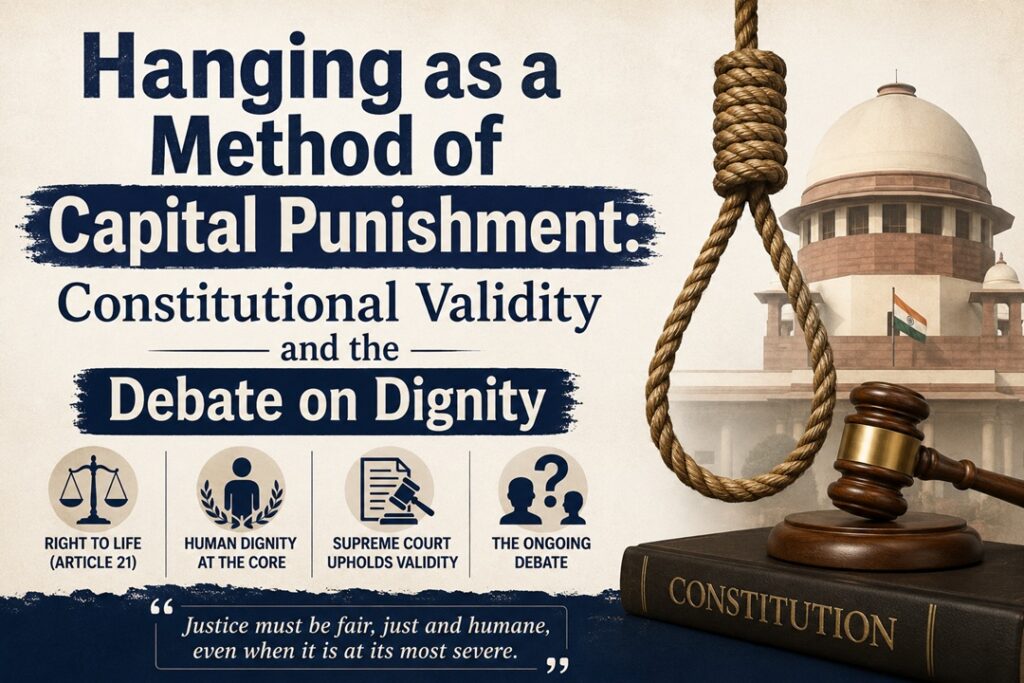
Hanging as a Method of Capital Punishment: Constitutional Validity and the Debate on Dignity
Context
The Supreme Court has recently upheld the constitutional validity of hanging as a method of carrying out the death penalty, while leaving open the possibility of reconsidering the method if future scientific or empirical evidence establishes that it violates constitutional standards of dignity.
Understanding Hanging as an Execution Method
- Hanging – It involves suspending a condemned person by the neck using a noose, with death resulting from the consequences of the suspension.
- Intended mechanism – The long-drop technique aims to cause severe cervical spine injury and rapid loss of consciousness.
- Long-drop technique – This is the method generally associated with executions in India and is designed to produce rapid incapacitation.
- Role of variables – The outcome can depend on factors such as drop length, body characteristics and accurate implementation of the prescribed procedure.
Constitutional Framework Governing Executions
- Article 21 – The Constitution protects the right to life and personal liberty.
- Judicial interpretation has expanded Article 21 to encompass the right to live and die with dignity within its broader constitutional framework.
- Constitutional safeguards do not disappear merely because a person has been sentenced to death.
- Prisoners awaiting execution must therefore be treated with humanity, dignity and procedural fairness.
- Although the death penalty may be constitutionally permissible, its execution must conform to standards that prevent unnecessary cruelty or degrading treatment.
- BNSS provision – The Bharatiya Nagarik Suraksha Sanhita provides that a person sentenced to death shall be “hanged by the neck till he is dead.”
- This provision substantially retains the wording and legal approach earlier contained in Section 354(5) of the CrPC, 1973, whose roots lie in colonial-era criminal procedure.
Historical Development of Capital Punishment by Hanging
- Colonial inheritance – Under British rule, hanging became the principal legally recognised method of civilian execution.
- The practice was incorporated into the criminal justice framework established during the colonial period.
- After Independence – India retained capital punishment, but its exercise became subject to constitutional scrutiny.
- Article 21 gradually shifted judicial attention from merely asking whether the State could impose death to examining how an execution must be carried out.
- Deena v. Union of India, 1983 – The Supreme Court upheld hanging as constitutionally valid after examining medical material, expert opinions and possible alternatives.
- The Court concluded that, when properly conducted, hanging could be considered sufficiently swift and not inherently barbaric.
- Gian Kaur v. State of Punjab, 1996 – The Court examined Article 21 in the context of dignity and death, strengthening the role of dignity in constitutional jurisprudence.
- Law Commission, 187th Report, 2003 – It proposed lethal injection as a possible alternative method of execution, but the recommendation was not implemented through legislation.
- Supreme Court ruling, 2026 – The Court declined to overturn the earlier Deena precedent, holding that the material before it did not establish that hanging had become constitutionally unacceptable.
- At the same time, the Court recognised that new scientific or empirical evidence could justify reconsideration in the future.
International Approaches to Executions
- Different jurisdictions employ different methods, and no single method is universally accepted as automatically satisfying the requirement of human dignity.
- Methods such as lethal injection, electrocution, lethal gas and shooting have each generated debates concerning pain, reliability, medical ethics and procedural safeguards.
- The central constitutional concern is therefore not simply the choice of method but whether its implementation satisfies standards of human dignity and non-cruelty.
Basis for the Supreme Court’s Decision
- Binding judicial precedent – In Deena, the Supreme Court had already examined hanging against constitutional and medical standards and upheld its validity.
- Absence of conclusive scientific material – The petitioners could not establish that subsequent evidence had fundamentally displaced the reasoning underlying Deena.
- Legislative continuity – Parliament retained hanging as the statutory method under the BNSS.
- No demonstrably superior substitute – The Court found that alternative methods had not been conclusively shown to provide a constitutionally superior solution.
BNSS Section 393(5): Where a person is sentenced to death, the sentence directs that the person be hanged by the neck until dead.
The provision broadly carries forward the statutory framework that existed under the earlier Code of Criminal Procedure.
Key Concerns That Remain
- Medical and scientific concerns – Questions remain regarding whether hanging consistently produces rapid unconsciousness without unnecessary suffering.
- Dignity and capital punishment – Even where the death penalty is constitutionally valid, the State has a duty to ensure that its implementation does not become cruel, degrading or unnecessarily painful.
- Colonial-era legacy – The continued use of a method inherited from colonial criminal law raises questions about its compatibility with contemporary constitutional morality.
- Limited empirical data – The relatively small number of executions in recent decades makes it difficult to develop extensive empirical evidence regarding the effectiveness and consequences of different methods.
- Psychological distress – Constitutional concerns extend beyond the execution itself to the prolonged uncertainty, anxiety and psychological suffering associated with death-row confinement.
- Alternatives are also debated – Replacing hanging with another method would not automatically eliminate concerns surrounding dignity, suffering or the possibility of procedural failure.
Measures Required Going Forward
- Periodic scientific assessment – Hanging should be reviewed regularly in light of contemporary medical, forensic and scientific evidence.
- Assessment of alternatives – The Union Government should examine whether alternative methods can provide greater reliability and stronger protection against unnecessary suffering.
- Evidence-based decision-making – Future policy should draw upon:
- Medical and scientific findings,
- Forensic research,
- International practices,
- Constitutional and human-rights standards.
- Improve procedural safeguards – Authorities must strictly comply with every legal and procedural requirement before an execution is carried out.
- Protect death-row prisoners – The dignity and mental well-being of prisoners must be protected throughout the period preceding execution.
- Legislative review – Parliament should periodically reassess the statutory method instead of allowing historical continuity alone to determine execution policy.
Way Forward
The Supreme Court’s decision does not necessarily bring the constitutional debate over hanging to an end. The judgment leaves room for future judicial reconsideration if credible medical, scientific or empirical evidence demonstrates that the method is inconsistent with the constitutional guarantee of dignity.
Source : The Indian Express