
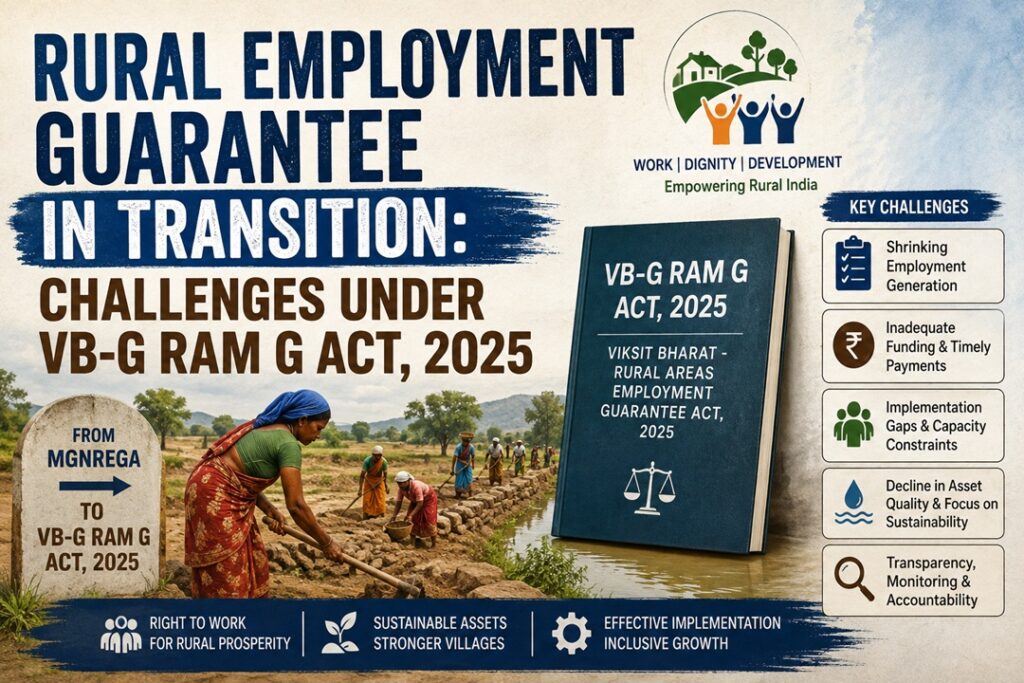
Rural Employment Guarantee in Transition: Challenges Under VB-G RAM G Act, 2025
Context
Economist Jean Drèze has pointed to a marked decline in rural employment generation during the shift from the repealed Mahatma Gandhi National Rural Employment Guarantee Act (MGNREGA), 2005 to the Viksit Bharat–Guarantee for Rozgar and Ajeevika Mission (Gramin) (VB-G RAM G) Act, 2025.
Understanding the Employment Slowdown
- The term refers to the administrative uncertainty, procedural delays, and reduced availability of rural employment witnessed during the transition from MGNREGA to the new legislation.
- Although the statutory employment guarantee has increased from 100 to 125 days per household, delays in operationalising rules, the introduction of state-wise funding ceilings, and additional compliance requirements have disrupted rural job creation.
- The transition has therefore created a gap between the legal expansion of the employment guarantee and its actual implementation on the ground.
Latest Trends in Rural Job Creation
- Fall in Person-Days: Between April and July 2026, rural employment generation stood at around 70 crore person-days, nearly 43% lower than the average recorded in 2024–25 and 2025–26.
- Weak July Performance: Employment generation in July 2026 remained at only 8.3–9 crore person-days, representing a decline of more than 40% from July 2025.
- Impact on Vulnerable States: In 10 of 19 major states, including Uttar Pradesh, Madhya Pradesh and Jharkhand, employment generation fell by 60%–85%.
- Mismatch Between Allocation and Implementation: The Union Budget 2026–27 provided ₹95,692 crore for VB-G RAM G, with the overall projected expenditure reaching around ₹1.5 lakh crore after including the states’ contribution. Despite this, actual work generation remained subdued.
MGNREGA and VB-G RAM G: Major Changes
| Aspect | MGNREGA, 2005 (Repealed) | VB-G RAM G Act, 2025 (Current) |
|---|---|---|
| Employment Entitlement | 100 days of unskilled manual employment per rural household. | 125 days of unskilled manual employment per rural household. |
| Funding Pattern | Demand-driven framework, with the Centre bearing 100% of unskilled wage expenditure. | Centrally Sponsored Scheme, with a 60:40 Centre-State ratio for general states and 90:10 for Himalayan and North-Eastern states. |
| Expenditure Framework | No fixed overall ceiling; expenditure responded to actual demand for work. | Normative allocations establish predetermined expenditure limits for states. |
| Planning Approach | Bottom-up planning through Gram Sabha-approved works. | Links Viksit Gram Panchayat Plans with a National Rural Infrastructure Stack. |
| Seasonal Provision | Employment could be generated throughout the year based on demand. | Allows a work suspension of up to 60 days during peak agricultural seasons. |
Why Has the Transition Created Difficulties?
- Delay in Operational Rules: The legislation was enacted in December 2025, but draft rules emerged only in late May 2026 and were finalised at the end of June.
- Higher Financial Responsibility for States: The 60:40 funding arrangement shifted a larger share of the financial burden onto state governments.
- Digital and Authentication Challenges: Facial recognition, biometric requirements and digital muster rolls can create difficulties in areas with weak connectivity.
- Shift from Demand-Based Financing: Normative allocations may discourage local administrations from opening additional works after spending limits are approached.
- Timing of the Disruption: The transition coincided with the summer period when demand for rural employment is traditionally high.
Measures Needed to Strengthen Implementation
- Ensure Timely Fund Flow: Establish mechanisms such as revolving funds to facilitate uninterrupted wage payments.
- Provide Offline Alternatives: Develop reliable offline verification and non-biometric alternatives to prevent technology-related exclusion.
- Retain Demand Responsiveness: Treat normative allocations as planning estimates rather than rigid expenditure ceilings during periods of high unemployment.
- Improve Panchayat Capacity: Strengthen the technical, digital and administrative capabilities of Gram Panchayats.
- Strengthen Accountability: Conduct regular social audits and ensure effective grievance-redressal mechanisms.
Conclusion
The VB-G RAM G Act, 2025 seeks to expand the rural employment guarantee while linking it with broader rural infrastructure and development objectives. However, implementation delays, funding constraints and technological requirements have contributed to a sharp decline in employment generation. Predictable financing, flexible implementation and an effective demand-based mechanism are essential to preserve the rural employment guarantee as a dependable social safety net.
Source : The Hindu