
Climate-Resilient Food Security in India
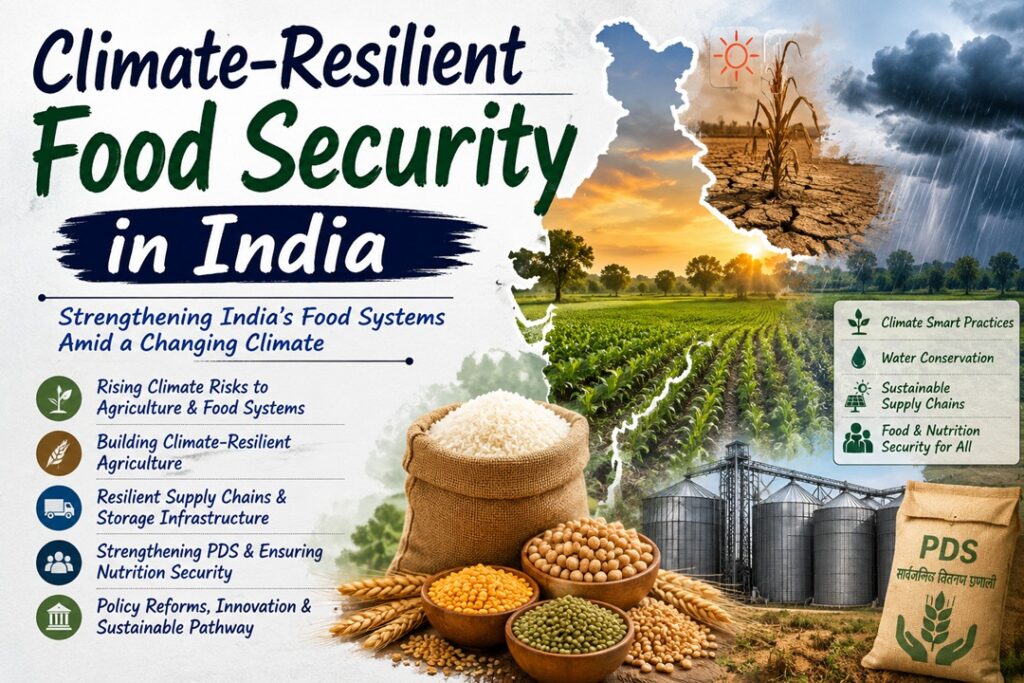
Context
India has made major progress in food production and maintains substantial foodgrain stocks. However, rising temperatures, erratic rainfall, extreme weather events, groundwater stress and post-harvest losses are creating new vulnerabilities across the food system. The challenge now is to move from conventional food security towards a climate-resilient and nutrition-sensitive food system.
Climate-Proofing India’s Food System
Understanding Climate-Proofing of Food Security
What Does Climate-Proofing Food Security Mean?
- Climate-proofing the food system means redesigning agricultural production, procurement, storage, transportation and food distribution so that they remain functional despite climate shocks.
- The focus must shift from merely ensuring sufficient calorie availability towards sustainable food and nutrition security.
- It involves:
- Climate-resilient crop varieties
- Crop diversification
- Water-efficient agriculture
- Climate-smart procurement
- Resilient storage and logistics
- Weather-based agricultural planning
- Nutrition-oriented PDS reforms
- The approach can strengthen implementation of the National Food Security Act (NFSA), 2013 by making food-security systems more responsive to climate risks.
India’s Current Food-Security Position
- Record Foodgrain Production: India produced a record 357.73 million tonnes of foodgrains in 2024–25, compared with 332.30 million tonnes in 2023–24.
- Major Crop Output: 2024–25 production included about 150.18 million tonnes of rice, 117.94 million tonnes of wheat and 25.68 million tonnes of pulses.
- Large Food-Security Network: Under NFSA, subsidised foodgrains are provided to approximately 81.35 crore beneficiaries.
- Digitalised PDS: One Nation One Ration Card (ONORC) is operational across all 36 States and Union Territories, while more than 99% of Fair Price Shops have ePoS devices.
- Storage Capacity: FCI and State agencies have substantial covered and CAP storage capacity for central-pool grains, alongside thousands of cold-storage facilities for perishables.
Major Climate Risks to the Food Chain
1. Rising Heat and Crop Productivity
- Increasing temperatures can adversely affect crop growth, particularly during sensitive stages of wheat and other rabi crops.
- Heatwaves can reduce grain filling, productivity and crop quality.
- Unseasonal rainfall following heat events can further damage standing crops.
2. Unpredictable Monsoon Patterns
- Indian agriculture remains significantly dependent on the monsoon.
- Longer dry spells followed by intense rainfall can cause:
- Crop failures
- Soil erosion
- Waterlogging
- Flood damage
- Disruption of sowing and harvesting cycles.
3. Groundwater Stress
- Excessive dependence on groundwater for irrigation creates long-term sustainability concerns.
- Water-intensive crops such as paddy can intensify pressure on aquifers in already water-stressed regions.
- Climate change can worsen the mismatch between water availability and agricultural demand.
4. Storage and Post-Harvest Vulnerabilities
- Extreme heat and humidity can accelerate:
- Grain deterioration
- Pest infestation
- Fungal growth
- Quality losses.
- Floods and extreme rainfall can damage warehouses and transport infrastructure.
- Climate-resilient storage is therefore essential for maintaining buffer stocks.
5. Cold-Chain Gaps
- Fruits, vegetables, dairy and other perishables are particularly vulnerable to high temperatures.
- Insufficient refrigerated transportation and cold-storage facilities can increase post-harvest losses.
- Strengthening cold chains can simultaneously improve farmer incomes, food availability and price stability.
6. Nutrition Security Challenges
- Food security cannot be measured only by the availability of rice and wheat.
- A cereal-heavy food basket may provide adequate calories without ensuring sufficient:
- Protein
- Vitamins
- Minerals
- Micronutrients.
- Greater inclusion of pulses, millets, oilseeds, fruits and vegetables is therefore important.
Major Components of a Climate-Resilient Food System
Crop Diversification and Decentralised Procurement
- Procurement should gradually expand beyond the traditional rice-wheat concentration.
- Greater support can be provided to:
- Millets
- Pulses
- Oilseeds
- Drought-tolerant crops
- Region-specific climate-resilient varieties.
- This can reduce ecological pressure while improving dietary diversity.
Making the PDS More Nutrition-Oriented
- Nutri-cereals and pulses can be incorporated more systematically into the food basket.
- Local procurement can link farmers with:
- PDS
- PM POSHAN
- Anganwadi services.
- This can improve both local agricultural resilience and nutritional outcomes.
Climate-Resilient Storage Infrastructure
- Expand modern silos and scientific warehouses.
- Develop flood-resistant storage facilities.
- Improve temperature and humidity management.
- Promote decentralised storage through institutions such as Primary Agricultural Credit Societies (PACS).
Strengthening Cold Chains
- Expand refrigerated transportation.
- Establish integrated farm-to-market cold chains.
- Improve rural pre-cooling and cold-storage facilities.
- Encourage renewable-energy-powered cold storage where feasible.
Climate-Based Agricultural Planning
- Weather forecasts should directly inform:
- Sowing decisions
- Procurement targets
- Buffer-stock management
- Crop insurance
- District-level contingency plans.
- Greater integration of IMD forecasts with agricultural decision-making can reduce climate-related losses.
Water-Smart Agriculture
- Expand:
- Drip irrigation
- Sprinkler irrigation
- Rainwater harvesting
- Watershed development
- Soil-moisture conservation.
- Encourage less water-intensive crops in groundwater-stressed regions.
- Promote efficient irrigation rather than simply increasing irrigation coverage.
Climate-Resilient Seeds and Technology
- Increase investment in varieties that are:
- Heat tolerant
- Drought resistant
- Flood tolerant
- Pest resistant
- Nutritionally enhanced.
- Strengthen cooperation among ICAR, agricultural universities, startups and private research institutions.
Role of Crop Insurance
- Climate change increases the frequency and unpredictability of crop losses.
- Weather-indexed and technology-enabled insurance can provide faster compensation.
- PM Fasal Bima Yojana can be strengthened through:
- Better weather data
- Remote sensing
- Faster loss assessment
- Transparent claim settlement.
- Insurance should complement, rather than replace, investments in climate adaptation.
Creating a “Climate Buffer”
Traditional food-security policy largely focuses on maintaining adequate grain stocks.
India could develop a broader Climate Buffer comprising:
- Multi-crop food reserves
- Strategic pulses and oilseed stocks
- Crop insurance
- Water reserves and watershed systems
- Climate-resilient storage
- Emergency logistics capacity
- District-level agricultural contingency plans.
This would allow India to respond not only to food shortages but also to climate-induced disruptions across the food supply chain.
Linking Food Security with Climate Goals
Agriculture must simultaneously address food security and environmental sustainability.
Low-Emission Farming
- Promote Alternate Wetting and Drying (AWD) in rice cultivation to reduce methane emissions and water use.
- Encourage Direct Seeded Rice (DSR) where agro-climatic conditions permit.
- Expand conservation agriculture and efficient fertiliser use.
- Promote renewable energy for irrigation and cold storage.
Sustainable Procurement
- Government procurement can become an instrument for encouraging climate-resilient crops.
- Procurement incentives should increasingly reflect:
- Water efficiency
- Nutritional value
- Climate resilience
- Local suitability.
Key Policy Reforms Required
1. Climate-Sensitive NFSA Monitoring
NFSA implementation should monitor not only the quantity of food distributed but also:
- Dietary diversity
- Climate exposure
- Water sustainability
- Storage resilience
- Nutritional outcomes.
2. Diversify the Public Food Basket
The PDS should gradually become more representative of India’s diverse food systems instead of remaining heavily dependent on a limited number of cereals.
3. Increase Adaptation Finance
Greater public and private investment is required for:
- Micro-irrigation
- Climate-resilient seeds
- Solar cold chains
- Modern warehouses
- Watershed development
- Climate information systems.
4. Strengthen Local Food Systems
Decentralised procurement and storage can:
- Reduce transportation distances
- Lower supply-chain vulnerabilities
- Support local farmers
- Improve regional food availability.
5. Integrate Technology
Satellite imagery, AI, remote sensing, weather models and digital agricultural platforms can improve:
- Crop monitoring
- Yield forecasting
- Disaster assessment
- Procurement planning
- Insurance claims
- Food-stock management.
Challenges
- Rice-wheat procurement dependence can discourage diversification.
- MSP and procurement incentives may not sufficiently favour climate-resilient crops.
- Small and fragmented landholdings can make adoption of advanced technologies difficult.
- High adaptation costs can limit farmers’ capacity to invest.
- Cold-chain and storage gaps remain significant in several regions.
- Institutional coordination between agriculture, food, water, environment and disaster-management agencies needs improvement.
- Nutrition and food-security policies are often implemented separately rather than as an integrated system.
Way Forward
- Move from cereal-centric to diversified procurement.
- Integrate climate forecasts into agricultural and PDS decision-making.
- Expand climate-resilient storage and cold-chain infrastructure.
- Promote water-efficient and low-emission farming.
- Strengthen climate-resilient seeds and agricultural R&D.
- Create a comprehensive Climate Buffer combining food stocks, insurance, water management and resilient infrastructure.
- Make the PDS increasingly nutrition-sensitive and locally responsive.
- Mobilise dedicated adaptation finance for farmers and rural infrastructure.
Conclusion
India must move from conventional food security towards climate-resilient nutrition security. Diversified crops, efficient water use, resilient infrastructure and climate-smart PDS reforms can strengthen food security while protecting farmer livelihoods.
Source : The Hindu