
Ancient Buddhist Site of Sarnath: India’s 45th UNESCO World Heritage Property
Context
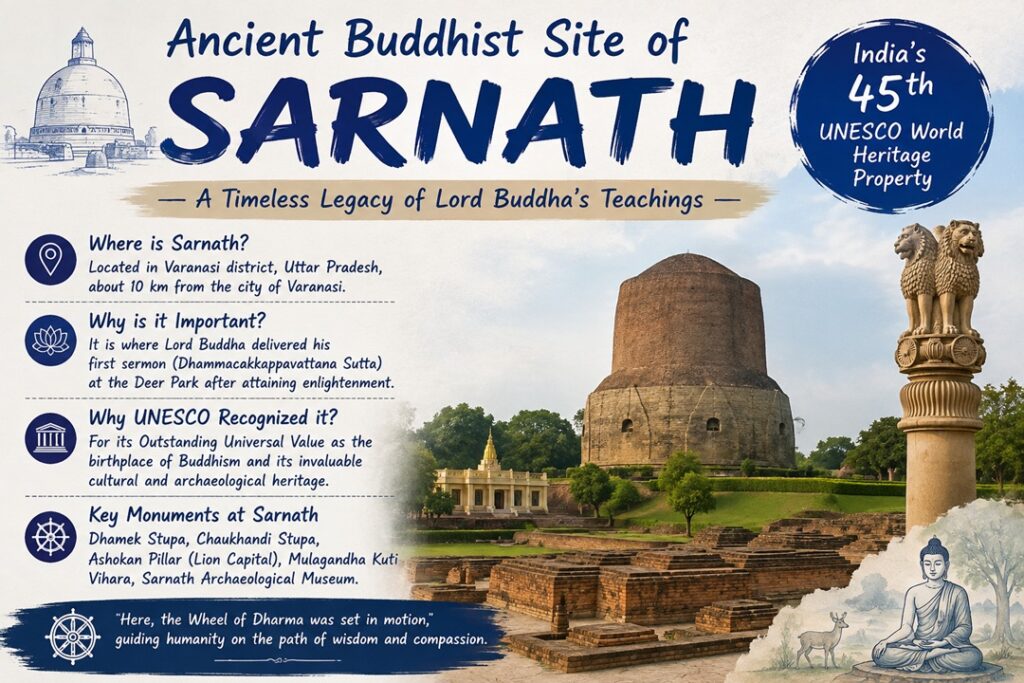
The Ancient Buddhist Site of Sarnath has been inscribed on the UNESCO World Heritage List during the 48th Session of the World Heritage Committee in Busan, South Korea. The inscription makes Sarnath India’s 45th World Heritage property and further strengthens the global recognition of India’s Buddhist and civilisational heritage.
What is the Ancient Buddhist Site of Sarnath?
- Sarnath is located in Varanasi, Uttar Pradesh, and is one of the four principal Buddhist pilgrimage destinations associated with the life of Gautama Buddha.
- Sarnath was known as Rishipatana, Ishipatana and Mrigadava (Deer Park) in ancient Buddhist traditions.
- Gautama Buddha delivered his first sermon at Sarnath in the 6th century BCE, after attaining enlightenment at Bodh Gaya.
- Buddha met his first five disciples at Sarnath and initiated them into his teachings.
- His first discourse is known as Dharmachakra Pravartana, meaning the “Turning of the Wheel of the Law.”
- The event marked the beginning of the organised propagation of Buddha’s teachings and is associated with the emergence of the Buddhist Sangha.
- Sarnath is also closely associated with the Buddhist concept of the Three Jewels — Buddha, Dharma and Sangha.
How did Sarnath develop as a Buddhist centre?
- Long Historical Evolution – Sarnath developed over nearly sixteen centuries, supported by rulers, monks and devotees.
- Architectural Expansion – Several stupas, monasteries, temples and viharas were constructed and reconstructed over different periods.
- Historical Layers – Archaeological remains represent different phases from the pre-Mauryan period to the 12th century CE.
- Mauryan Contribution – Emperor Ashoka played an important role in developing Sarnath as a major Buddhist centre.
- Gupta Period – The site experienced considerable artistic and architectural development during the Gupta era.
- Decline – Sarnath gradually declined as a major Buddhist centre around the 12th century CE.
- Rediscovery – The archaeological remains were rediscovered and systematically explored in the modern period.
What does the UNESCO World Heritage property include?
The UNESCO property comprises two connected components:
1. Chaukhandi Stupa
- It is one of the principal monuments associated with Sarnath.
- The structure has a distinctive octagonal tower added during a later period.
- It is traditionally associated with the place where Buddha met his five former companions.
2. Archaeological Remains of Sarnath
The archaeological complex contains:
- Dhamek Stupa
- Dharmarajika Stupa
- Mulagandhakuti Vihara
- Ashokan Pillar
- Monastic remains
- Ancient temples
- Votive stupas
- Other archaeological structures
Why is Sarnath significant to Buddhism?
Centre of Buddha’s Teachings
Sarnath represents the place where Buddha formally began communicating his teachings after attaining enlightenment.
Beginning of the Buddhist Sangha
The first sermon and initiation of Buddha’s disciples are traditionally associated with the beginning of the Buddhist monastic community.
Symbol of the Dharma
The Dharmachakra, or Wheel of Dharma, represents the spread of Buddha’s teachings and is strongly associated with Sarnath.
Global Pilgrimage Destination
Sarnath attracts Buddhist pilgrims and visitors from Japan, Thailand, Sri Lanka, Myanmar, Vietnam, South Korea, Cambodia, Mongolia and other Buddhist communities across the world.
What UNESCO criteria were used to recognise Sarnath?
Sarnath was inscribed under UNESCO criteria (iii) and (vi).
Criterion (iii): Testimony to a Cultural Tradition
- Sarnath provides exceptional evidence of the development and continuation of Buddhist traditions.
- Its monuments demonstrate the site’s enduring importance as a centre of Buddhist pilgrimage.
Criterion (vi): Association with Events of Universal Significance
- Sarnath has a direct association with Gautama Buddha’s first sermon.
- It is connected with Buddha’s first disciples and the dissemination of his teachings.
- The site reflects important Buddhist concepts such as Dharma, Sangha and Triratna.
How did Sarnath achieve UNESCO World Heritage status?
Tentative List
Sarnath was included in India’s UNESCO Tentative List in 1998.
Nomination Process
India prepared and submitted the formal nomination for consideration by the World Heritage Committee.
Expert Evaluation
The nomination underwent detailed technical assessment involving UNESCO’s advisory mechanisms and an ICOMOS evaluation mission.
Final Inscription
The process culminated in the 48th Session of the World Heritage Committee in Busan, South Korea, where Sarnath was inscribed on the World Heritage List.
What is the importance of UNESCO recognition?
International Recognition
The inscription gives Sarnath greater international recognition as a site of outstanding cultural and spiritual value.
Buddhist Cultural Diplomacy
It strengthens India’s cultural engagement with Buddhist-majority and Buddhist-influenced countries.
Heritage Conservation
World Heritage recognition can strengthen efforts towards scientific conservation, documentation and sustainable management.
Tourism Promotion
The status can further encourage heritage and Buddhist tourism, generating opportunities for local communities.
Global Buddhist Heritage Network
Sarnath joins an international network of important Buddhist heritage sites across Asia.
What are the four principal Buddhist pilgrimage sites?
| Site | Major Association | Location |
|---|---|---|
| Lumbini | Birth of Buddha | Nepal |
| Bodh Gaya | Enlightenment | Bihar, India |
| Sarnath | First Sermon | Uttar Pradesh, India |
| Kushinagar | Mahaparinirvana | Uttar Pradesh, India |
Sarnath is particularly significant as the site where Buddha first publicly preached his Dharma.
How is Sarnath connected with other Buddhist World Heritage sites?
India already has several important Buddhist heritage properties, including:
- Buddhist Monuments at Sanchi
- Archaeological Site of Nalanda Mahavihara
- Ajanta Caves
Other important Buddhist heritage sites in South Asia include:
- Lumbini – Nepal
- Anuradhapura – Sri Lanka
- Paharpur – Bangladesh
- Taxila – Pakistan
- Takht-i-Bahi – Pakistan
Together, these sites demonstrate the historical spread of Buddhism across South and Southeast Asia.
UNESCO: Protecting Global Heritage
- Full Name – United Nations Educational, Scientific and Cultural Organization.
- Established – 1945.
- Purpose – Promotes international cooperation in education, science, culture and communication.
- World Heritage Role – UNESCO identifies and supports the protection of cultural and natural properties possessing Outstanding Universal Value.
- Legal Framework – Its World Heritage programme operates under the 1972 World Heritage Convention.
- World Heritage Convention – It provides an international framework for identifying, protecting and preserving important cultural and natural heritage.
- World Heritage List – As of July 2026, the list contained 1,273 properties across 173 countries, including cultural, natural and mixed properties.
How has India’s World Heritage portfolio expanded?
Current Position
Following the inscription of Sarnath, India has 45 UNESCO World Heritage properties, consisting of:
- 37 Cultural sites
- 7 Natural sites
- 1 Mixed site
India ranks sixth globally and second in the Asia-Pacific region in terms of the number of World Heritage properties.
India’s First World Heritage Entries
India’s first World Heritage inscriptions came in 1983, including:
- Agra Fort
- Ajanta Caves
- Ellora Caves
- Taj Mahal
Recent Expansion
- Maratha Military Landscapes – Inscribed in 2024.
- Ancient Buddhist Site of Sarnath – Added subsequently, taking India’s total to 45.
Future Prospects
India’s Tentative List contains 69 properties, creating a substantial pipeline for future World Heritage nominations.
Government Measures for Heritage Conservation
1. Adopt a Heritage Programme
- Launched – 2017 and revamped in 2023.
- Partnership Model – Encourages participation of private organisations, PSUs, NGOs, trusts and other stakeholders.
- Objective – Improve visitor amenities at centrally protected monuments.
- Funding Support – CSR and other contributions support conservation-related visitor facilities.
2. Gyan Bharatam Mission
- Launched – 2025.
- Objective – Preserve, digitise and disseminate India’s manuscript heritage.
- Focus – Protecting manuscripts that document India’s ancient knowledge systems.
- Technology Use – Digital technologies and conservation networks are being used to safeguard fragile manuscripts and improve accessibility.
National Manuscript Survey 2026
- Seeks to identify and document manuscripts across the country.
- Aims to develop a comprehensive national manuscript database.
3. National Mission on Monuments and Antiquities
- Implementation – Archaeological Survey of India.
- Objective – Develop a comprehensive database of India’s built heritage and antiquities.
- Importance – Documentation and inventory creation help in conservation planning, prioritisation and monitoring.
4. Repatriation of Antiquities
- India has intensified efforts to bring back cultural objects taken abroad.
- 669 antiquities have been recovered, including 656 since 2014.
- Important returned artefacts include the Chola-period Shiva Nataraja, Saint Sundarar with Paravai and Somaskanda.
What challenges remain in protecting Sarnath?
Tourism Pressure
Growing visitor numbers need to be managed carefully to prevent damage to archaeological structures.
Preserving the Sacred Landscape
Conservation should extend beyond individual monuments to the broader historic and sacred landscape of Sarnath.
Balancing Conservation and Pilgrimage
The site has both archaeological and living religious importance, requiring a balance between heritage protection and pilgrimage activities.
Community Participation
Local communities and Buddhist stakeholders should have a greater role in heritage management and interpretation.
Sustainable Development
Tourism infrastructure should be developed without compromising the authenticity and integrity of the heritage property.
What should be the way forward?
- Adopt an integrated landscape-based conservation strategy.
- Strengthen scientific monitoring and documentation of monuments.
- Promote sustainable and responsible tourism.
- Increase participation of Buddhist communities and local stakeholders.
- Use digital technologies for preservation, interpretation and visitor education.
- Strengthen connections among Sarnath, Bodh Gaya, Kushinagar and other Buddhist heritage sites.
- Use Buddhist heritage as an avenue for cultural diplomacy and international cooperation.
Conclusion
The UNESCO recognition of Sarnath is a significant milestone in India’s heritage conservation journey. It acknowledges both the site’s archaeological importance and its continuing spiritual relevance, while offering India an opportunity to strengthen heritage conservation, sustainable tourism and Buddhist cultural diplomacy.
Source : PIB