
India’s Renewed Engagement with Central Asia
Context
Prime Minister of India is undertaking a state visit to Uzbekistan, followed by participation in the Shanghai Cooperation Organization (SCO) Heads of State Summit in Bishkek, Kyrgyzstan. The visit highlights India’s efforts to deepen strategic, economic and cultural engagement with the Central Asian region.
India’s Central Asian Policy: An Overview
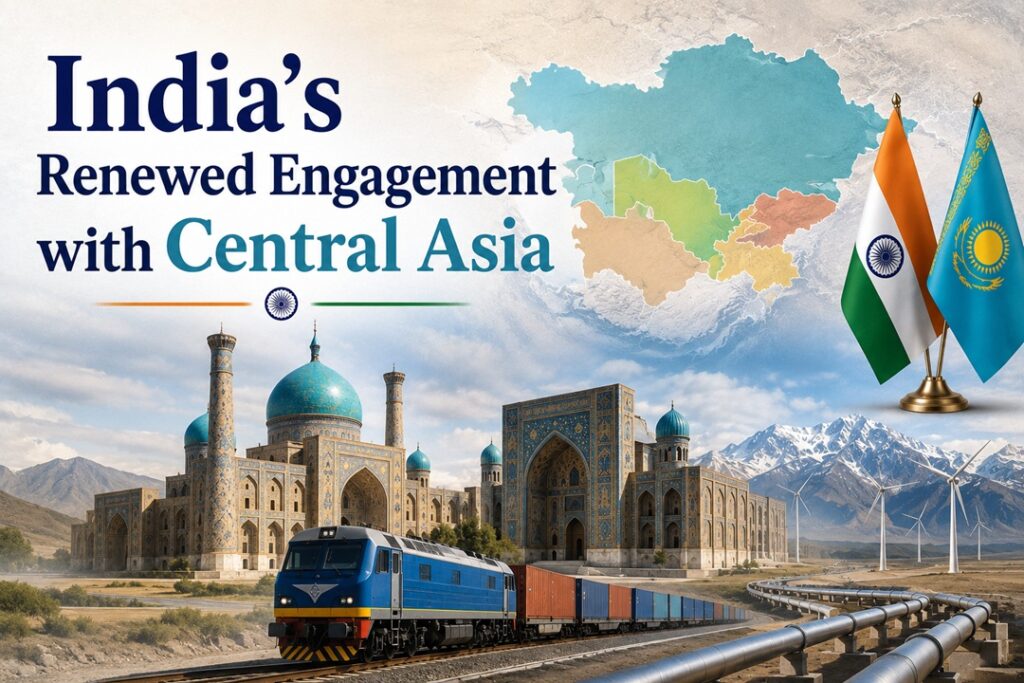
- India’s Central Asian approach seeks to strengthen relations with the five post-Soviet republics — Kazakhstan, Kyrgyzstan, Tajikistan, Turkmenistan and Uzbekistan — as an important component of its extended neighbourhood policy.
- The engagement combines historical and civilizational linkages with contemporary priorities such as regional security, counter-terrorism, energy security, critical minerals and connectivity.
- India also seeks to diversify partnerships in Central Asia amid growing Chinese economic influence and changing Russian engagement with the region.
Why Central Asia Matters to India?
1. Eurasian Strategic Significance
- Central Asia occupies a pivotal position at the crossroads of Europe, Russia, China, South Asia and the Middle East.
- Its proximity to India through Afghanistan’s Wakhan Corridor gives the region considerable strategic importance for India’s northern security interests.
- Stability in Central Asia is therefore closely linked to India’s wider continental security environment.
2. Regional Security and Counter-Terrorism
- Central Asian countries have generally adopted strong positions against terrorism, extremism and radicalisation.
- Cooperation with these states helps India address security threats emanating from Afghanistan and prevent extremist networks from gaining greater regional reach.
- Platforms such as the SCO provide opportunities for intelligence cooperation, counter-terrorism exercises and coordinated responses to emerging security threats.
3. Energy and Strategic Minerals
- Central Asia possesses substantial reserves of hydrocarbons, uranium and other strategic resources.
- Kazakhstan is an important supplier of uranium for India’s civilian nuclear energy programme.
- The region’s deposits of lithium, rare earth elements and other critical minerals can support India’s clean-energy transition, electronics manufacturing and strategic industries.
4. Balancing Major-Power Influence
- China has expanded its economic and infrastructure presence through the Belt and Road Initiative (BRI).
- Russia remains an important political, security and historical partner, although its regional influence is evolving.
- Central Asian countries themselves are seeking diversified partnerships, creating space for India to emerge as a reliable development and strategic partner.
Major Areas of India’s Partnership
1. Multilateral and Regional Cooperation
- India utilises the SCO and India-Central Asia Dialogue to advance cooperation in security, connectivity, trade and development.
- These platforms allow India to engage simultaneously with all five Central Asian republics.
- India’s participation also strengthens its role in wider Eurasian diplomacy.
2. Strengthening Ties with Uzbekistan
- Uzbekistan has emerged as an important partner in India’s Central Asian outreach.
- Cooperation covers counter-terrorism, pharmaceuticals, digital technologies, education, healthcare and scientific research.
- Defence cooperation, including joint military exercises such as Dustlik, provides an additional strategic dimension.
3. Building Alternative Connectivity Routes
- Pakistan’s refusal to provide India overland transit creates a major connectivity constraint.
- India is therefore promoting alternative routes through Iran, particularly the Chabahar Port and International North-South Transport Corridor (INSTC).
- Such corridors can connect India with Central Asian markets while reducing dependence on routes passing through Pakistan.
4. Cultural and Human-Centric Diplomacy
- India enjoys deep historical connections with Central Asia through the Silk Road, Buddhism, Sufism, languages, art and architecture.
- Contemporary links have expanded through Indian education, healthcare, pharmaceuticals, information technology and skill development.
- These people-to-people connections provide a strong foundation for India’s wider diplomatic engagement.
Obstacles to India’s Central Asian Strategy
1. Limited Direct Connectivity
- The absence of direct land access through Pakistan remains one of the biggest barriers to India-Central Asia trade.
- Dependence on multimodal sea-land routes increases transportation time and logistics costs.
2. China’s Strong Economic Footprint
- China has a substantially larger trade and investment presence across Central Asia.
- Its infrastructure projects, transport networks and BRI investments give Chinese companies significant economic advantages.
- Indian businesses therefore face difficulties in competing on scale and financing.
3. Instability in Afghanistan
- Political uncertainty in Afghanistan, terrorism, narcotics trafficking and militant networks continue to pose security risks.
- Any deterioration in Afghanistan can have spillover effects on Central Asian stability and India’s regional interests.
4. Low Trade and Investment
- India-Central Asia economic exchanges remain below their potential.
- High logistics costs, limited banking connectivity, inadequate cargo links and payment-related difficulties restrict commercial expansion.
5. Regional Resource and Border Disputes
- Historical border disagreements, ethnic enclaves and competition over water resources can complicate regional cooperation.
- Disputes involving the Amu Darya and Syr Darya river systems remain important challenges for regional integration.
Measures to Deepen India’s Regional Footprint
1. Make Connectivity Projects More Effective
- Accelerate the operationalisation of Chabahar Port and improve its integration with the INSTC.
- Strengthen multimodal rail, road and maritime links connecting India with Central Asian markets.
- Greater utilisation of the Ashgabat Agreement can further facilitate regional transit.
2. Develop Air and Digital Connectivity
- Establish dedicated air-cargo routes between India and Central Asian economies.
- Expand cooperation in digital public infrastructure, digital payments, telemedicine and e-governance.
- India’s digital solutions can become an important instrument of development diplomacy.
3. Create Strategic Mineral Partnerships
- Develop joint ventures for exploration, mining, processing and supply-chain management of critical minerals.
- Focus particularly on lithium, rare earth elements and other minerals required for batteries, renewable energy and advanced manufacturing.
4. Expand Defence and Intelligence Cooperation
- Increase joint military exercises and defence exchanges with Central Asian partners.
- Strengthen intelligence cooperation through SCO mechanisms, particularly the Regional Anti-Terrorist Structure (RATS).
- Cooperation should also cover cyber threats, drug trafficking and emerging non-traditional security challenges.
5. Invest in Human Capital and Cultural Links
- Expand Indian Technical and Economic Cooperation (ITEC) programmes and scholarships.
- Encourage greater academic partnerships between Indian and Central Asian universities.
- Facilitate tourism, student mobility, healthcare access and professional exchanges.
Conclusion
India’s renewed engagement with Central Asia is important for strengthening its Eurasian strategic presence. The priority now should be to convert historical goodwill into better connectivity, stronger trade, critical-mineral partnerships and deeper security cooperation. A sustained and multi-dimensional approach can position India as a trusted partner in Central Asia while advancing its wider continental interests.
Source : The Hindu