
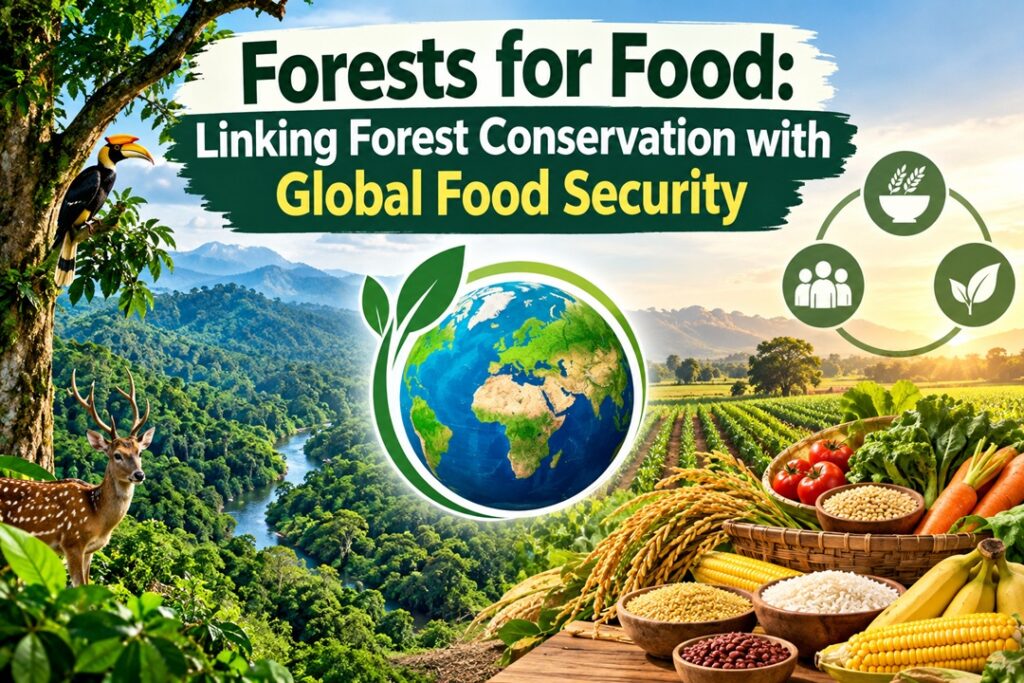
Forests for Food: Linking Forest Conservation with Global Food Security
Context
The FAO, in collaboration with CIFOR-ICRAF under the Collaborative Partnership on Forests, has highlighted through its report Forests for Food: Nourishing People, Sustaining the Planet that forests are closely connected with food security, nutrition, livelihoods and agricultural productivity. The report seeks to address the often-overlooked contribution of wild foods and forest ecosystems to global food systems.
More than 5 billion people depend on forests to some extent for their livelihoods, making forest conservation an important component of both environmental sustainability and food security.
Forests as Pillars of Food Security
The report examines the relationship between forests and the four dimensions of food security and nutrition—availability, access, utilization and stability.
- Livelihoods: Forests contribute substantially to rural incomes, generating up to 20% of household income in some developing regions.
- Food diversity: More than 50,000 wild species are used globally, including at least 10,000 species directly consumed as food.
- Nutrition: In some remote forest-dependent communities, wild foods provide up to 80% of daily dietary protein and almost half of consumed food by weight.
- Energy and water safety: Around 1.8 billion people primarily depended on woodfuel for cooking in 2022, while about 410 million relied mainly on wood energy to boil or sterilize drinking water.
- Agricultural productivity: Forests provide habitats for pollinators supporting around 35% of global crop production, while forested watersheds supply freshwater to more than 85% of major cities.
- Rainfall regulation: Agricultural regions in 155 countries can depend on forests in other countries for as much as 40% of annual rainfall through atmospheric moisture recycling.
- Healthcare: More than 1 billion people use forest-derived medicinal plants for primary healthcare, indirectly contributing to nutritional well-being by preventing or treating diseases that affect nutrient absorption.
Thus, forests support food systems not only through direct food provision but also through water regulation, pollination, climate moderation, energy supply and healthcare.
Forest Foods and Vulnerable Communities
Wild meat, freshwater fish, fruits, nuts, leaves and other forest products can act as important nutritional buffers for poor and remote households. They provide proteins and micronutrients such as iron, zinc and vitamin B12 without necessarily requiring the purchasing power associated with commercial food products.
Evidence from India, Africa and the Amazon also indicates that children living in landscapes with greater forest cover can have greater dietary diversity and lower incidences of stunting and wasting.
Community-led conservation provides another important pathway. For instance, the recovery of giant arapaima populations in protected Amazonian lakes demonstrates how combining local knowledge with resource management can simultaneously improve conservation outcomes, incomes and household nutrition.
Forests under Growing Pressure
Despite their importance, forests continue to face substantial degradation.
Between 2015 and 2025, approximately 10.9 million hectares of forest were deforested annually, with agricultural expansion, insecure tenure and commodity production among the major pressures.
At the same time, global net forest loss has slowed—from about 10.7 million hectares annually during 1990–2000 to 4.12 million hectares during 2015–2025, partly reflecting afforestation and restoration efforts.
This creates a fundamental policy contradiction: agricultural expansion can destroy ecosystems that are themselves essential for sustaining agricultural productivity.
Major Challenges
1. Forest foods remain statistically invisible
Wild-food collection is frequently informal and therefore poorly captured in national databases. The absence of common definitions and classifications makes it difficult to measure its contribution to food security and rural economies.
2. Agricultural conversion
Commercial crop cultivation and livestock production account for a major share of tropical deforestation. Forest loss consequently threatens biodiversity, soil quality, water availability and climate resilience.
3. Weak tenure rights
Indigenous and customary communities often lack secure legal recognition of their rights over forests and natural resources. This can increase their vulnerability to displacement by commercial concessions.
4. Unsustainable harvesting
Growing urban demand and improved harvesting technologies can encourage excessive extraction of wild meat and other forest products, threatening wildlife populations and long-term food availability.
5. Food safety and zoonotic risks
Deforestation, wildlife exploitation and poorly regulated animal-product supply chains can increase human–animal contact and potentially facilitate zoonotic disease transmission. This makes forest-food governance a One Health concern involving human, animal and ecosystem health.
Way Forward
- Integrate forests into food policy: Forest foods, agroforestry and non-wood forest products should be incorporated into agricultural, nutrition, school-feeding and rural-development programmes.
- Strengthen community tenure: Secure legal recognition of indigenous and community rights can improve both livelihoods and incentives for sustainable forest management.
- Improve data systems: National surveys and statistical frameworks should systematically record wild-food consumption, nutritional value and economic contributions.
- Promote agroforestry: Combining trees with crops and livestock can improve soil health, regulate microclimates, strengthen biodiversity and increase resilience to climate extremes.
- Adopt One Health safeguards: Sustainable harvest limits, veterinary surveillance, hygienic processing and monitoring of wildlife supply chains can reduce food-safety and zoonotic risks.
- Strengthen landscape-level planning: Agriculture, forestry, water and nutrition policies should be designed together rather than through isolated administrative approaches.
Conclusion
Forests are more than carbon sinks or biodiversity reservoirs; they are productive components of global food systems. Recognizing their nutritional, economic and ecological contributions—and protecting the rights of forest-dependent communities—can help reconcile conservation with the objectives of SDG 2 (Zero Hunger) and build more resilient and sustainable food systems.
Source : Down To Earth