
Global Employment Crisis: Addressing the 800-Million Jobs Gap
Context
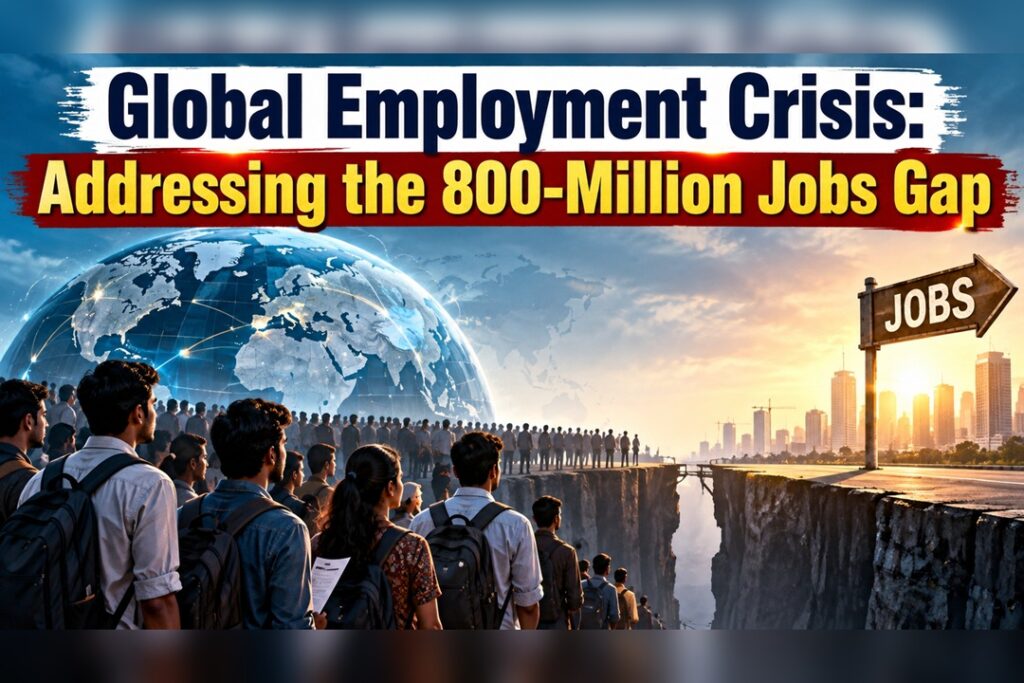
A World Bank forecast highlights a growing employment challenge in the Global South, where around 1.2 billion young people are expected to enter the labour market over the next decade, but only 400 million jobs are projected to be available.
Understanding the Global Employment Crisis
The global jobs crisis refers to the widening gap between the growing working-age population and the ability of economies to generate adequate, productive and decent employment. It can lead to unemployment, underemployment, low wages and the expansion of informal work, particularly in developing countries.
Why Traditional Employment Models Are Losing Effectiveness
- Declining Role of Labour-Intensive Manufacturing: The East Asian development model relied on labour-intensive industries such as textiles, footwear and toys to shift workers from agriculture to factories. However, this pathway is becoming less effective.
- Premature Deindustrialisation: Automation, robotics and computer-controlled machinery enable industries to increase production without proportionately increasing their workforce. Developing countries are consequently experiencing declining manufacturing employment opportunities before achieving high income levels.
- Growing Skill Inequalities: Modern industries increasingly demand advanced technical, digital and analytical skills. Young people without access to quality education and specialised training risk being excluded from emerging employment opportunities.
Key Indicators of the Employment Challenge
- Widening Job Deficit: The projected entry of 1.2 billion young people into the workforce against 400 million potential jobs implies a shortfall of approximately 800 million employment opportunities.
- Low Productivity in Agriculture: In India, agriculture supports a substantial share of the workforce while contributing a considerably smaller proportion to national output. This reflects low productivity and disguised unemployment in rural areas.
- Graduate Unemployment: Educated young people often struggle to secure suitable jobs despite possessing formal qualifications, highlighting the mismatch between educational outcomes and industry requirements.
- Limited Demographic Window: India’s relatively young population offers a temporary opportunity to accelerate economic growth. However, the benefits of this demographic dividend depend on the timely creation of productive jobs.
Structural Barriers to Employment Generation
- Constraints on MSME Growth: Complex regulations, compliance costs and bureaucratic delays discourage small enterprises from expanding their operations and workforce.
- Infrastructure and Logistics Costs: Inadequate transport connectivity, unreliable utilities and fragmented supply chains raise production costs and reduce the competitiveness of domestic industries.
- Misallocation of Capital: Uncertain property rights, delayed dispute resolution and investment preferences for speculative assets can limit the flow of capital into productive manufacturing and employment-intensive enterprises.
- Skill and Education Mismatch: An excessive emphasis on theoretical learning, combined with inadequate vocational training and apprenticeships, leaves many graduates unprepared for available jobs.
Employment-Generating Sectors with High Potential
- Care Economy: Expanding healthcare, nursing, childcare and elderly-care services can create a wide range of employment opportunities while improving social welfare and encouraging greater female workforce participation.
- Agricultural Value Addition: Food processing, cold storage, packaging and organised supply chains can generate rural employment, reduce post-harvest losses and increase farmers’ incomes.
- Tourism and Heritage-Based Enterprises: Eco-tourism, cultural tourism and heritage conservation can support local businesses, including homestays, handicrafts, transport services and community-based tourism enterprises.
- Green Manufacturing: Renewable-energy equipment, electric vehicle components, repair services and electronic waste recycling can create new employment opportunities if production and supply chains are designed to include labour-intensive activities.
Way Forward
- Strengthen Public Investment: Expand investment in transport, logistics, renewable energy and digital infrastructure to generate immediate employment and improve the long-term competitiveness of businesses.
- Enable MSME Expansion: Simplify regulatory procedures, establish effective single-window clearance systems, reduce unnecessary compliance burdens and improve access to affordable credit.
- Align Skills with Industry Needs: Integrate vocational education, paid apprenticeships and industry partnerships into mainstream education to improve employability and facilitate school-to-work transitions.
- Mobilise Development Finance: Multilateral institutions such as the World Bank and Asian Development Bank should support employment-intensive infrastructure, green industries and productive enterprises across developing economies.
- Promote Formal and Decent Work: Strengthen social security, worker protection and access to formal employment while reducing incentives for enterprises to remain small or informal.
- Invest in Women’s Employment: Improve childcare facilities, workplace safety, transport access and flexible working arrangements to remove barriers to women’s participation in the labour market.
Conclusion
The global employment crisis is not simply a problem of insufficient economic growth; it reflects the inability of existing growth models to generate enough productive jobs. For India and other developing economies, converting demographic potential into shared prosperity will require employment-oriented industrialisation, stronger MSMEs, practical skill development and investment in the care economy, agricultural processing and green enterprises.
Source : The Hindu