
Religious Conversion and Reservation: Supreme Court Reaffirms the Need for Evidence-Based Classification
Context
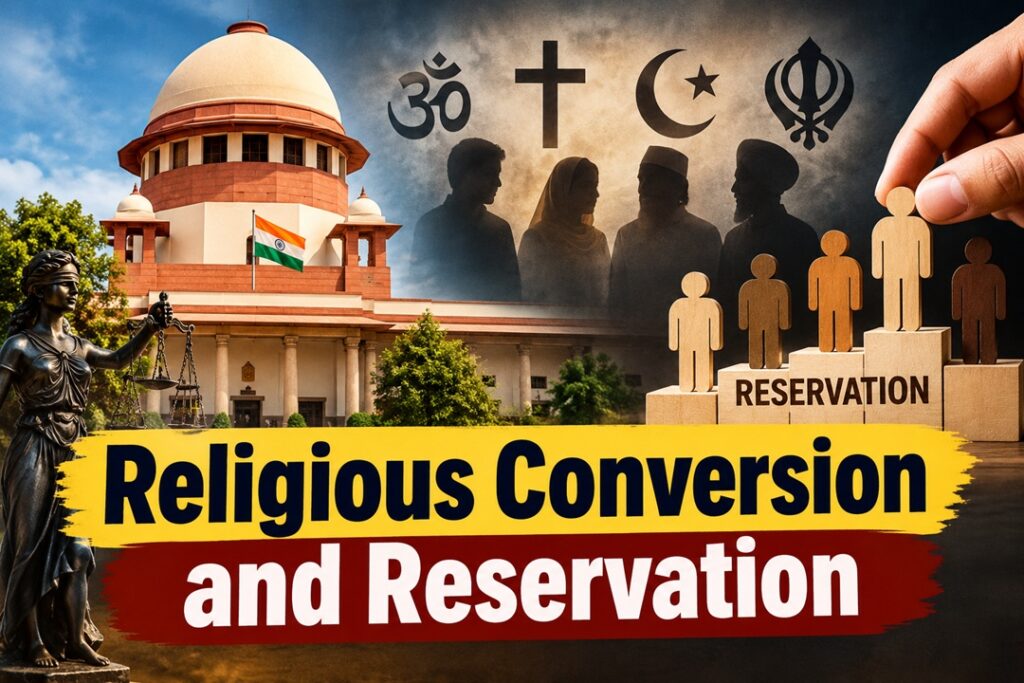
The Supreme Court of India, in The Secretary to Government v. Sameer Ahamed N., upheld the Madras High Court’s decision striking down Tamil Nadu’s Government Order dated March 9, 2024. The ruling clarifies that religious conversion alone does not confer eligibility for an existing notified Backward Class community, highlighting the relationship between constitutional equality, affirmative action and freedom of religion.
Constitutional and Legal Framework
1. How Religious Conversion Affects Reservation
- Scheduled Caste (SC) status: Paragraph 3 of the Constitution (Scheduled Castes) Order, 1950, issued under Article 341, restricts SC recognition to persons professing Hinduism, Sikhism or Buddhism. Conversion to Islam or Christianity generally results in the loss of SC status under the existing framework.
- Other Backward Classes (OBC) reservation: Articles 15(4) and 16(4) permit affirmative action for socially and educationally backward classes. Eligible communities may belong to different religious groups, but conversion alone does not establish membership in a notified backward class.
- Article 342A: Provides the constitutional framework for identifying Socially and Educationally Backward Classes (SEBCs), including the states’ authority to prepare and maintain their own lists under the applicable constitutional provisions.
2. Background of the Dispute
In March 2024, the Tamil Nadu government issued an order allowing persons who converted to Islam from Backward Classes, Most Backward Classes, Denotified Communities and Scheduled Castes to seek Backward Class Muslim community certificates.
The dispute arose when a person born into a Hindu backward community, after converting to Islam, sought recognition as a member of the Muslim Lebbai community. The state sought to protect individuals from losing access to welfare benefits solely because of religious conversion.
The Madras High Court invalidated the order, holding that conversion and certification by a religious body could not independently establish membership in a notified backward Muslim community. The Supreme Court upheld this position, emphasising the need for evidence of actual community membership and legally established backwardness.
3. Major Findings of the Supreme Court
No automatic transfer of community status: Conversion to Islam does not automatically make a person a member of a particular notified Muslim backward community, such as the Labbai or Mapilla communities. Eligibility must be established under the applicable legal criteria.
Community certificates must reflect established status: A certificate records an individual’s legally recognised community membership; it cannot independently create eligibility for reservation. A Jamath may recognise religious conversion or community affiliation, but its certification does not replace the statutory requirements governing reservation.
Empirical evidence is essential: The state cannot combine people from different caste and social backgrounds into a single backward-class category without demonstrating that they share relevant characteristics of social and educational disadvantage.
Religious identity and statutory classification are distinct: The freedom to adopt a religion does not automatically determine a person’s eligibility for a particular reservation category. Such eligibility depends on the applicable constitutional provisions, notified lists and prescribed criteria.
Important Commissions and Their Contributions
- Mandal Commission (1980): Developed a framework for identifying backward classes using social, educational and economic indicators. It reinforced the importance of assessing disadvantage through multiple criteria rather than religion alone.
- Justice Rajindar Sachar Committee (2006): Documented socio-economic and educational disadvantages among Muslims and highlighted inequalities within the community.
- Justice Ranganath Misra Commission (2007): Recommended removing the religion-based restriction in the 1950 Presidential Order so that Scheduled Caste recognition could extend to eligible persons irrespective of religious affiliation.
- Justice K.G. Balakrishnan Commission (2022): Was constituted to examine whether Scheduled Caste status could be extended to persons who historically belonged to Dalit communities but subsequently converted to Christianity or Islam.
These initiatives demonstrate the continuing debate over whether reservation policies adequately address discrimination that may persist after religious conversion.
Advantages of the Judgment
- Protects existing beneficiaries: Prevents the arbitrary expansion of notified categories without establishing eligibility, helping safeguard the interests of communities already included in backward-class lists.
- Strengthens evidence-based policymaking: Requires governments to justify new classifications through credible social, educational and economic evidence.
- Preserves the distinction between communities: Recognises that individuals from different caste backgrounds may experience different forms and degrees of disadvantage, making careful classification necessary.
- Reinforces constitutional procedures: Limits the use of executive orders to alter the practical scope of reservation eligibility without following the applicable legal framework.
Concerns and Limitations
- Possible loss of protective benefits: Individuals from historically disadvantaged backgrounds may lose access to certain benefits after conversion, even where social discrimination continues.
- Persistence of caste-based exclusion: Religious conversion does not necessarily eliminate inherited social hierarchies, occupational restrictions or community discrimination.
- Difficulties for individuals: Converts may face uncertainty when attempting to establish eligibility for a different notified category, particularly where clear assessment mechanisms are lacking.
- Challenges for inclusive welfare policies: Governments must distinguish between arbitrary inclusion and legitimate efforts to address demonstrable disadvantage among marginalised groups.
Significance for Indian Polity and Social Justice
The ruling clarifies the relationship between Article 341, which governs the Scheduled Caste framework, and Articles 15(4) and 16(4), which enable affirmative action for backward classes.
It also highlights the importance of the 105th Constitutional Amendment, which restored states’ authority to identify SEBCs for their own purposes within the constitutional framework.
The judgment does not mean that religious minorities or converts are categorically excluded from all backward-class benefits. Rather, it requires their eligibility to be established through the relevant notified community classifications and lawful procedures. States can examine whether additional groups face persistent disadvantage, but any new classification must satisfy constitutional requirements and be supported by appropriate evidence.
Way Forward
- Conduct comprehensive socio-economic surveys: State governments should assess the educational, occupational, economic and social conditions of converts from historically disadvantaged communities.
- Strengthen Backward Classes Commissions: Independent commissions should undertake field studies, consult affected communities and provide reasoned recommendations before new categories are introduced.
- Develop transparent certification procedures: Clear guidelines should distinguish religious conversion, community membership and eligibility for statutory benefits, reducing uncertainty for applicants.
- Address continuing discrimination: Anti-discrimination measures and targeted welfare programmes should respond to documented exclusion, regardless of whether an individual qualifies for a particular reservation category.
- Review the SC status framework through constitutional processes: The question of extending Scheduled Caste recognition to converts to Islam and Christianity requires careful examination of constitutional provisions, historical evidence and continuing patterns of discrimination.
Conclusion
The Supreme Court’s ruling reinforces the principle that reservation eligibility must follow constitutional procedures and be supported by evidence rather than arise automatically from religious conversion. However, the continuing presence of caste-based disadvantage among converts raises important questions about the reach of India’s affirmative-action framework. A balanced approach should preserve the integrity of notified categories while enabling governments to recognise genuine and demonstrable disadvantage through transparent, evidence-based and constitutionally compliant measures.
Source : The Hindu