
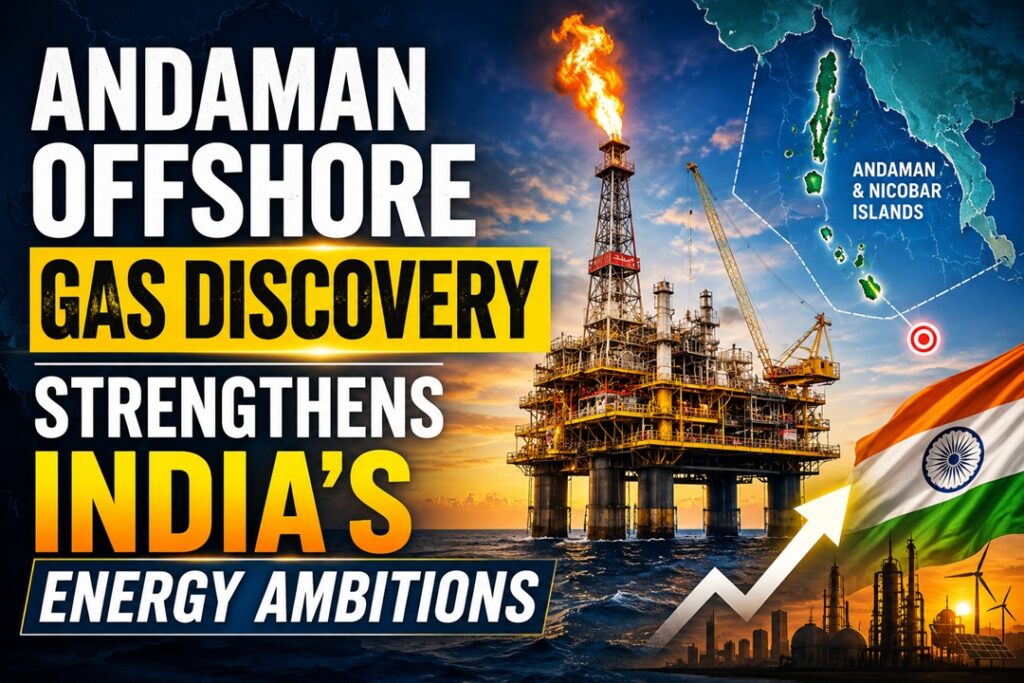
Andaman Offshore Gas Discovery Strengthens India’s Energy Ambitions
Context
State-owned Oil India Limited (OIL) has announced another natural gas discovery in the Andaman offshore region, reinforcing the basin’s potential to emerge as a major hydrocarbon-producing area and support India’s long-term energy security objectives.
Andaman-Nicobar Archipelago: Strategic and Geological Significance
Geographical Setting
- The Andaman and Nicobar Islands comprise around 836 islands, divided into the Andaman group in the north and the Nicobar group in the south, located in the Bay of Bengal.
- The islands lie about 1,190 km from Chennai and nearly 1,255 km from Kolkata.
Natural Division
- The Ten Degree Channel, approximately 150 km wide, separates the Andaman Islands from the Nicobar Islands.
Southern Extremity of India
- Indira Point on Great Nicobar Island represents India’s southernmost geographical point.
Major Island Clusters
- Andaman Group – Includes North, Middle and South Andaman (collectively known as Great Andaman), along with island chains such as the Ritchie Archipelago and Sentinel Islands.
- Nicobar Group – Consists of 22 principal islands, several of which are inhabited.
Neighbouring Countries
- The island chain is situated close to Myanmar, Thailand, and Indonesia, enhancing its strategic relevance.
Geological Framework
- The islands form part of the Bengal-Arakan sedimentary basin, a region known for hydrocarbon potential.
- Their location along the Indian–Burmese tectonic boundary has generated structural and stratigraphic traps favourable for oil and gas accumulation.
Regional Hydrocarbon Linkages
- Geological continuity with productive energy provinces such as:
- Myanmar’s offshore gas fields
- Indonesia’s North Sumatra petroleum basin
- Recent discoveries in neighbouring offshore regions have increased international interest in the Andaman basin.
Highlights of the Latest Gas Discovery
New Exploration Success
- The latest gas find was reported from the Vijayapuram-3 exploratory well, located roughly 15 km off the eastern coast of the Andaman Islands in waters about 355 metres deep.
Follow-Up to Earlier Discovery
- The discovery succeeds the Vijayapuram-2 gas strike reported in 2025, making it the second successful gas-bearing well in the same block.
Reservoir Confirmation
- Testing in the Eocene geological formation at depths exceeding 1,900 metres confirmed the presence of natural gas.
- Continuous flaring and rapid pressure recovery indicated encouraging reservoir quality.
Boost for Offshore Exploration
- Consecutive discoveries strengthen evidence of an active petroleum system in the Andaman offshore region.
- The findings suggest the possibility of additional hydrocarbon accumulations across the basin.
Emerging Frontier Basin
- With two successful gas discoveries out of three exploratory wells, the basin is increasingly viewed as a promising frontier for future exploration activities.
Parallel Exploration Efforts
- Exploration operations are also underway in major offshore basins such as:
- Krishna-Godavari Basin
- Mahanadi Basin
- Cauvery Basin
- Mumbai Offshore Basin
Government Policy Backing
- Under the Hydrocarbon Exploration and Licensing Policy (HELP), four exploration blocks covering nearly 23,261 sq km have been awarded in the Andaman-Nicobar region.
National Initiatives Supporting Offshore Resource Exploration
Samudra Manthan Mission
Overview
- Also referred to as the National Deep Water Exploration Mission, it was announced in 2025.
Objective
- To identify and exploit offshore oil and gas reserves beneath the seabed.
- To enhance domestic hydrocarbon output and lower import dependence.
Focus Areas
- Extensive deepwater and ultra-deepwater drilling campaigns across India’s offshore sedimentary basins.
Deep Ocean Mission (DOM)
Launch
- Initiated in 2021.
Purpose
- To develop indigenous capabilities for exploration and sustainable utilisation of deep-sea resources.
Core Components
- Development of deep-sea mining technologies and manned submersibles.
- Ocean-climate observation and forecasting systems.
- Exploration and conservation of deep-sea biodiversity.
- Survey of seabed mineral resources, including polymetallic nodules.
- Technologies for ocean-based freshwater and energy generation.
- Establishment of advanced marine research infrastructure.
Why the Andaman Gas Discoveries Matter
Strengthening Energy Independence
- India imports a significant share of its crude oil and natural gas requirements.
- Domestic discoveries can gradually reduce reliance on external energy sources.
Strategic Maritime Advantage
- The islands are positioned close to the Strait of Malacca, one of the world’s busiest maritime trade routes.
- Hydrocarbon development could reinforce India’s strategic presence in the Indo-Pacific region.
Economic Opportunities
- Successful commercialisation may attract fresh investments in offshore exploration, infrastructure and energy services.
Potential for Future Discoveries
- The basin remains largely underexplored, increasing the likelihood of additional hydrocarbon finds.
Challenges Ahead
- Commercial production may require several years of appraisal and development.
- Detailed seismic surveys, reserve estimation and infrastructure creation will be essential before large-scale extraction begins.
Conclusion
The recent discoveries at Vijayapuram have significantly improved confidence in the hydrocarbon potential of the Andaman offshore basin. Supported by targeted exploration policies and deep-sea missions, the region could play a vital role in enhancing India’s energy security, strategic influence, and offshore resource development in the coming decades.
Source : The Indian Express