
Ashtalakshmi Vision: North-East Driving India’s New Development Era
Context
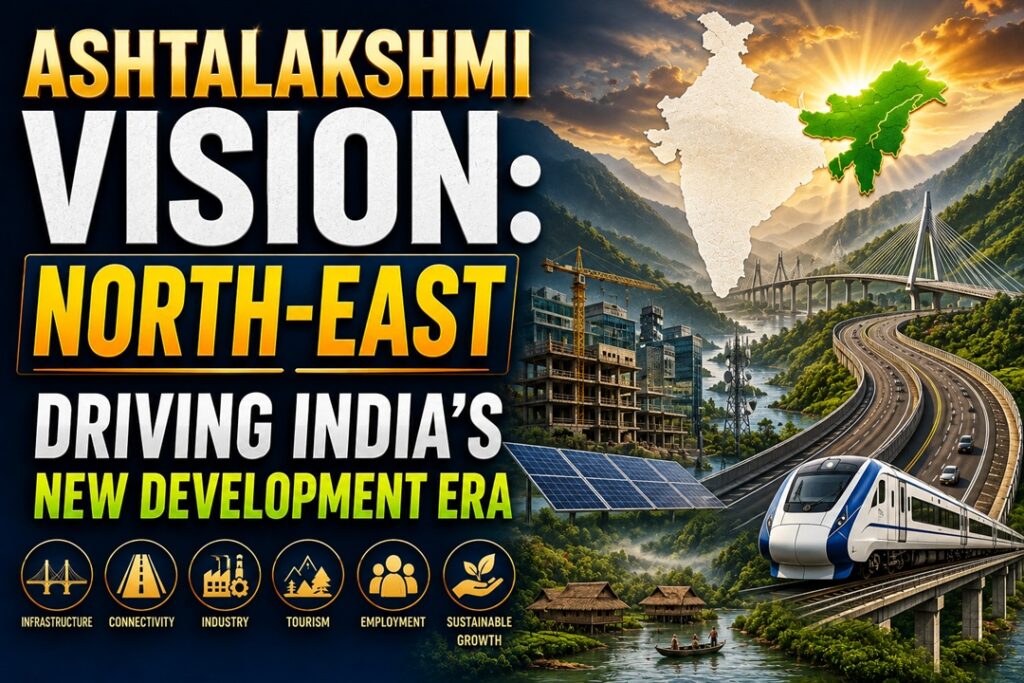
The Press Information Bureau (PIB) has published a comprehensive report titled “Ashtalakshmi – The North-East at the Core of India’s Development Journey”, showcasing the remarkable socio-economic and infrastructure transformation witnessed across the North-Eastern region over the past decade.
Ashtalakshmi Development Framework
What is the Ashtalakshmi Framework?
Drawing inspiration from the eight forms of Goddess Lakshmi, which symbolize prosperity and well-being, the Ashtalakshmi Framework envisions the eight North-Eastern states—Assam, Arunachal Pradesh, Manipur, Meghalaya, Mizoram, Nagaland, Tripura, and Sikkim—as key pillars of India’s growth trajectory. The model harnesses the region’s cultural richness, ecological wealth, and strategic location to promote inclusive and sustainable development.
Major Investments and Infrastructure Expansion
Transforming Connectivity and Public Infrastructure
- More than 3,700 development projects have received central approval across the region.
- PM-DevINE supports critical initiatives in infrastructure, employment generation, and social development.
- Enhanced railway allocations have accelerated modernization and network penetration.
- Expansion of broad-gauge railway lines has connected previously remote areas with the national transport grid.
- Renewable energy training initiatives are creating a skilled workforce for the green economy.
Social Progress and Digital Inclusion
Improving Quality of Life Across the Region
- States such as Arunachal Pradesh and Mizoram have achieved near-universal rural tap-water access.
- Extensive sanitation efforts have enabled the entire region to attain Open Defecation Free (ODF) status.
- Large-scale housing programs under PMAY have improved residential security and living standards.
- Expanded Ayushman Bharat coverage has strengthened healthcare accessibility.
- BharatNet and telecom expansion have significantly improved internet access and digital services.
Agriculture, Fisheries and Rural Prosperity
Strengthening Local Livelihoods
- Fish production has risen steadily, with Assam emerging as a leading fisheries center.
- The region’s substantial agarwood resources are generating export and income opportunities.
- PM-KISAN continues to provide direct financial support to millions of farmers.
- Organic farming initiatives under MOVCD-NER have boosted Farmer Producer Organizations (FPOs) and promoted sustainable agriculture.
Emerging Developmental Trends in the North-East
A New Era of Strategic Connectivity
- Landmark projects such as the Bogibeel Bridge, Dhola–Sadiya Bridge, and Sela Tunnel have reduced geographical barriers and enhanced strategic mobility.
- Several North-Eastern states have achieved 100% railway electrification, reducing dependence on diesel-based transport.
- Under the UDAN Scheme, operational airports in the region have increased substantially, improving regional air connectivity.
- National Waterways along the Brahmaputra and Barak river systems have revitalized inland water transport.
- Major hydropower projects, including Dibang and Subansiri Lower, are strengthening the region’s clean-energy capacity.
Persistent Challenges in Regional Development
Key Constraints Requiring Attention
- Difficult mountainous terrain and fragile ecosystems increase infrastructure construction complexity.
- Transportation disruptions caused by weather conditions elevate logistics and supply-chain costs.
- Variations in institutional capacity can affect implementation efficiency of large projects.
- Limited processing infrastructure restricts value addition for agricultural and forest-based products.
Future Priorities for Accelerated Growth
Roadmap for the Next Phase
- Fast-track completion of the Noney Railway Bridge in Manipur, expected to become one of the world’s tallest railway pier bridges.
- Expedite strategic connectivity projects such as the India–Myanmar–Thailand Trilateral Highway and the Kaladan Multi-Modal Transit Transport Project.
- Promote decentralized renewable-energy solutions through JJM 2.0 and PM-KUSUM.
- Enhance commercialization of the region’s 89 GI-tagged products through cold-storage facilities and expanded export networks under Krishi UDAN.
Conclusion
The North-East is rapidly evolving from a geographically isolated frontier into a dynamic growth hub powered by modern infrastructure, digital connectivity, clean energy, and sustainable agriculture. Continued investment in cross-border connectivity, local value addition, and ecological conservation will be crucial in transforming the region into a major engine of India’s long-term economic and strategic development.
Source : PIB