
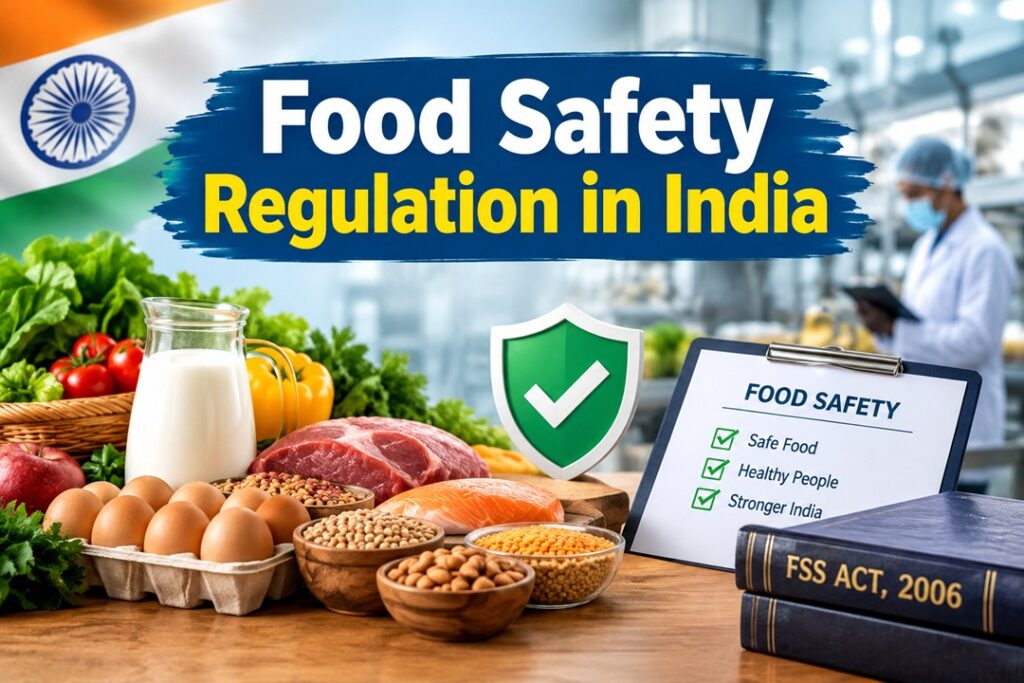
Food Safety Regulation in India: Balancing Public Health and Due Process
Context
Recent inspections by the Maharashtra Food and Drug Administration (FDA) have led to suspension of licences of several food businesses over alleged safety and hygiene violations. The issue has brought renewed attention to the circumstances in which authorities can immediately suspend a food licence and when businesses should first be given an opportunity to rectify deficiencies under the Food Safety and Standards Act, 2006 (FSS Act).
The legal framework seeks to maintain a balance between swift intervention to protect consumers and procedural fairness for food businesses.
Food Safety and Standards Act, 2006
The FSS Act, 2006 consolidated various food-related laws and created the Food Safety and Standards Authority of India (FSSAI) as the principal regulator for food safety.
A Food Business Operator (FBO) covers entities involved in manufacturing, processing, packaging, storing, transporting, distributing, importing, selling or serving food, irrespective of whether they operate for profit.
Improvement Notice under Section 32
The ordinary mechanism for dealing with violations is an improvement notice.
Where the Designated Officer has reasonable grounds to believe that an FBO has breached the Act or regulations, the notice must:
- Identify the grounds for alleging non-compliance.
- Specify the particular violations.
- Prescribe measures necessary to achieve compliance.
- Provide a reasonable period for corrective action.
The compliance period cannot ordinarily be less than 14 days.
If the FBO does not comply, its licence can be suspended, while continued non-compliance may eventually result in cancellation, subject to the prescribed procedure.
Thus, the basic approach of the Act is correction before punishment.
Exception in the Interest of Public Health
Section 32 also contains an important exception. Where immediate intervention is necessary to protect public health, the Designated Officer may suspend a licence forthwith without first issuing an improvement notice, provided the reasons are recorded in writing.
However, this is an exceptional power. A mere technical or easily rectifiable deficiency does not automatically establish grounds for immediate suspension.
The authority must therefore demonstrate that:
- The violation presents a meaningful health risk.
- Immediate intervention is necessary.
- Waiting for corrective action could endanger consumers.
- The action taken is proportionate to the nature and seriousness of the violation.
Role of the Designated Officer
Under Section 36, the Commissioner of Food Safety appoints the Designated Officer for a district.
The officer performs several regulatory functions, including:
- Granting, suspending and cancelling food licences.
- Investigating complaints.
- Arranging testing of food samples.
- Prohibiting the sale of unsafe food where required.
- Maintaining inspection-related records.
- Initiating or recommending appropriate enforcement action.
These powers must be exercised within the statutory framework and consistently with reasonableness, proportionality and procedural fairness.
Judicial Approach to Immediate Suspension
Courts have increasingly attempted to distinguish between ordinary regulatory shortcomings and genuine public-health emergencies.
Kerala High Court
In V.B. Muraleedharan v. Commissioner of Food Safety (2020), the Kerala High Court observed that the absence of an improvement notice does not necessarily invalidate every enforcement action. The circumstances of the violation and the available test evidence can influence whether such notice was necessary.
Madras High Court
In A.R. Dairy Food (P) Ltd. v. Food Safety and Standards Authority of India (2025), the Madras High Court treated suspension as an interim regulatory measure, rather than something that can continue indefinitely. Authorities must take an appropriate decision on further action within a reasonable period.
Bombay High Court
The Bombay High Court has recently dealt with several Maharashtra cases involving the scope of immediate suspension.
In Wardha Tahsil Go-Dugdha Utpadak Sahakari Sangh Ltd. v. State of Maharashtra (2026), inspections revealed multiple deficiencies relating to sanitation, storage, pest control, hygiene, training and documentation. The alleged use of industrial ice meant to be non-edible in buttermilk was particularly significant because of its potential health implications.
The court distinguished routine deficiencies from conduct capable of creating a direct health risk. While preventive action concerning the serious violation was considered justified, the suspension of the entire licence was found excessive.
Similarly, in Akshay Dairy Farm v. State of Maharashtra (2026), the court questioned whether immediate suspension was warranted when the order did not sufficiently establish why urgent action was indispensable or why corrective measures would not have been adequate.
In Saraswati Milk Products (P) Ltd. v. State of Maharashtra (2026), considerations such as substantial compliance and failure to provide relevant inspection material reinforced the importance of fair procedure.
The Madhya Pradesh High Court followed a comparable approach in Sayaji Hotels (Indore) Ltd. v. Food Safety and Standards Authority of India (2026), holding that issues such as inadequate labelling or unhygienic surroundings do not automatically justify immediate suspension where the circumstances do not indicate an urgent threat to health.
Corrective Action Must Also Have Consequences
Procedural safeguards cannot become a means for businesses to avoid responsibility.
The regulatory system must ensure that identified violations are actually corrected. The experience involving Park Inn by Radisson demonstrates this balance: preventive action was taken after hygiene concerns, including insects in a kitchen area, but the licence was subsequently restored after the deficiencies were substantially addressed.
In Siddharth Agro v. State of Maharashtra (2026), the Bombay High Court highlighted the other side of the issue. Once deficiencies have been rectified and the authority is satisfied through inspection or other evidence, restrictive measures should not continue unnecessarily.
Prolonged suspension or cancellation can have consequences not only for the business but also for employees, suppliers and consumers.
Therefore, enforcement should work in both directions:
Swift action when consumers face danger + withdrawal of restrictions once the danger has been effectively removed.
Compensation for Consumers
The FSS Act also provides a mechanism for compensating consumers who suffer injury or death because of unsafe food.
Under Section 65, compensation may be directed against the responsible manufacturer, distributor, seller or importer.
The statutory framework provides:
- At least ₹5 lakh in cases of death.
- Up to ₹3 lakh for grievous injury.
- Up to ₹1 lakh for other injuries.
In cases of death, interim relief is also contemplated for the next of kin. Depending on the circumstances, unsafe food may additionally be recalled, licences may be cancelled, prohibition orders may be issued and prosecution or other penalties may follow.
Key Principles for Food-Safety Enforcement
Public Health as the Primary Consideration
Where contaminated food, toxic substances or dangerous processing practices create an immediate threat, regulators must have the ability to intervene without waiting for the ordinary corrective period.
Not Every Violation is an Emergency
Minor hygiene or documentation deficiencies that can safely be corrected should ordinarily be dealt with through an improvement notice.
Proportionality in Regulatory Action
Even where urgent intervention is justified, authorities should consider whether shutting down the entire food business is necessary. Restricting a particular product, process or activity may sometimes provide sufficient consumer protection.
Way Forward
A stronger food-safety regime should combine risk-based enforcement with procedural safeguards.
Authorities should:
- Prioritise inspections according to the level of potential health risk.
- Maintain detailed and transparent inspection records.
- Clearly document the reasons for invoking immediate suspension.
- Periodically review preventive orders.
- Revoke restrictive measures promptly once violations are satisfactorily rectified.
- Use targeted restrictions where they can adequately address the identified risk.
Food businesses, meanwhile, must treat sanitation, pest control, safe storage, traceability, employee training and hygiene as continuous responsibilities rather than one-time compliance requirements.
Conclusion
The FSS Act does not establish an absolute requirement that every food business must receive 14 days to rectify deficiencies before any suspension can occur. At the same time, it does not authorise automatic closure whenever a violation is detected.
The legal position rests on a clear distinction: improvement notice and corrective action are the normal route, while immediate suspension is an exceptional response justified by a genuine public-health concern.
Source : The Hindu