
India and the Middle-Income Trap: From Growth to Productivity-Led Development
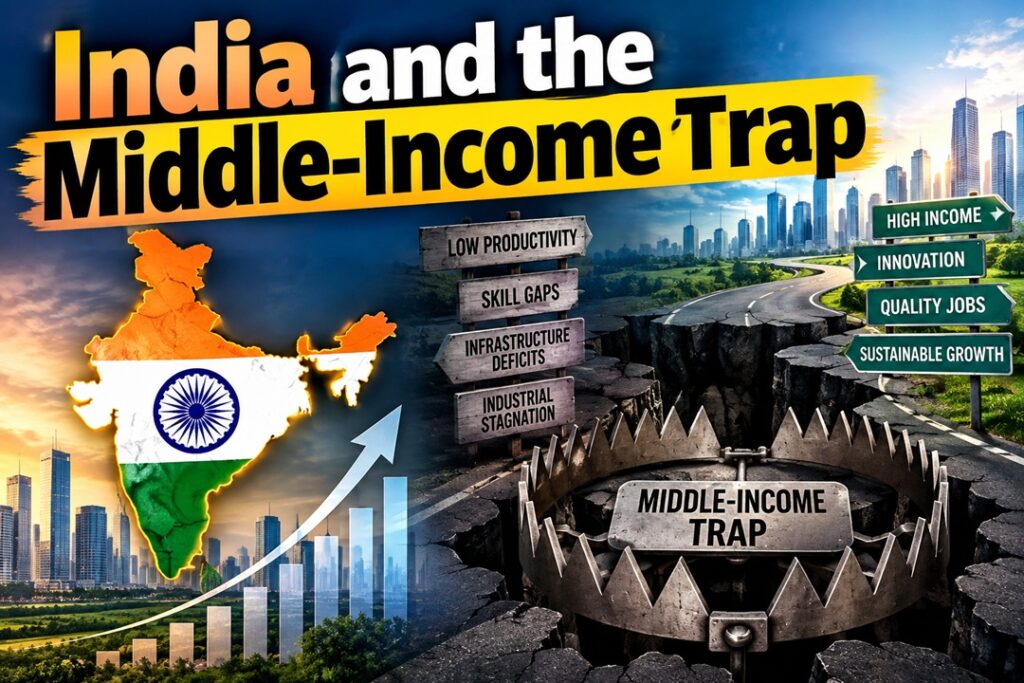
Context
India has achieved rapid economic growth and entered the group of major engines of global expansion. However, sustaining high GDP growth alone may not be sufficient to secure a transition to high-income status. Weak employment generation, modest wage growth, subdued private investment, uneven productivity gains and unequal access to opportunities could create the conditions associated with a middle-income trap.
Understanding the Middle-Income Trap
The middle-income trap occurs when an economy successfully moves beyond low-income status but subsequently struggles to achieve the productivity and innovation required for high-income development.
In the initial stages, growth can be driven by:
- Shifting workers from low-productivity agriculture to manufacturing and services.
- Using relatively inexpensive labour to expand production.
- Adopting technologies already developed elsewhere.
- Increasing capital investment and participating in global markets.
This strategy becomes less effective as wages increase and the advantages of low-cost production diminish. At that stage, countries need to rely increasingly on productivity, technological innovation, skilled labour, research and domestic knowledge creation.
Thus, the critical transition is from catch-up growth to capability-driven growth.
Why India Faces the Risk
India’s principal concern is not the absence of economic growth, but the possibility that growth may not generate enough productive employment and broad-based improvements in living standards.
1. Employment-Intensive Growth Remains Weak
Manufacturing has expanded, but its capacity to absorb India’s large labour force remains inadequate. Productivity improvements have often been concentrated in capital-intensive and technology-intensive sectors that employ relatively fewer workers.
This creates a potential cycle:
Low-quality employment → stagnant wages → weak consumption → inadequate investment → limited job creation → low productivity
If this cycle persists, high aggregate growth could coexist with employment insecurity and limited improvement in household incomes.
2. Uneven Recovery and Productivity
Large formal enterprises and technologically advanced sectors have generally been better positioned to benefit from economic recovery than informal enterprises and workers.
Consequently, productivity gains are not evenly distributed. Firms with greater access to capital, technology and skilled workers can advance rapidly, while smaller businesses may remain trapped in low-productivity activities.
3. The Vocational Skills Gap
India’s shortage is not simply of education but of job-relevant technical capabilities.
Although the country has a substantial network of Industrial Training Institutes (ITIs) and other skill-development institutions, participation, utilisation and employment outcomes remain uneven.
Social preferences also matter. Academic degrees often enjoy greater prestige than technical trades such as welding, machining, plumbing, electrical work and carpentry. India’s historical social structure has further contributed to the undervaluation of many manual and artisanal occupations.
The result is a paradox: educated youth may struggle to secure suitable employment while industries simultaneously report shortages of technically capable workers.
Beyond the Market-versus-State Debate
India’s development challenge cannot be adequately explained by choosing between greater market freedom and greater government expenditure.
The market-oriented perspective stresses labour-market reforms, deregulation, infrastructure, agricultural reforms and a favourable investment environment.
The Keynesian perspective gives greater emphasis to aggregate demand, public spending, redistribution and social protection.
Both address important dimensions, but the deeper question is how institutions determine:
- Who obtains quality education and skills.
- Which occupations receive social and economic recognition.
- How efficiently capital and technology reach firms.
- Whether workers can move into higher-productivity activities.
- How effectively public institutions deliver education, healthcare and infrastructure.
India therefore needs to focus not merely on creating employment, but on raising the productivity and dignity of productive work.
The Role of Useful Knowledge
Economist Joel Mokyr’s work highlights the importance of accumulating and disseminating “useful knowledge” for sustained economic development.
Scientific discoveries generate growth only when they are translated into technologies, production techniques and practical capabilities that firms and workers can actually use.
For India, the required chain is:
Science → Technology → Skills → Industrial application → Productivity → Higher incomes
India possesses considerable scientific and technological capacity, but diffusion remains uneven. Advanced technologies are frequently concentrated among large companies, urban clusters and highly educated workers.
The greater challenge is therefore to ensure that small firms, informal enterprises and ordinary workers can also access and apply productivity-enhancing technologies.
Lessons from East Asia
The experience of East Asian economies demonstrates that successful transformation requires more than either unrestricted markets or redistribution.
- South Korea combined industrial development with mass education, technological learning and export-oriented manufacturing.
- China invested extensively in education, healthcare, infrastructure, technical capabilities and manufacturing while progressively strengthening domestic technological capacity.
- In contrast, economies such as Brazil and Argentina illustrate how middle-income countries can struggle when productivity-enhancing structural transformation fails to remain sustained.
The lesson for India is not to copy any particular country’s model, but to build institutions suited to its own economic and social conditions.
Productivism and Productive Opportunity
Economist Dani Rodrik’s productivist approach places productive employment and economic opportunity at the centre of economic policy.
Unlike a narrowly market-led model, productivism recognises that the State can help shape markets and expand productive opportunities. At the same time, it differs from a purely redistributive approach because it seeks to enable people to participate in productive economic activity in the first place.
For India, this implies an economy where people can obtain:
- Decent and productive employment.
- Rising wages.
- Market-relevant skills.
- Social security.
- Opportunities for career advancement.
- Greater dignity for technical and vocational occupations.
Way Forward
Strengthen Vocational and Technical Education
ITIs, polytechnics and skill institutions should be integrated more closely with industrial requirements. Curricula need regular updating, apprenticeships should be expanded, and the effectiveness of training should be assessed through employment, earnings and career progression, rather than enrolment numbers alone.
Give Skilled Work Greater Economic Value
Vocational careers need credible pathways for upward mobility. Better wages, recognised certifications, career progression and social-security coverage can make technical occupations more attractive.
Accelerate Technology Diffusion
India should complement frontier innovation with policies that help smaller firms adopt existing technologies. Affordable finance, digital infrastructure, technology-extension services and stronger industry-academia links can reduce the productivity gap between leading and lagging firms.
Pursue Employment-Generating Industrialisation
Industrial policy should prioritise sectors capable of combining productivity gains with large-scale employment, including textiles, electronics, food processing, machinery and renewable-energy equipment. Greater integration into domestic and global value chains can further expand opportunities.
Increase Research and Development
Higher public and private R&D spending, stronger university-industry partnerships and incentives for commercially relevant innovation are necessary to develop domestic technological capabilities.
Build State Capacity
Quality education, healthcare, infrastructure and effective local governance should be treated as productivity-enhancing investments, not merely welfare expenditure. Stronger implementation capacity is essential for ensuring that these investments translate into widespread human-capital development.
Conclusion
India’s demographic advantage will not automatically become a development advantage. The decisive factor will be whether millions of workers can move into higher-productivity, better-paid and socially valued occupations.
Escaping the middle-income trap therefore requires more than maintaining rapid GDP growth. India must build an ecosystem in which knowledge spreads across firms and workers, vocational skills command dignity, technology reaches smaller enterprises, and productive employment expands alongside innovation. The objective should be growth that is not only faster, but more productive, employment-intensive and inclusive.
Source : The Hindu