
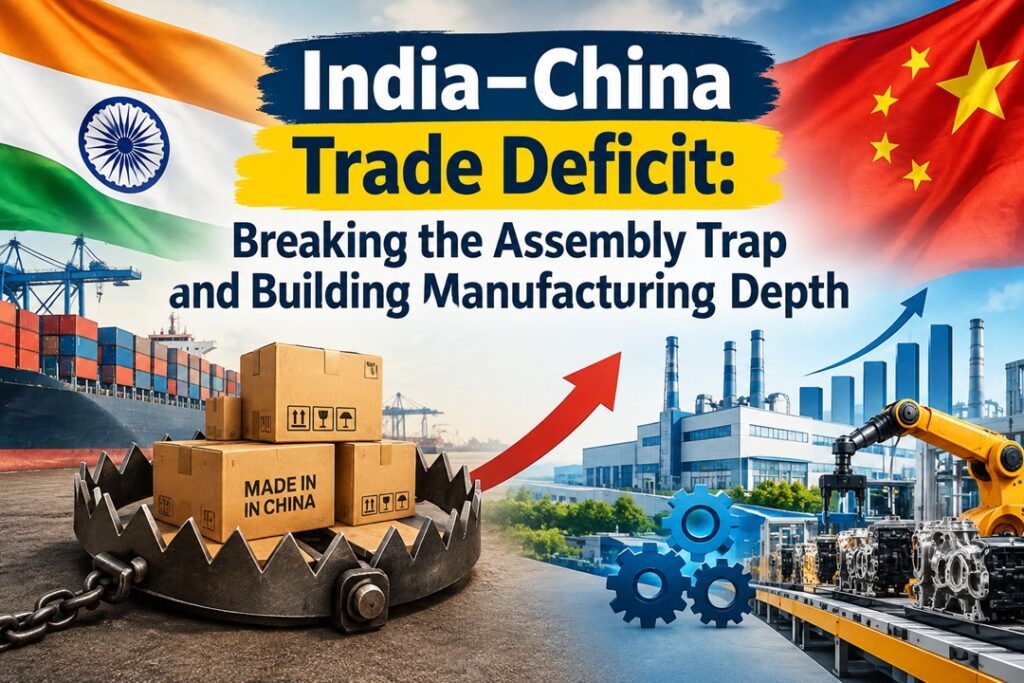
India–China Trade Deficit: Breaking the Assembly Trap and Building Manufacturing Depth
Context
India’s manufacturing expansion has increased domestic assembly and exports, but it has also exposed a persistent dependence on Chinese components and industrial inputs. The challenge is therefore not merely to reduce imports, but to build the domestic capabilities needed for deeper integration into global value chains.
India’s Manufacturing Paradox
The paradox of self-reliance arises when policies aimed at import substitution and domestic manufacturing succeed in expanding production but simultaneously increase dependence on imported intermediate goods.
India has rapidly expanded final assembly, particularly in smartphones and electronics. However, the domestic ecosystem for precision components, semiconductor fabrication, advanced tooling and other upstream inputs remains relatively underdeveloped. This creates an “assembly trap”, where higher domestic production can require larger volumes of imported components.
Changing Pattern of India–China Trade
India–China bilateral trade reached $167.6 billion in 2025, but the expansion has been highly asymmetric.
- India’s exports to China remained broadly stagnant between 2021 and 2025.
- Chinese imports into India increased by around 71%, from $87.5 billion in 2021 to $149.5 billion in 2025.
- Nearly 70% of Chinese imports are intermediate goods, while another 22% comprise capital goods.
- Finished consumer products constitute only a relatively small share of the import basket.
This indicates that India’s trade deficit is increasingly linked to the requirements of its own industrial production rather than simply consumer demand.
The concentration is particularly visible in technologically intensive sectors. Imports of the five largest product categories increased from $19 billion in 2021 to $34.6 billion in 2025, including electronics, integrated circuits, computers and telecommunications equipment.
The Smartphone Assembly Paradox
India’s mobile-phone manufacturing illustrates the problem clearly. Domestic assembly has expanded substantially, but the proportion of imported parts and components in the import basket increased from 3.3% in 2022 to 10.1% in 2025.
Thus, growth in final-product manufacturing has not automatically generated equivalent growth in domestic component production. Much of the higher-value activity remains concentrated outside India, while domestic firms capture a comparatively smaller share through assembly.
Why Does the Dependence Persist?
- Limited domestic component ecosystem:
Capabilities in precision engineering, PCB assemblies, advanced electronics and semiconductor fabrication are still developing. - Chinese scale and cost advantages:
China possesses mature industrial clusters, extensive supplier networks and economies of scale that make its intermediate goods highly competitive. - Incentive structure:
Production incentives have often emphasised output and export volumes. Without sufficient emphasis on domestic value addition, firms may find it commercially attractive to assemble imported components rather than develop local supply chains. - Tariff and input-cost distortions:
Inverted duty structures and difficulties in obtaining competitively priced raw materials can make domestic component production less attractive than importing sub-assemblies.
Strategic and Economic Implications
The dependence has implications beyond the trade balance.
- Supply-chain vulnerability: Disruptions affecting Chinese supplies could impact telecommunications, pharmaceuticals, renewable energy and electric vehicles.
- Limited value capture: High-value components such as chips, displays and memory modules account for a substantial part of product value, while assembly generally generates lower margins.
- Technology dependence: Persistent reliance on imported advanced components can slow the development of indigenous technological capabilities.
- External-sector pressure: A merchandise trade deficit of this magnitude can contribute to broader balance-of-payments and foreign-exchange pressures.
The central concern is therefore not simply the volume of Chinese imports, but the absence of sufficient domestic alternatives in strategically important intermediate and capital goods.
Way Forward
Shift from assembly-led manufacturing to value-chain integration:
Industrial policy should increasingly measure success through domestic value addition, local supplier development, technological capability and productivity rather than assembly volumes alone.
Deepen component manufacturing:
PLI and related incentives can give greater weight to precision tooling, PCBAs, advanced materials, semiconductor packaging and testing, and other upstream capabilities.
Use targeted trade protection:
Instead of blanket restrictions, India can consider calibrated and temporary protection for components where domestic firms demonstrate the potential to become competitive.
Promote industry–research linkages:
Public research institutions and the Anusandhan National Research Foundation can support applied research in materials science, precision engineering, electronic design and advanced manufacturing.
Diversify external sourcing:
China-plus-one strategies, FTAs and trusted supply-chain partnerships can reduce excessive dependence on a single source while keeping Indian manufacturing connected to global markets.
Adopt “guarded globalisation”:
Self-reliance need not mean economic isolation. India can remain integrated with global value chains while simultaneously developing domestic capabilities in sectors where excessive external dependence creates strategic risks.
Conclusion
India’s manufacturing challenge is moving beyond “making products in India” to “making more of the product in India.” Sustainable self-reliance will require stronger domestic component ecosystems, technological capabilities and backward integration. Expanding assembly is an important starting point, but deeper value creation and resilient supply chains are essential for reducing structural dependence on Chinese imports.
Source : The Hindu