
India Launches Its First Hydrogen Fuel Cell Train
Context
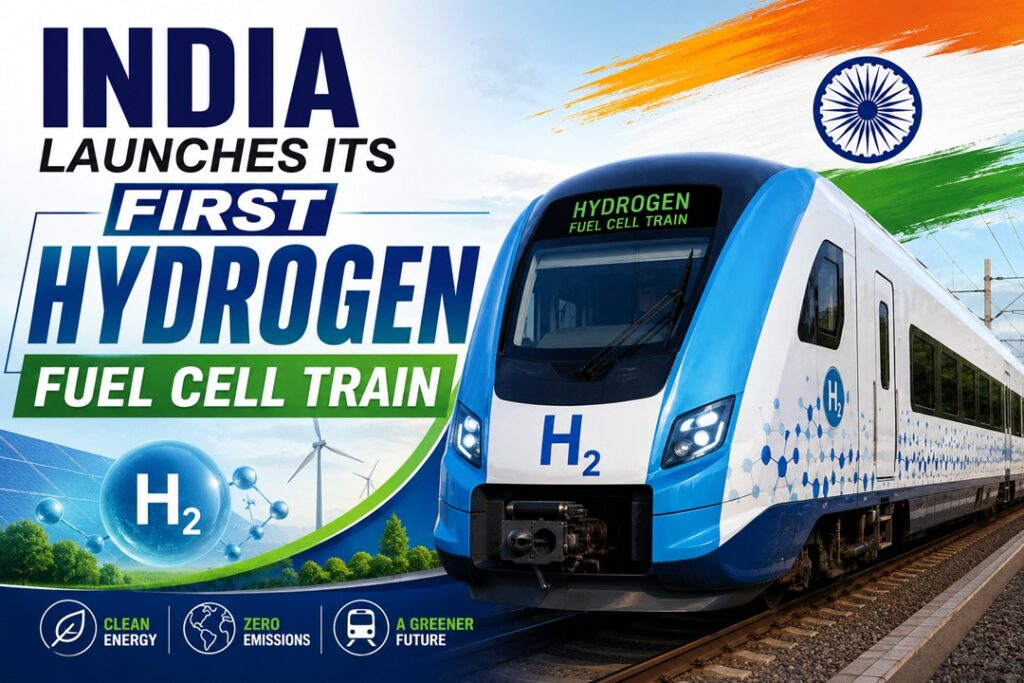
India has entered a new phase of sustainable railway transportation with the launch of its first hydrogen fuel cell-powered passenger train on the 89-km Jind–Sonipat section in Haryana. The service was inaugurated by Prime Minister Narendra Modi on 17 July 2026, marking India’s entry into the group of countries operating hydrogen-powered passenger trains. The project supports the country’s transition towards clean mobility, reduced carbon emissions, energy security, and the objectives of the National Green Hydrogen Mission and Net Zero commitments.
Hydrogen Fuel Cell Train: An Overview
What is a Hydrogen Fuel Cell Train?
A hydrogen fuel cell train is a self-powered railway system that generates electricity onboard using hydrogen gas rather than diesel fuel or overhead electric lines.
Working Mechanism
- The train carries hydrogen fuel in high-pressure storage cylinders.
- Hydrogen reacts with oxygen from the atmosphere inside a Proton Exchange Membrane (PEM) fuel cell.
- This electrochemical reaction produces electricity without combustion.
- The electricity powers traction motors that drive the train.
- The only direct emissions are water vapour and heat, making it a zero tailpipe emission transport system.
Major Features of India’s First Hydrogen Train
Train Composition
The train consists of:
- 2 Hydrogen Driving Power Cars (DPCs)
- 8 Passenger Trailer Coaches
Total coaches: 10
Passenger Capacity
- Total carrying capacity: Around 2,600 passengers
- Seating capacity: Approximately 682 passengers
Technical Specifications
- Route: Jind–Sonipat (89 km), Haryana
- Operational speed: 75 km/h
- Design speed: 110 km/h
- Daily operations: Two round trips
- Daily distance covered: Around 356 km
- Hydrogen consumption: Approximately 300 kg per day
The train is regarded as one of the longest hydrogen-powered passenger trains globally and among the most powerful hydrogen trainsets with a total installed capacity of 2,400 kW.
Hydrogen Propulsion System
Power Arrangement
Each Hydrogen Driving Power Car contains:
- Hydrogen fuel cells
- Lithium Iron Phosphate (LFP) batteries
- High-pressure hydrogen cylinders
Power Modules
Each power car has four integrated power modules, each producing 300 kW.
Each module generates:
- 115 kW from the hydrogen fuel cell
- 185 kW from the LFP battery
Together, both power cars produce 2,400 kW (about 3,200 horsepower), comparable to modern Electric Multiple Units (EMU) and Diesel Electric Multiple Units (DEMU).
Role of the Battery System
The hydrogen fuel cell continuously generates electricity, while the battery adjusts to changing power requirements.
Energy Management
- During start-up and low-speed operation, surplus electricity charges the battery.
- During acceleration and higher speeds, the battery provides additional power.
- During braking and station halts, excess electricity again charges the battery.
This hybrid system improves energy efficiency and ensures the battery remains nearly 80% charged after regular operation.
Fuel Cell Supplier: The PEM fuel cells have been imported from Ballard (Canada).
Hydrogen Production, Storage and Refuelling
Hydrogen Production
Hydrogen is produced onsite through electrolysis, where electricity separates water into hydrogen and oxygen.
Storage
- Hydrogen is compressed to approximately 500 bar.
- Storage capacity at Jind depot: Around 3,000 kg.
Refuelling Process
- Hydrogen is supplied to the train at 350 bar pressure.
- Two independent dispensers simultaneously refuel both Driving Power Cars.
- A chiller system maintains hydrogen at nearly –15°C during refuelling.
The hydrogen facility has been approved by the Petroleum and Explosives Safety Organisation (PESO).
Safety Features
Since hydrogen is colourless, odourless, and highly flammable, multiple safety mechanisms have been incorporated.
Safety Systems
- Hydrogen leak detectors
- Flame detectors
- Heat sensors
- Smoke detectors
- Continuous ventilation
- Automatic hydrogen shut-off system
- Fire alarms
- Water spray fire suppression
Driver Cabin Features
- Real-time monitoring of hydrogen systems
- Emergency operating mode for safe movement during emergencies
The complete hydrogen system underwent independent certification by TÜV SÜD (Germany) before commercial operation.
Development of the Project
The hydrogen train project began during 2020–21 with an estimated cost of ₹136 crore.
Implementation started in April 2022 after awarding the contract to Medha Servo Drives, Hyderabad.
Key Organisations
- Research Designs and Standards Organisation (RDSO): Technical specifications and approvals
- Medha Servo Drives: Hydrogen propulsion integration
- Integral Coach Factory (ICF): Coach design and train aesthetics
Commercial operation received approval from the Ministry of Railways in May 2026.
Global Scenario
Hydrogen Trains Around the World
- Germany became the first country to introduce commercial hydrogen passenger trains through Coradia iLint.
- Countries including France, Italy, China, Japan, and the United States have also launched pilot hydrogen rail services.
Most global hydrogen trains consist of only 2–4 coaches, whereas India’s 10-coach train ranks among the world’s longest hydrogen-powered passenger trainsets.
Future Prospects
Indian Railways plans to expand hydrogen technology based on the experience gained from the Jind–Sonipat project.
Planned Expansion
- Introduction on additional railway routes
- Deployment on heritage railways, including the Kalka–Shimla line
- Promotion of low-carbon railway transportation
- Support for the National Green Hydrogen Mission
- Strengthening energy independence
- Contributing to India’s Net Zero commitments
Future deployment will depend on operational performance, reliability, and economic viability.
Significance of the Project
India’s first hydrogen fuel cell train represents a major milestone in railway innovation and sustainable transportation. It replaces diesel-based propulsion with clean hydrogen fuel cells and battery technology while delivering performance comparable to conventional trains.
The project demonstrates India’s growing capabilities in advanced green technologies, hydrogen infrastructure, and clean mobility solutions. It also strengthens the country’s commitment to reducing transport-related emissions, enhancing energy security, and promoting environmentally sustainable public transportation.
With this achievement, India joins a select group of nations operating hydrogen-powered passenger trains and takes an important step towards the future of carbon-neutral railway transport.
Source : News on Air