
India–South Korea Maritime Partnership: A New Chapter in Shipbuilding Cooperation
Context
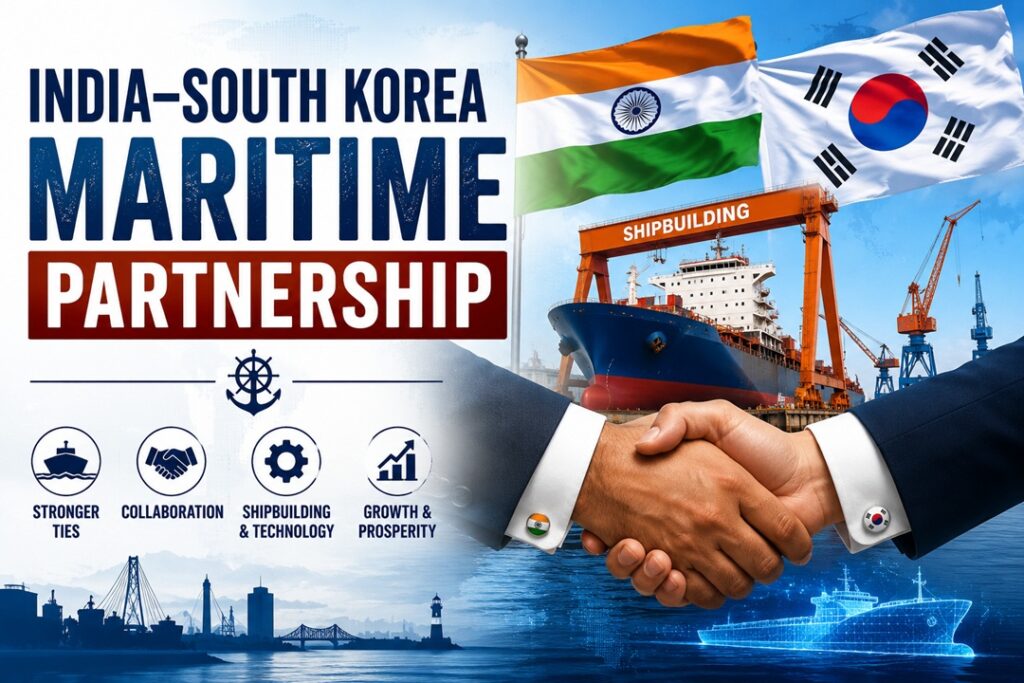
During the landmark visit of South Korean President Lee Jae Myung to India—the first by a South Korean President in eight years—he held high-level talks with Indian Prime Minister Narendra Modi. The visit resulted in several strategic agreements aimed at strengthening maritime cooperation and accelerating India’s ambition to emerge as a global shipbuilding hub.
India’s Emerging Maritime Manufacturing Ecosystem
About India’s Emerging Maritime Manufacturing Ecosystem
What is it?
India is transitioning from limited and import-dependent ship construction to a modern, integrated shipbuilding ecosystem based on industrial clusters, advanced manufacturing, and global partnerships. Inspired by South Korea’s globally successful maritime industry, India aims to develop world-class shipyards, indigenous supply chains, and export-oriented production facilities.
Major Outcomes of the India–South Korea Maritime Cooperation
Large-Scale Shipyard Investment
A subsidiary of HD Korea Shipbuilding & Offshore Engineering (Hyundai) signed an agreement with Cochin Shipyard Limited to establish a modern greenfield shipbuilding complex at Thoothukudi, Tamil Nadu, involving an investment of nearly US$4 billion.
Expansion of Defence Shipbuilding
Samsung Heavy Industries (SHI) entered into a strategic manufacturing partnership with Swan Defence and Heavy Industries for the construction of advanced commercial and defence vessels within India.
Development of a Domestic Marine Supply Chain
The Korea Marine Equipment Association (KOMEA), representing more than 300 specialised marine equipment manufacturers, has opened its Mumbai office to promote local manufacturing of ship components, marine machinery, and repair services.
Technology and Skill Development Cooperation
India and South Korea signed multiple government-to-government (G2G) and business-to-business (B2B) agreements covering maritime education, technology transfer, workforce training, industrial research, and collaborative innovation.
Growing Strategic Investment by Korean Companies
The participation of South Korea’s leading shipbuilders—Hyundai, Samsung Heavy Industries, and Hanwha Ocean—reflects Seoul’s long-term commitment to strengthening India’s maritime manufacturing capabilities.
India’s Present Shipbuilding Landscape
Long-Term National Vision
India’s Maritime Vision 2030 and Maritime Amrit Kaal Vision 2047 seek to position the country among the top 10 global shipbuilding nations by 2030 and the top five by 2047.
Policy Support and Financial Incentives
The Government has introduced initiatives such as:
- Maritime Development Fund
- Shipbuilding Financial Assistance Policy
- Shipbuilding Development Scheme
These measures are designed to attract investments and strengthen domestic shipbuilding infrastructure.
Dedicated Maritime Financing Institution
The establishment of the Sagarmala Finance Corporation Limited (SFCL)—India’s first dedicated maritime-focused Non-Banking Financial Company (NBFC)—aims to improve access to long-term financing for maritime infrastructure projects.
Faster Project Approvals
Recent policy reforms have enabled quicker environmental and regulatory clearances for major shipbuilding projects, demonstrating improved ease of doing business in the maritime sector.
Challenges Facing India’s Shipbuilding Industry
Limited Indigenous Component Manufacturing
India continues to depend heavily on imported marine equipment and specialised ship components due to an underdeveloped domestic supplier ecosystem.
Policy and Regulatory Uncertainty
Frequent policy changes, lengthy approval procedures, and legal uncertainties can discourage long-term foreign investments.
Shortage of Skilled Maritime Professionals
The industry requires a larger pool of engineers and technicians trained in digital ship design, automation, robotics, and green maritime technologies.
Expensive Project Financing
Higher borrowing costs and limited availability of long-term capital reduce the competitiveness of Indian shipbuilders compared to major international players.
Strong Global Competition
Established shipbuilding powers such as China, South Korea, and Japan continue to dominate global markets through economies of scale, advanced technologies, and extensive government support.
Way Forward
Strengthen Centre–State Coordination
Ensure timely land acquisition, infrastructure development, utility connections, and regulatory approvals to facilitate large-scale investments.
Build Indigenous Marine Industrial Clusters
Develop integrated supplier networks around major shipyards to promote local production of marine equipment and reduce import dependence.
Expand Affordable Maritime Financing
Utilise the resources of the Sagarmala Finance Corporation Limited to provide long-term, low-interest financing for shipbuilding and ship repair projects.
Enhance Research and Human Resource Development
Establish partnerships between Indian maritime universities and South Korean institutions to strengthen research, innovation, and skill development.
Adopt a Phased Industrial Growth Strategy
Implement measurable production targets, technology absorption plans, and export-oriented manufacturing policies to build a globally competitive shipbuilding industry.
Conclusion
The agreements concluded during President Lee Jae Myung’s 2026 visit represent a major milestone in India–South Korea maritime cooperation. By combining advanced Korean technology, substantial foreign investment, supportive government policies, and robust domestic manufacturing ecosystems, India has the opportunity to emerge as a leading global centre for shipbuilding, maritime innovation, and blue economy development.
Source : The Hindu