
Patrice Lumumba’s Living Memorial
Context
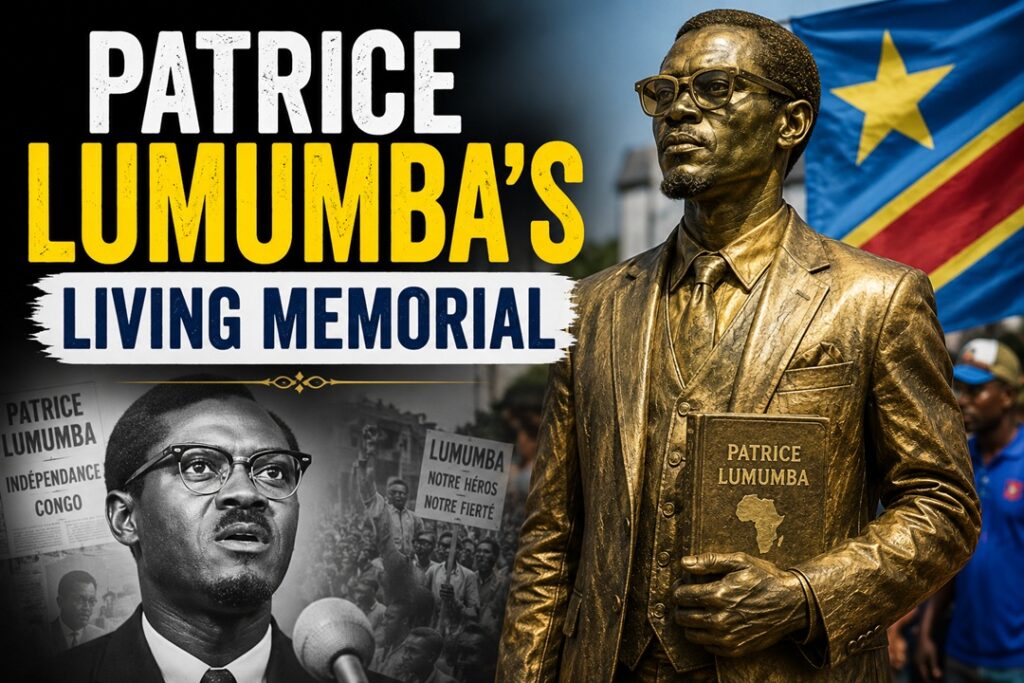
During the FIFA World Cup 2026, Congolese fan Michel Nkuka Mboladinga gained international attention by portraying a living statue of Patrice Lumumba, paying tribute to the Democratic Republic of the Congo’s first Prime Minister and one of Africa’s most influential anti-colonial leaders.
What is Patrice Lumumba’s Living Memorial?
Michel Nkuka Mboladinga, popularly known as Lumumba Vea, has transformed football stadiums into spaces for historical remembrance and African solidarity.
Standing motionless throughout World Cup matches, he recreates the famous Patrice Lumumba statue in Kinshasa, symbolising national independence, decolonisation, African unity, and resistance against colonial domination.
Patrice Lumumba: Life and Political Journey
Early Years
- Born on 2 July 1925 in Kasai Province of the Belgian Congo.
- Worked as a postal clerk during colonial rule, a rare opportunity for Congolese citizens.
- Influenced by Enlightenment thinkers such as Voltaire and Victor Hugo.
Entry into Politics
- His political views became more radical after a prison term in 1956.
- Co-founded the Mouvement National Congolais (MNC), the first nationwide political movement that united different ethnic communities under a common nationalist vision.
Rise to Leadership
- Inspired by African independence movements, particularly Ghana under Kwame Nkrumah.
- Led nationwide campaigns demanding freedom from Belgian colonial rule.
- Following the 1960 general elections, became the first democratically elected Prime Minister of the independent Democratic Republic of the Congo.
The Historic Independence Speech
On 30 June 1960, during Congo’s Independence Day celebrations attended by Belgian King Baudouin and President Joseph Kasa-Vubu, Lumumba delivered an unscripted speech condemning decades of colonial exploitation.
He declared that Congo’s independence had been achieved through struggle and sacrifice rather than through colonial generosity, making the speech a defining moment in African anti-colonial history.
Political Crisis and Assassination
- Soon after independence, Congo faced political instability, foreign intervention, and the secession of the mineral-rich Katanga Province.
- Lumumba was removed from office and arrested following a military coup led by Colonel Joseph Mobutu.
- In January 1961, he was executed with the involvement of Belgian authorities and support from Western intelligence agencies.
- His body was destroyed to conceal evidence, while in 2022 a preserved tooth was ceremonially returned to his family for symbolic burial.
Belgian Colonial Rule in the Congo
Congo Free State
- The Berlin Conference (1884–85) recognised the Congo Free State as the personal possession of Belgian King Leopold II.
Exploitation of Resources
- Forced labour was extensively used to extract rubber, gold, diamonds, cobalt, uranium, and other minerals.
- Millions of Congolese lost their lives due to violence, famine, disease, and exploitative colonial policies.
Educational Neglect
- Colonial authorities deliberately restricted education for native Congolese.
- At independence in 1960, only a very small number of Congolese citizens possessed university degrees.
Major Contributions of Patrice Lumumba
National Integration
- Promoted national unity by bringing together over 200 ethnic communities under a shared Congolese identity.
Pan-African Vision
- Advocated African unity and believed political independence must be accompanied by economic control over natural resources.
Defence of Sovereignty
- Opposed foreign political interference and demanded complete control over Congo’s governance and mineral wealth.
Inspiration for Future Leaders
- His ideas influenced later African leaders and liberation movements, including Thomas Sankara and Nelson Mandela.
Why is the Living Tribute Significant?
Preserving Historical Memory
The tribute uses the global platform of the FIFA World Cup to remind audiences of Congo’s anti-colonial struggle and Lumumba’s enduring legacy.
Symbol of Modern Congo
As the Democratic Republic of the Congo continues to face security challenges and competition over its natural resources, Lumumba remains a symbol of national unity and sovereignty.
Global Relevance
By performing the tribute in countries linked to Cold War geopolitics, the living memorial highlights the continuing importance of historical accountability, decolonisation, and African self-determination.
Conclusion
Michel Nkuka Mboladinga’s living tribute transforms a football stadium into a space of historical remembrance. By recreating Patrice Lumumba’s iconic image, he honours a leader whose vision of an independent, united, and sovereign Africa continues to inspire movements for justice, dignity, and self-determination across the continent and beyond.
Source : The Indian Express