
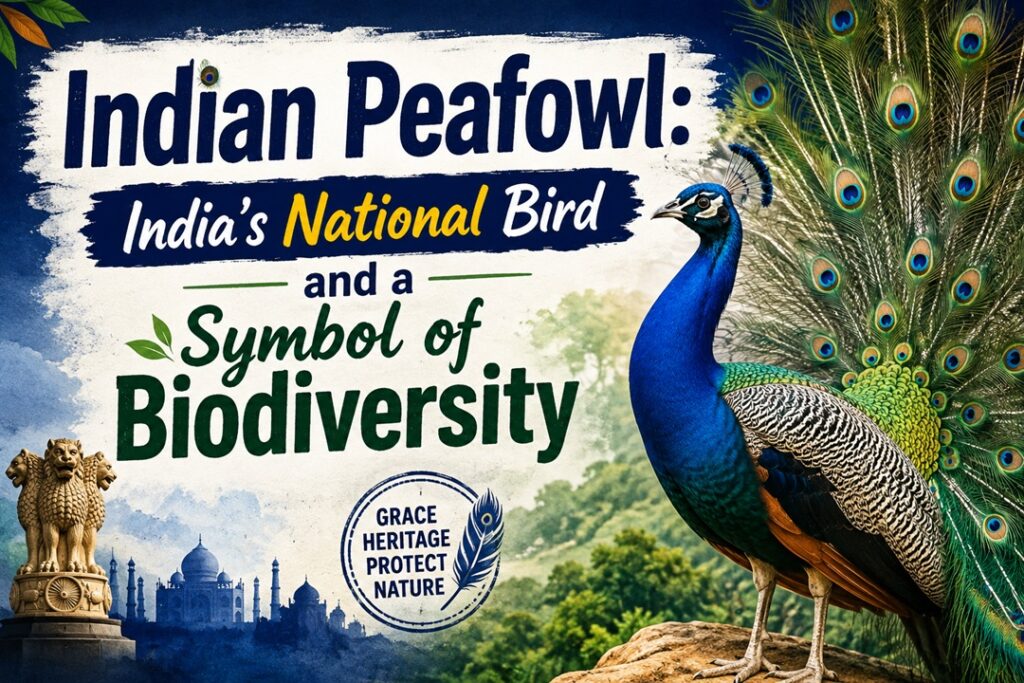
Indian Peafowl: India’s National Bird and a Symbol of Biodiversity
Context
India presented five Indian peafowl—four blue peafowl and one rare white-feathered male—to the United Nations Office at Geneva (UNOG), highlighting India’s rich wildlife heritage and commitment to biodiversity conservation.
India’s Iconic National Bird
About the Indian Peafowl
What is it?
The Indian Peafowl, commonly known as the Indian Peacock, is a large and striking bird belonging to the pheasant family (Phasianidae). It was declared the National Bird of India in 1963 and has deep cultural, religious, artistic, and ecological significance across the country.
Natural Range and Living Environment
Habitat:
Indian peafowl are highly adaptable and occur in open forests, thorny scrublands, grasslands, agricultural landscapes, riverbanks, and areas surrounding human settlements. They are also commonly seen in village outskirts, parks, and other green spaces.
Distribution:
The species is native to South Asia, particularly India, Sri Lanka, Nepal, Bhutan, and Pakistan. It has also been introduced into several parts of the world.
IUCN Status: Least Concern
Protection under Indian Law: Schedule I of the Wildlife Protection Act, 1972
Distinctive Features of Indian Peafowl
Strong Difference Between Male and Female
Indian peafowl exhibit pronounced sexual dimorphism. The male, or peacock, has a brilliant metallic-blue head and neck, along with a prominent crest. The female, or peahen, is comparatively smaller and has subdued brownish plumage that provides effective camouflage while nesting.
Elaborate Courtship Plumage
The spectacular “tail” of the male is actually an elongated upper-tail covert train consisting of more than 200 feathers. These feathers feature distinctive iridescent eye-like markings called ocelli, which are prominently displayed during courtship.
Rare White Colouration
White peafowl are uncommon genetic variants. Their completely white plumage can result from leucism, a condition involving reduced pigmentation. Unlike albino birds, leucistic peafowl generally retain normally pigmented eyes.
Broad and Opportunistic Diet
Indian peafowl are omnivorous ground feeders. Their diet includes grains, seeds, fruits, insects, small reptiles, and young snakes. They may even prey on venomous snakes such as cobras.
Night-time Roosting
Peafowl generally spend the night roosting in elevated locations, including tall trees and suitable structures. Group roosting helps provide protection from ground-based predators.
Remarkable Ecological Flexibility
The species can survive across diverse environments and climatic conditions, ranging from dry and semi-arid regions to moist tropical forests and urban landscapes. This adaptability has contributed to its widespread presence across India.
Why the Indian Peafowl Matters
- National Symbol: It represents India’s natural heritage, cultural traditions, beauty, and biodiversity.
- Ecological Importance: As an omnivorous species, it contributes to ecosystem processes through its feeding and movement across habitats.
- Cultural Heritage: Peafowl have featured prominently in Indian mythology, art, architecture, literature, and traditional symbolism.
- Conservation Significance: Their international presentation at UNOG provides an opportunity to showcase India’s wildlife heritage and its emphasis on biodiversity conservation.
- Environmental Diplomacy: Highlighting the Indian peafowl on an international platform reinforces India’s efforts to promote ecological awareness and conservation through global engagement.
Key Takeaway
The Indian peafowl is more than India’s national bird. Its distinctive appearance, adaptability, cultural importance, and protected status make it an important representative of India’s biodiversity and natural heritage.
Source : NDTV