
Makkah Defence Pact: A New Strategic Triangle in West Asia
Context
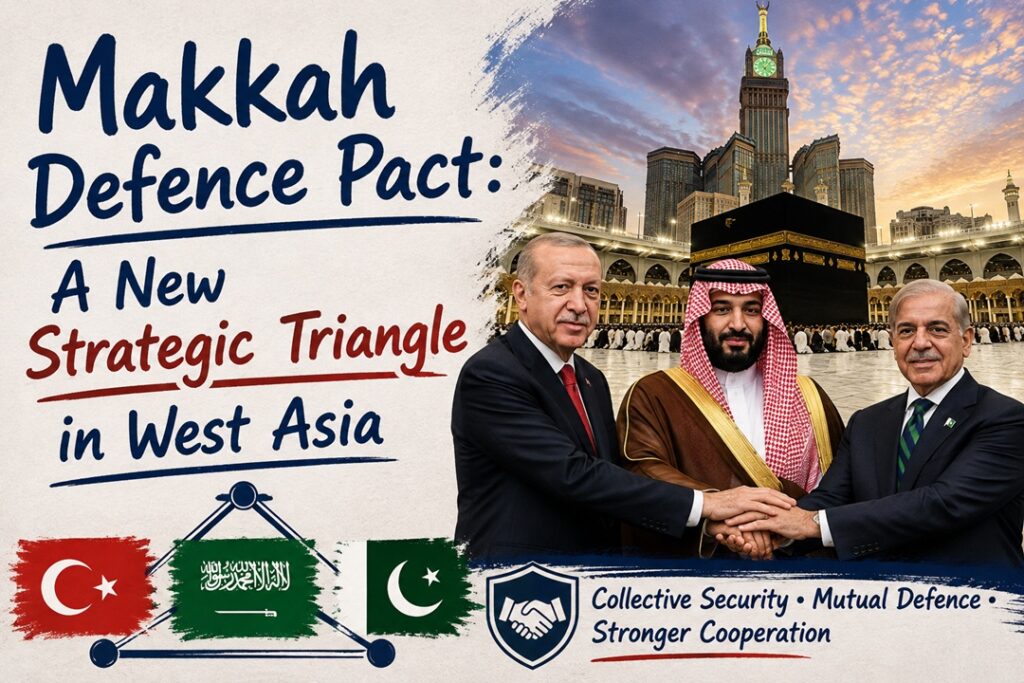
Leaders of Saudi Arabia, Türkiye, and Pakistan have signed the Makkah Joint Defence Agreement (MJDA) in Makkah, establishing a collective security arrangement under which aggression against one member would be treated as an attack on all three. The framework resembles the collective-defence principle embodied in NATO’s Article 5.
What is the Makkah Joint Defence Agreement?
The Makkah Joint Defence Agreement (MJDA) marks the emergence of a new trilateral security framework connecting the Gulf, Türkiye and South Asia. It builds on the Strategic Mutual Defence Agreement (SMDA) signed between Saudi Arabia and Pakistan in 2025 and broadens the partnership by bringing Türkiye into the arrangement.
The pact is largely shaped by Saudi Arabia’s security concerns amid growing regional instability. It seeks to combine the economic strength of Saudi Arabia, Türkiye’s advanced defence capabilities and Pakistan’s military capacity to establish a stronger regional deterrence mechanism.
Major Provisions of the Makkah Accord
Mutual Security Commitment: The agreement introduces a collective-defence provision under which an armed attack against one member is considered aggression against all participating states.
Permanent Coordination Mechanism: A permanent secretariat is to be established in Saudi Arabia, supported by a ministerial-level committee and periodic meetings for defence coordination.
Pooling of Strategic Strengths: The arrangement brings together Saudi Arabia’s financial resources, Türkiye’s defence-industrial expertise in areas such as drones and missile systems, and Pakistan’s large military establishment and nuclear capabilities.
Defence Cooperation and Interoperability: Greater military coordination could involve joint exercises, defence production, technology development, equipment cooperation and efforts to improve interoperability among the three armed forces.
Why Does the Pact Matter?
Significance for West Asia
Push for Strategic Autonomy: The agreement reflects an increasing preference among regional powers for developing independent security capabilities rather than depending exclusively on established US-led security arrangements.
Enhanced Regional Deterrence: For Saudi Arabia, the pact could provide an additional security layer against missile, drone, asymmetric and other threats to critical infrastructure and energy transportation.
Connecting Multiple Strategic Regions: By linking the Gulf, Eastern Mediterranean and South Asia, the agreement creates a security relationship spanning important geopolitical and maritime theatres.
Wider International Consequences
Rise of Alternative Security Partnerships: The pact illustrates the emergence of flexible, non-Western strategic arrangements among major powers of the Global South.
Impact on Indian Ocean Security: Greater defence cooperation among the three countries could influence maritime security, energy flows and commercial shipping around strategically important corridors such as the Strait of Hormuz and Bab al-Mandeb.
Key Obstacles Before the Makkah Pact
Historical Strategic Differences: Saudi Arabia and Türkiye have experienced periods of political competition and differing approaches to regional leadership, which could complicate deeper military integration.
Unclear Operational Framework: Questions remain regarding unified command, actual troop commitments, response mechanisms and rules of engagement, particularly in conflicts involving non-state actors.
Different Approaches Towards Iran: Türkiye and Pakistan maintain important economic and geographical links with Iran. This could make them reluctant to participate in military action directed against Tehran.
Command and Domestic Constraints: Differences in military structures, conditions for overseas deployment and domestic political priorities could limit the pact’s operational effectiveness.
Possibility of New Rival Blocs: The emergence of a stronger trilateral security arrangement could concern countries such as Iran, the UAE, Greece and Israel, potentially encouraging competing strategic partnerships.
Implications for India
Greater Strategic Space for Pakistan: Islamabad could gain additional diplomatic influence and military confidence through closer alignment with two major regional powers.
Saudi Arabia’s Independent Interests: Despite its defence cooperation with Pakistan, Riyadh has substantial economic, energy and strategic interests with India. This makes a direct alignment against New Delhi unlikely.
Need for Maritime Vigilance: Greater military activity around the Arabian Gulf and Arabian Sea would require India to closely track developments affecting its maritime trade and energy routes.
Limited Direct Anti-India Orientation: The pact is primarily driven by West Asian security concerns rather than India-Pakistan rivalry. Therefore, its ability to be converted into an anti-India alliance remains limited.
Balanced Diplomatic Engagement: India should continue strengthening relations with Saudi Arabia and other Gulf partners while maintaining close consultations on emerging regional security developments.
Conclusion
The Makkah Joint Defence Agreement signals an important evolution in West Asian security politics, reflecting the growing ambition of regional powers to develop their own strategic and defence arrangements. By combining Saudi Arabia’s financial strength, Türkiye’s defence technology and Pakistan’s military capabilities, the pact has the potential to create a significant deterrence framework.
However, divergent geopolitical priorities, uncertain command arrangements and differing approaches towards Iran could constrain its long-term institutionalisation. For India, the appropriate response is calibrated diplomacy—deepening ties with Gulf partners, safeguarding maritime interests and avoiding an exaggerated interpretation of a pact primarily shaped by West Asian security dynamics.
Source : The Hindu