
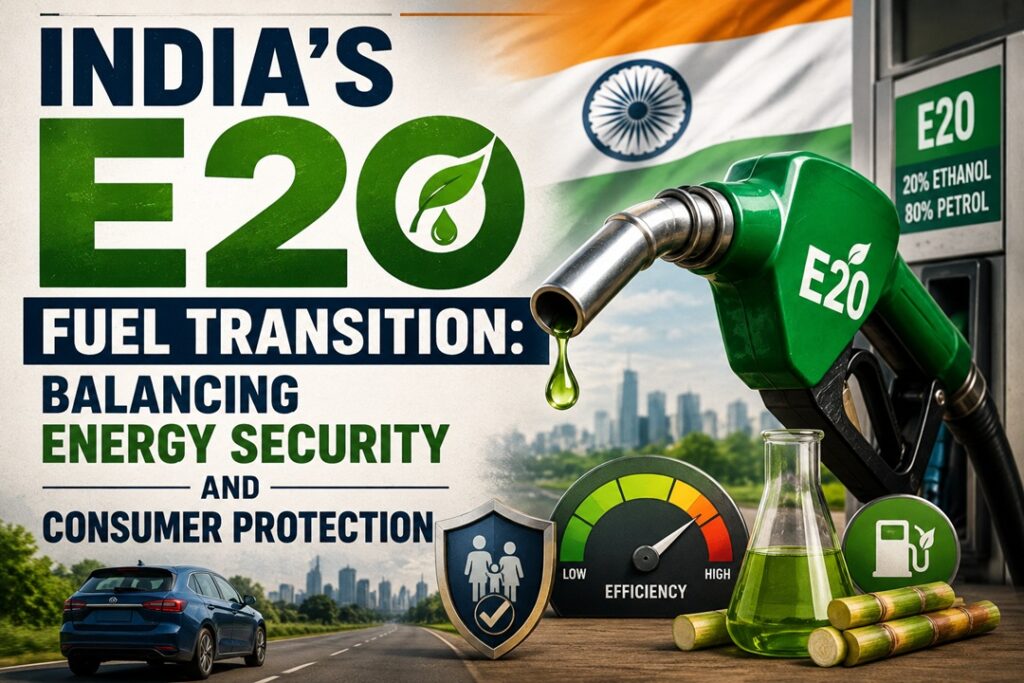
India’s E20 Fuel Transition: Balancing Energy Security and Consumer Protection
Context
India’s nationwide move towards E20 petrol—containing up to 20% anhydrous ethanol and a minimum Research Octane Number (RON) of 95—has generated debate over vehicle compatibility, fuel quality and consumer protection.
India’s E20 Rollout: Balancing Green Goals with Consumer Concerns
What Does the E20 Policy Entail?
- The E20 transition is a major component of the Ethanol Blended Petrol (EBP) Programme, designed to replace a portion of fossil-based petrol with domestically produced renewable ethanol.
- Ethanol is a hygroscopic and solvent-like fuel additive with around 30–35% lower energy density than conventional petrol. Its widespread use can therefore create technical concerns for older vehicles designed primarily for E5 or E10 blends.
- The absence of separate lower-blend fuel options has intensified concerns among owners of pre-2023 vehicles.
Important Figures and Emerging Evidence
- Large Legacy Vehicle Base: India has around 310 million petrol vehicles, of which nearly 240 million, or about 77%, are legacy vehicles that were not originally engineered specifically for E20.
- Fuel Economy and Upkeep: Consumer feedback indicates that more than 66% of pre-2023 vehicle owners report mileage reductions of over 10%, while around 55% report increased maintenance requirements and premature component deterioration.
- Chloride Contamination: Fuel quality checks across several States have reportedly detected organic chloride concentrations well above the prescribed 3 ppm ceiling, including levels of 570 ppm in parts of Rajasthan and 420 ppm in Delhi.
- Moisture Contamination: Water contamination in retail storage has reportedly reached around 12,500 ppm in Uttar Pradesh and 13,000 ppm in Andhra Pradesh, increasing the possibility of phase separation and corrosion.
Where Does India Stand on E20?
- Nationwide E20 Availability: From April 1, 2026, petrol containing up to 20% ethanol with a minimum RON of 95 has been mandated for retail sale across States and Union Territories.
- E0 Withdrawal: The disappearance of unblended petrol from retail outlets has reduced fuel choices for consumers with older vehicles.
- Post-2023 Vehicle Standards: Vehicles manufactured after April 2023 under advanced BS6 emission requirements are better equipped for E20, including ethanol-compatible fuel-system materials and calibrated engine-management systems.
- Compatibility Assessment Gap: The government has indicated that a comprehensive inter-ministerial evaluation of the exact proportion of India’s vehicle fleet fully compatible with E20 has not been undertaken.
- Mixed Research Findings: Laboratory assessments have generally indicated relatively modest efficiency impacts, while some field observations, consumer reports and automotive industry data point towards higher wear and component-related problems in older vehicles.
Measures Undertaken by the Government and Industry
- Improved Fuel Specification: E20 has been assigned a minimum RON of 95, strengthening resistance to engine knocking and supporting stable combustion.
- Faster Ethanol Adoption: India has accelerated ethanol blending substantially ahead of the earlier 2030 objective by expanding ethanol production based on sugarcane, grains and other feedstocks.
- Industry-Led Testing: The Society of Indian Automobile Manufacturers (SIAM) has undertaken scientific studies involving multiple stakeholders to assess the long-term impact of ethanol blends on vehicle components.
Major Issues in the E20 Transition
- Moisture Absorption and Phase Separation: Ethanol readily absorbs water. Excessive moisture can result in phase separation, potentially causing corrosion, poor combustion and vehicle stalling.
- Damage to Rubber and Sealing Materials: Older fuel systems containing conventional NBR hoses, seals and diaphragms may experience swelling, hardening or deterioration after prolonged exposure to higher ethanol concentrations.
- Fuel-System Deposits: Ethanol’s solvent properties can loosen accumulated deposits and rust particles in ageing fuel tanks, potentially clogging filters and affecting injectors.
- Underground Storage Vulnerability: Water entering underground storage tanks can contaminate entire fuel batches, increasing the risk of phase separation and degraded fuel quality.
- Consumer Equity: Older vehicle owners could face reduced mileage and additional maintenance expenses without access to an affordable lower-ethanol alternative.
Policy Options for a Smoother Transition
- Provide Lower-Blend Fuel Choices: Oil marketing companies could consider retaining dedicated dispensing facilities for E0/E10 petrol, particularly in areas with a large population of older vehicles.
- Strengthen Pump-Level Information: Retail outlets should prominently display the ethanol percentage and RON rating of the fuel being dispensed.
- Promote Certified Retrofit Solutions: Affordable retrofit packages incorporating ethanol-resistant hoses, seals and improved filtration systems could help extend the usable life of older two-wheelers and cars.
- Tighten Fuel-Quality Surveillance: Continuous monitoring of water content, organic chlorides and other contaminants should cover production facilities, transport systems and retail storage tanks.
- Undertake Long-Term Field Studies: Independent, multi-year trials across different climatic regions can provide stronger evidence on mileage, durability and maintenance impacts among legacy vehicles.
Conclusion
India’s E20 transition can strengthen energy security, reduce petroleum imports and support cleaner mobility. However, its success will depend on ensuring fuel quality, protecting legacy vehicle owners and providing evidence-based consumer safeguards alongside the country’s broader biofuel objectives.
Source : The Hindu