
India-Japan Defence Partnership: Strengthening Strategic and Operational Cooperation in the Indo-Pacific
Context
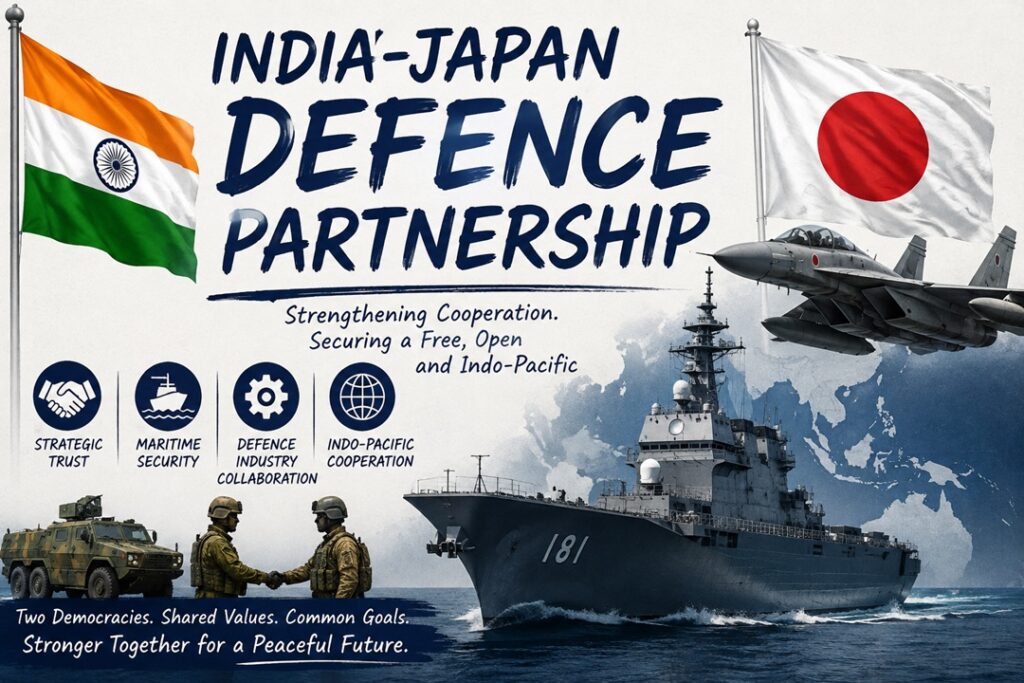
The rapidly changing security environment in Asia is encouraging India and Japan to reassess and expand their defence partnership, with greater emphasis on operational cooperation, defence technology, joint production and strategic resilience.
What is driving closer India-Japan security cooperation?
China’s Expanding Strategic Footprint
- The growing military and economic influence of China is one of the major factors shaping the security policies of both India and Japan.
- Beijing’s increasing military capabilities and assertive actions have raised concerns about attempts to alter the existing regional status quo.
- Japan’s concerns – Chinese activities in the East China Sea, particularly around the Senkaku Islands, remain a major security challenge.
- India’s concerns – India continues to face Chinese military pressure and border tensions along the Himalayan frontier.
- Although India’s primary security challenge is continental and Japan’s is largely maritime, both countries face a common strategic challenge arising from the changing balance of power in Asia.
Changing Role of the United States
- The United States continues to remain an important security partner for both India and Japan.
- Japan relies on its longstanding US alliance, while India considers American engagement important for maintaining stability in the Indo-Pacific.
- However, uncertainty over the continuity and predictability of US strategic commitments has encouraged both countries to strengthen their own capabilities.
- The objective is not to substitute the US role but to develop greater regional capacity, strategic autonomy and resilience.
How has Japan transformed its defence policy?
From Post-War Restraint to Strategic Assertiveness
- After World War II, Japan largely prioritised economic development while depending on the US security umbrella for national defence.
- Defence spending remained comparatively restrained, arms exports were heavily restricted and the Self-Defense Forces operated under significant political and constitutional limitations.
- The rapid expansion of Chinese military power gradually challenged this approach.
- Under former Prime Minister Shinzo Abe, Japan began a significant transformation of its security and defence policies.
- The 2022 defence reforms marked an important milestone in this transition.
Major Elements of Japan’s New Defence Approach
Japan has sought to:
- Raise defence expenditure towards approximately 2% of GDP;
- Develop long-range counterstrike capabilities;
- Strengthen air and missile defence;
- Expand capabilities in cyber and space;
- Increase the use of unmanned systems;
- Improve the ability of the Self-Defense Forces to operate beyond Japan’s immediate territory; and
- Strengthen the domestic defence-industrial base.
- Japan has also gradually relaxed restrictions on defence exports.
- The Official Security Assistance (OSA) framework enables Japan to provide security-related assistance to partner countries.
- Thus, defence capabilities, military technology, arms exports and security assistance are increasingly becoming instruments of Japanese foreign and strategic policy.
What are the existing pillars of India-Japan defence cooperation?
Institutional Mechanisms
India and Japan have developed several mechanisms that provide a foundation for deeper defence cooperation:
- 2+2 Foreign and Defence Ministerial Dialogue;
- Logistics support arrangements;
- Regular military exercises;
- Cooperation among the three armed forces;
- Maritime security cooperation; and
- Growing engagement in defence technology.
Maritime Security Cooperation
- Maritime security has emerged as an important area of bilateral cooperation.
- Both countries are working towards improving Maritime Domain Awareness (MDA) and strengthening coordination in the Indo-Pacific.
- Naval exercises and information-sharing initiatives provide opportunities to improve operational familiarity and interoperability.
Defence Technology Cooperation
- The proposed bilateral defence co-development initiative involving the UNICORN naval communications antenna represents an important move towards greater technological cooperation.
- Such projects can provide a foundation for broader collaboration in advanced defence systems.
- However, institutional agreements and individual projects need to be converted into long-term industrial and operational capabilities.
What lessons can India learn from Japan-Australia defence cooperation?
Moving Beyond Exercises
- Japan’s growing strategic partnership with Australia demonstrates how defence relationships can evolve beyond dialogue and military exercises.
- Tokyo and Canberra have expanded cooperation in:
- Military exercises;
- Reciprocal access arrangements;
- Logistics;
- Defence-industrial collaboration; and
- Defence procurement.
- Australia’s decision to acquire Mogami-class frigates designed by Japan represents an important development in Japan’s emergence as a defence exporter.
- For India, this demonstrates the potential for moving towards joint procurement, co-development and co-production.
What are the major challenges in India-Japan defence cooperation?
Limited Defence-Industrial Collaboration
- Defence cooperation between India and Japan has not yet reached its full potential in joint research, development and manufacturing.
- Differences in procurement procedures, regulatory systems and industrial structures can slow down collaborative projects.
- Greater participation of private companies is required to accelerate innovation and production.
Exercises Need Greater Operational Depth
- Existing military exercises provide an important foundation, but cooperation needs to become more operationally sophisticated.
- Future exercises could focus more strongly on:
- Anti-submarine warfare;
- Maritime surveillance;
- Air and missile defence;
- Logistics and replenishment;
- Unmanned systems;
- Cyber and space operations; and
- Intelligence and information sharing.
Untapped Technological Potential
- Japan possesses advanced capabilities in precision engineering, robotics, sensors and manufacturing.
- India has a growing defence industry, technological workforce, software capabilities and expanding start-up ecosystem.
- Combining these strengths could facilitate joint development of:
- Sensors;
- Robotics;
- Secure communication systems;
- Unmanned platforms; and
- Advanced maritime technologies.
Defence Supply-Chain Dependence
- Concentration of critical defence supply chains in a limited number of countries creates strategic vulnerabilities.
- India-Japan industrial cooperation can contribute to more diversified and resilient defence production networks.
- Joint manufacturing can also strengthen the wider defence ecosystem across the Indo-Pacific.
What should India and Japan do going forward?
Expand Co-Development and Co-Production
India and Japan should identify specific defence technologies and platforms for joint research, development and manufacturing. Long-term industrial partnerships should be prioritised over isolated procurement projects.
Improve Military Interoperability
Military exercises should increasingly simulate realistic operational scenarios, particularly in maritime warfare, logistics, surveillance and coordinated responses to regional contingencies.
Strengthen Maritime Domain Awareness
Both countries should improve the exchange of maritime information, surveillance data and intelligence to develop a clearer common operating picture across the Indo-Pacific.
Increase Private-Sector Participation
Private defence companies, start-ups and technology firms should be given greater opportunities to participate in bilateral projects. Simplified procedures and faster decision-making can help reduce bureaucratic delays.
Strengthen Minilateral Cooperation
India and Japan should expand cooperation with Australia, the United States, South Korea and other like-minded Indo-Pacific partners through trilateral and minilateral arrangements.
Such cooperation should focus on maintaining a free, open, inclusive and rules-based Indo-Pacific, rather than becoming an exclusively China-focused military arrangement.
Conclusion
India and Japan have a strong strategic convergence in the Indo-Pacific. Their defence relationship now needs to progress from dialogue and exercises towards operational interoperability, technology cooperation, joint development and co-production. A stronger partnership can enhance strategic resilience and contribute to stability in the Indo-Pacific.
Source : The Indian Express