
India’s Water Crisis: A Governance and Management Challenge
Context
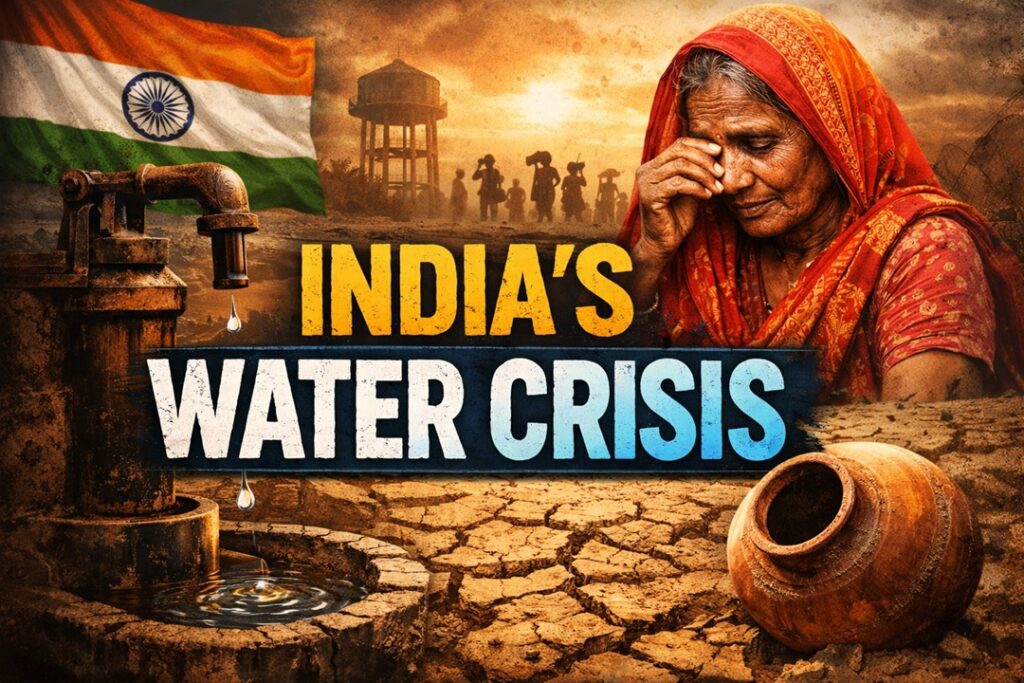
Recurring incidents of water contamination and waterborne diseases—recently reported in regions like Haryana and Madhya Pradesh—highlight that India’s water crisis is primarily due to governance failures and weak infrastructure rather than absolute scarcity.
India’s Water Challenge: A Systemic Management Failure
Nature of the Issue
- The crisis originates from a linear water management model that prioritizes extraction and supply (dams, pipelines) but ignores reuse and sustainability.
- Water is treated as a technical commodity, not an ecological resource, leading to contamination despite advanced urban systems.
Key Facts & Figures
- Limited Resource Base: India holds only ~4% of global freshwater but supports ~17% of the population.
- Groundwater Stress: Over 60% of irrigation and rural needs depend on groundwater.
- Urban Inequality: Cities like Delhi receive 20–40 GPCD in some areas vs required 60 GPCD.
- Water Losses: Around 50%+ water is lost as Non-Revenue Water (NRW).
- Skewed Spending: Majority funds go to supply infrastructure, while minimal share goes to restoring water bodies.
Why It Is a Governance Crisis (Not Scarcity)
- Aging Infrastructure: Leaky, corroded pipelines near sewer lines cause contamination.
- Poor Data Systems: Absence of updated pipeline mapping hampers maintenance.
- Fragmented Institutions: Multiple agencies operate in silos, reducing accountability.
- Neglect of Traditional Systems: Lakes, tanks, and ponds are encroached or degraded.
- Opaque Data Ownership: Critical water data often lies with private contractors, limiting public oversight.
Demand-Side & Usage Concerns
- Unplanned Urbanization: Excess concretization blocks groundwater recharge.
- Throwaway Water Economy: Wastewater is discharged instead of reused.
- External Dependence: Cities rely heavily on distant rivers instead of local sources.
- Agricultural Mismanagement: Polluted canals affect irrigation quality and health.
- Weak Public Participation: Citizens are passive consumers, not active managers.
Government Interventions
- AMRUT & SBM-U 2.0: Focus on urban water supply, sanitation, and green infrastructure.
- Atal Bhujal Yojana: Promotes community-led groundwater sustainability.
- Jal Jeevan Mission (Urban): Ensures functional tap connections for households.
- Rainwater Harvesting Norms: Mandatory in many states for building approvals.
- Ayushman Bharat Linkages: Addresses health impacts of water contamination.
Way Forward: Sustainable Water Governance
- Water-Sensitive Urban Planning: Integrate ecology, hydrology, and urban design.
- Circular Water Use: Promote wastewater recycling via decentralized STPs.
- Revival of Water Bodies: Restore lakes and wetlands as recharge systems.
- Smart Monitoring: Deploy digital tools (SCADA, sensors) to track losses.
- Community-Centric Approach: Involve citizens and farmers in water governance.
Conclusion
India’s water crisis is less about physical scarcity and more about institutional inefficiency and mismanagement. A shift toward integrated, circular, and participatory water governance is essential to prevent recurring public health disasters and ensure long-term sustainability.
Source : FL