
Mission Poshan 2.0: Strengthening India’s Nutrition Framework
Context
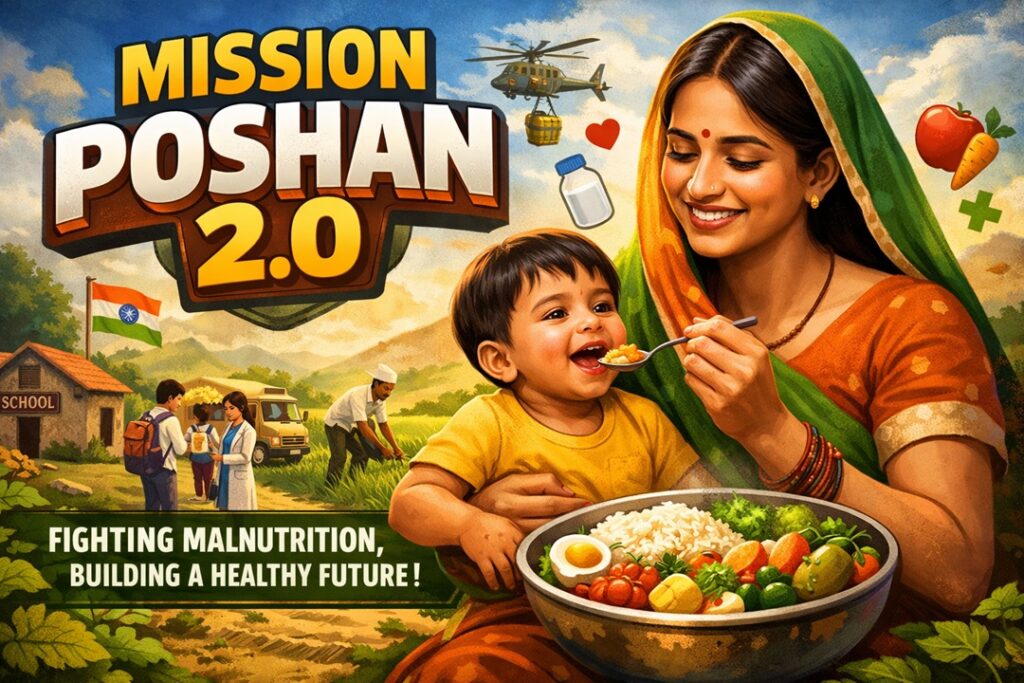
Mission Poshan 2.0 represents a major policy push by the Government of India to address persistent malnutrition and improve nutritional outcomes among women and children through an integrated, technology-driven, and lifecycle-based approach.
About the Nutrition Mission
Definition – POSHAN (Prime Minister’s Overarching Scheme for Holistic Nourishment) is India’s flagship programme to address malnutrition.
Objective – Targets improved nutrition outcomes for children, pregnant women, lactating mothers, and adolescent girls.
Nature of Scheme – Centrally Sponsored Scheme with revised sharing ratios (60:40; 90:10 for special states; 100% for UTs without legislature).
Launch Timeline – Initiated on 8 March 2018.
Strategic Orientation – Moves from welfare-based provisioning to a lifecycle and outcome-oriented framework.
Core Focus – Emphasis on the first 1000 days (conception to 2 years) for optimal development.
Evolution and Policy Context
ICDS (1975) – Established base for nutrition, health, and early childcare via Anganwadis.
PMMVY (2017) – Introduced maternity entitlements through DBT.
National Nutrition Strategy (2017) – Highlighted convergence, monitoring, and behavioural change.
POSHAN Abhiyaan (2018) – Created unified multi-sectoral coordination.
Mission Poshan 2.0 (2021) – Consolidated schemes for improved delivery efficiency.
Broader Shift – Integration of health, sanitation, education, and gender dimensions.
Core Design Features
Multi-sectoral Convergence – Coordination across 25+ ministries.
Preventive Lifecycle Approach – Focus on adolescent, maternal, and child nutrition.
Digital Governance – Real-time tracking through Poshan Tracker.
Mass Mobilisation – Jan Andolan via Poshan Maah and Pakhwada.
Outcome Targets – Reduction in stunting, wasting, anaemia, and low birth weight.
Critical Window Approach – Special focus on early childhood phase.
Institutional Reforms under Poshan 2.0
Scheme Integration – Merges Anganwadi Services, SAG, and POSHAN Abhiyaan.
Nutrition Diversification – Shift to balanced diets with micronutrients.
Outcome-Based Focus – Emphasis on maternal nutrition and SAM/MAM management.
Infrastructure Upgrade – Conversion to Saksham Anganwadis.
Holistic Health Approach – Inclusion of AYUSH systems.
Programme Components
Supplementary Nutrition – Coverage for children (6 months–6 years), mothers, and adolescents under NFSA.
Malnutrition Management – SAM referrals to NRCs and CMAM strategy.
Local Food Systems – Promotion of Poshan Vatikas.
Growth Monitoring – Regular screening and home visits.
Early Childhood Education –
Aligned with NEP 2020 and ECCE Policy.
Play-based learning (3–6 years).
Initiatives like Poshan Bhi Padhai Bhi.
Capacity Enhancement –
Large-scale training of Anganwadi workforce.
Frameworks like Navchetana (0–3 yrs) and Aadharshila (3–6 yrs).
Saksham Anganwadi –
Modernised centres with digital tools and improved facilities.
Co-location with schools for smooth transition.
Developmental Significance
Human Capital Formation – Enhances productivity and learning outcomes.
Malnutrition Reduction – Direct impact on stunting, wasting, anaemia.
Women-Centric Approach – Strengthens maternal health.
Cognitive Gains – Links nutrition with early education.
Community Participation – Behavioural change through Jan Andolan.
SDG Linkages – Supports SDG 2, 3, and 4.
Governance and Innovation
Poshan Tracker (2021) – Monitors ~9 crore beneficiaries across 14 lakh Anganwadis.
Aadhaar & FRS Integration – Ensures transparency and accountability.
Home Visit Scheduler (2026) – Structured counselling visits for mothers and children.
Grievance System – Helpline (1515) in multiple languages.
Recognition – PM’s Award for Excellence in Public Administration (2024).
Performance Review
Key Gains –
Improved real-time monitoring.
Wide beneficiary outreach.
Strong community participation.
Better inter-ministerial coordination.
Persistent Issues –
Regional disparities in malnutrition.
Capacity gaps in implementation.
Digital divide in remote areas.
Slow behavioural transformation.
Infrastructure deficits.
Structural Concerns –
Hidden hunger (micronutrient deficiency).
Intergenerational malnutrition cycle.
Way Forward
Last-Mile Strengthening – Improve frontline workforce and infrastructure.
Behavioural Interventions – Deepen awareness on diet and hygiene.
Tech Integration – Expand digital accessibility and analytics use.
Nutritional Quality – Ensure diverse and fortified food supply.
Convergence Mechanism – Strengthen inter-sectoral coordination.
Targeted Strategy – Focus on high-burden districts.
Continuous Evaluation – Evidence-based policy adjustments.
Conclusion
Mission Poshan 2.0 reflects a holistic and convergent strategy to tackle malnutrition.
Its success depends on state capacity, grassroots governance, and cooperative federalism.
Nutrition must be viewed as a multi-dimensional development challenge, linked to poverty, gender inequality, sanitation, and food systems.
Sustained efforts will be critical to achieving the vision of a healthy and developed India by 2047.
Source : PIB