
International Pressure on Iran’s Enriched Uranium and the Global Nuclear Non-Proliferation Framework
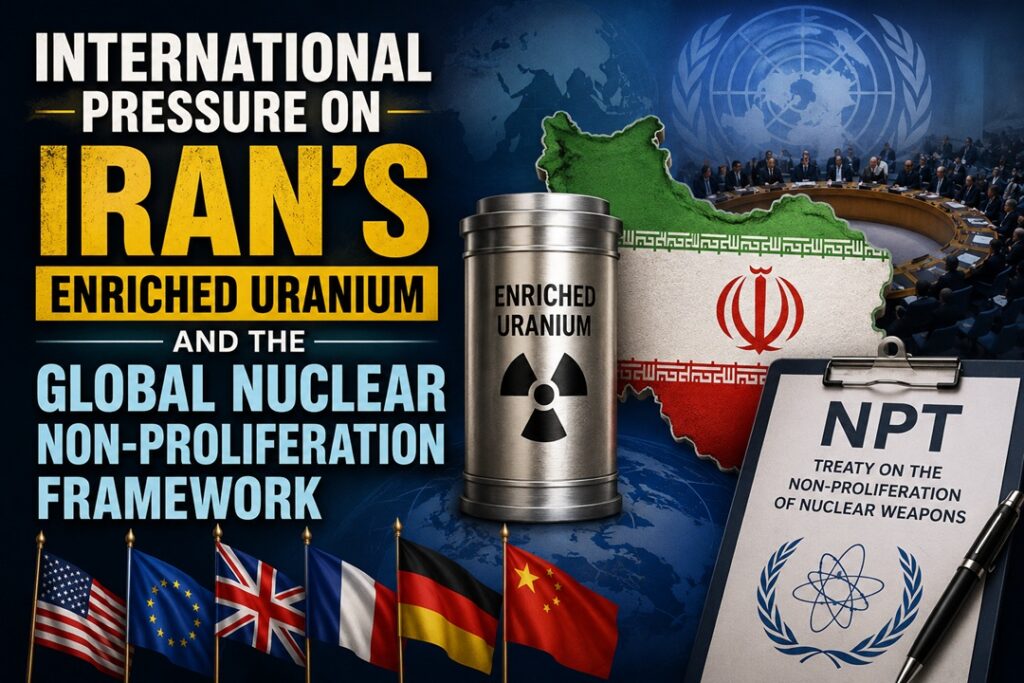
Context
International concern has intensified over Iran’s growing stockpile of enriched uranium, with several countries calling for stricter oversight and limitations on its nuclear programme. The developments have renewed attention on the Treaty on the Non-Proliferation of Nuclear Weapons (NPT) and the broader global efforts to prevent the spread of nuclear weapons.
Nuclear Non-Proliferation Treaty (NPT): An Overview
About the NPT
- Background – The Treaty on the Non-Proliferation of Nuclear Weapons (NPT) entered into force in 1970 and serves as the foundation of the international nuclear non-proliferation regime.
- Objective – It aims to prevent the spread of nuclear weapons, encourage the peaceful use of nuclear energy, and promote global nuclear disarmament.
- Monitoring Mechanism – The treaty is implemented under the supervision of the International Atomic Energy Agency (IAEA), which verifies compliance through inspections and safeguards.
Fundamental Pillars of the NPT
- Non-Proliferation – Non-nuclear states agree not to acquire or manufacture nuclear weapons.
- Disarmament – Nuclear-weapon states commit to pursuing negotiations towards complete nuclear disarmament.
- Peaceful Use of Nuclear Energy – All member countries have the right to develop nuclear technology for peaceful purposes under IAEA safeguards.
Categories of States
- Nuclear-Weapon States (NWS) – Countries that tested a nuclear weapon before 1 January 1967:
- United States
- Russia
- China
- France
- United Kingdom
- Non-Nuclear-Weapon States (NNWS) – All other treaty members that have renounced nuclear weapons.
Membership Status
- Total Members – 191 countries.
- Outside the Treaty
- Never Joined – India, Pakistan and Israel.
- Withdrawn – North Korea (withdrew in 2003).
Significance of the NPT
Preventing Nuclear Proliferation
- Restricts the spread of nuclear weapons and reduces the possibility of new nuclear-armed states emerging.
Promoting Peaceful Nuclear Cooperation
- Enables countries to use nuclear technology for electricity generation, agriculture, medicine, and scientific research.
International Verification
- IAEA inspections help ensure civilian nuclear facilities are not diverted for military purposes.
Advancing Nuclear Disarmament
- Creates a legal framework encouraging nuclear-weapon states to negotiate reductions in their arsenals.
Strengthening Global Security
- Establishes international norms that reduce the likelihood of nuclear conflict and enhance strategic stability.
Challenges Associated with the NPT
Unequal Structure
- Critics argue the treaty creates a permanent distinction between nuclear and non-nuclear states instead of eliminating nuclear inequality.
Limited Progress on Disarmament
- Nuclear powers continue modernising their arsenals despite commitments to eventual disarmament.
Compliance and Verification Issues
- Allegations of undeclared nuclear activities in countries such as Iran and North Korea have challenged the effectiveness of the verification system.
Non-Member Nuclear States
- India, Pakistan, Israel, and North Korea remain outside the treaty framework, affecting its universal credibility.
Dual-Use Nuclear Technology
- Uranium enrichment and plutonium reprocessing can support civilian energy production but may also facilitate weapon development.
Perceived Double Standards
- Many developing countries believe nuclear powers have not fulfilled their own disarmament obligations while expecting strict compliance from others.
Measures to Strengthen the NPT
Enhance IAEA Safeguards
- Promote universal adoption of the IAEA Additional Protocol to improve inspection capabilities and transparency.
Strengthen Withdrawal Provisions
- Introduce stronger diplomatic and economic consequences for countries that violate treaty obligations before withdrawing.
Accelerate Nuclear Disarmament
- Encourage nuclear-weapon states to undertake verifiable reductions and revive arms-control agreements.
Expand Nuclear-Weapon-Free Zones
- Promote legally binding nuclear-weapon-free regions, especially in conflict-prone areas such as the Middle East.
Strengthen Complementary Treaties
- Facilitate the implementation of the Comprehensive Nuclear-Test-Ban Treaty (CTBT) and negotiate a Fissile Material Cut-off Treaty (FMCT).
Comprehensive Nuclear-Test-Ban Treaty (CTBT)
About the CTBT
- The CTBT prohibits all nuclear weapon test explosions and any other nuclear explosions worldwide.
- Adopted – By the United Nations General Assembly in 1996.
- Monitoring Body – The Comprehensive Nuclear-Test-Ban Treaty Organization (CTBTO) operates a global monitoring network to detect nuclear tests.
Ratification Status
- Signed by 187 countries, but it has not yet entered into force.
- Entry into force requires ratification by 44 Annex 2 countries possessing nuclear reactors or research facilities during treaty negotiations.
Present Status
Not Signed/Ratified
- India
- Pakistan
- North Korea
Signed but Not Ratified
- United States
- China
- Egypt
- Iran
- Israel
Ratification Withdrawn
- Russia withdrew its ratification in 2023, although it had ratified the treaty in 2000.
Conclusion
The NPT remains the cornerstone of the global nuclear non-proliferation regime, while the CTBT complements it by seeking to eliminate nuclear testing. Strengthening compliance, improving verification, advancing disarmament commitments, and expanding universal participation remain essential for ensuring long-term international peace and nuclear security.
Source : The Hindu