
Ethical Prompt Engineering: Building Responsible and Fair AI Systems
Context
A recent policy discussion has argued that responsible Artificial Intelligence (AI) cannot depend only on voluntary commitments by technology companies. Experts emphasize the need for enforceable safeguards to address algorithmic discrimination, privacy risks, unchecked data collection, copyright concerns, and unfair labour practices.
Responsible AI and Ethical Prompt Engineering
About Responsible AI and Ethical Prompt Engineering
What is Ethical Prompt Engineering?
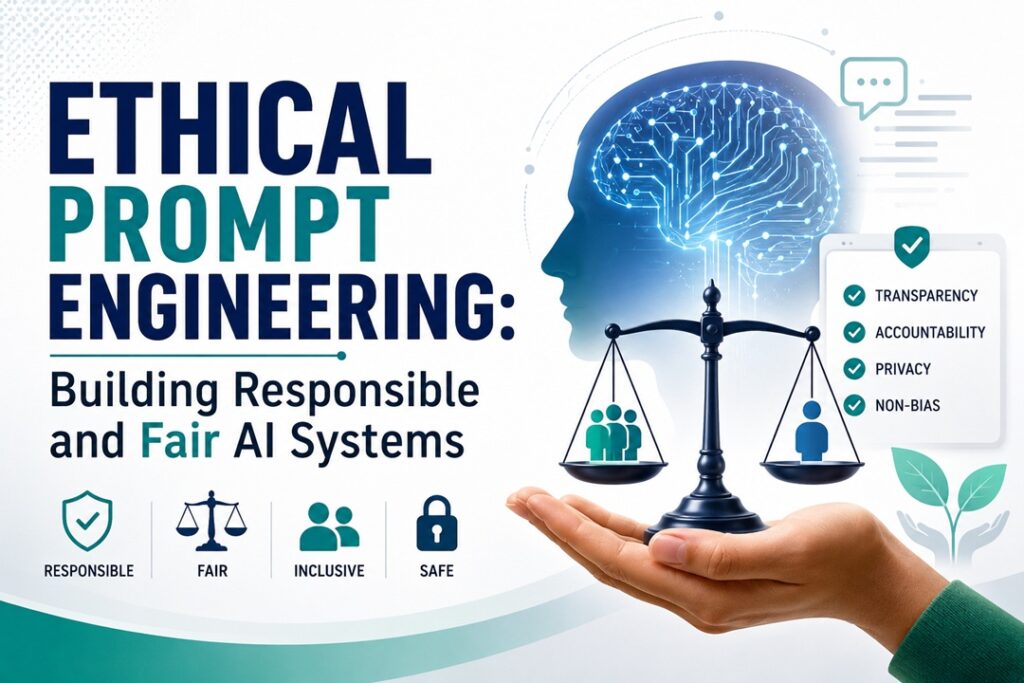
Ethical Prompt Engineering is a system-level approach that embeds ethical principles, human rights standards, and contextual safeguards directly into the foundational instructions of Large Language Models (LLMs) and Generative AI systems.
Instead of relying only on content moderation after responses are generated, this method requires AI models to assess their outputs against predefined ethical principles before presenting them to users.
It effectively acts as an internal ethical framework, enabling AI systems to reduce harmful content, minimize social bias, and improve the reliability of generated information.
Major Features of Ethical Prompt Engineering
Constitutional Rule Integration
AI systems are designed with embedded constitutional principles that continuously evaluate responses based on values such as accuracy, safety, fairness, and transparency.
Context-Aware Bias Monitoring
The model actively reviews its language patterns to identify subtle discriminatory expressions and maintain consistent treatment across different social groups.
Human Rights-Based Alignment
Ethical prompts are developed using internationally recognized frameworks such as the Universal Declaration of Human Rights (UDHR), ensuring that AI decisions prioritize public welfare over commercial interests.
Explainable Decision Process
The AI maintains a transparent reasoning process by documenting how ethical rules influenced its final response, improving trust and accountability.
Why Ethical Prompt Engineering Matters
Reducing Historical Data Bias
AI systems trained on historical datasets may unintentionally inherit long-standing social inequalities.
Example: Studies on facial recognition have shown significantly lower accuracy for certain demographic groups due to imbalanced training datasets.
Addressing Gender-Based Algorithmic Bias
Language models may frame identical achievements differently based solely on gender-specific names or identities.
Example: Research demonstrates that identical resumes can receive different evaluations when only the applicant’s name is changed.
Preventing Reinforcement of Existing Inequalities
Automated decision-making systems may repeatedly target communities that have historically received greater institutional attention, reinforcing existing disparities.
Example: Predictive policing software can repeatedly classify the same neighbourhoods as high-risk because of biased historical crime records.
Protecting Marginalized Communities
AI systems influence critical sectors such as banking, healthcare, and employment, making ethical safeguards essential to prevent discrimination.
Example: Credit assessment algorithms trained on historical financial records may unintentionally disadvantage economically weaker applicants.
Challenges in Ethical Prompt Engineering
Cultural Imbalance in Training Data
Most advanced AI systems are trained primarily on datasets originating from developed countries, limiting representation of diverse cultural perspectives.
Corporate Self-Regulation Limitations
Many organizations publish responsible AI principles without adopting legally enforceable accountability mechanisms.
Ethical Concerns in Data Annotation
The preparation and moderation of AI training data often depend on outsourced workers operating under stressful and poorly regulated working conditions.
Prompt Manipulation and Jailbreaking
Sophisticated prompt engineering techniques can sometimes bypass built-in safety mechanisms and generate unintended outputs.
Measures to Strengthen Ethical Prompt Engineering
Implement Strong Ethical Guardrails
Embed mandatory safeguards within system prompts to prevent misuse involving surveillance, discrimination, or excessive data collection.
Introduce Multi-Stage Response Verification
Use an internal secondary evaluation process where AI responses undergo an independent ethical review before being released.
Expand Diverse Training Datasets
Include multilingual resources, indigenous knowledge systems, and datasets representing underrepresented communities worldwide.
Establish Independent AI Audits
Enable external experts and regulatory agencies to periodically evaluate AI systems for fairness, transparency, and compliance.
Standardize Fairness Benchmarks
Develop uniform evaluation criteria that ensure neutral language and equitable treatment across gender, ethnicity, and socio-economic backgrounds.
Conclusion
Ethical Prompt Engineering is an important step toward making AI systems more transparent, fair, and socially responsible. However, technical safeguards alone are insufficient. A comprehensive governance framework combining robust regulation, independent oversight, and legally enforceable accountability is essential to ensure AI advances human rights, public trust, and inclusive technological development.
Source : Frontline