
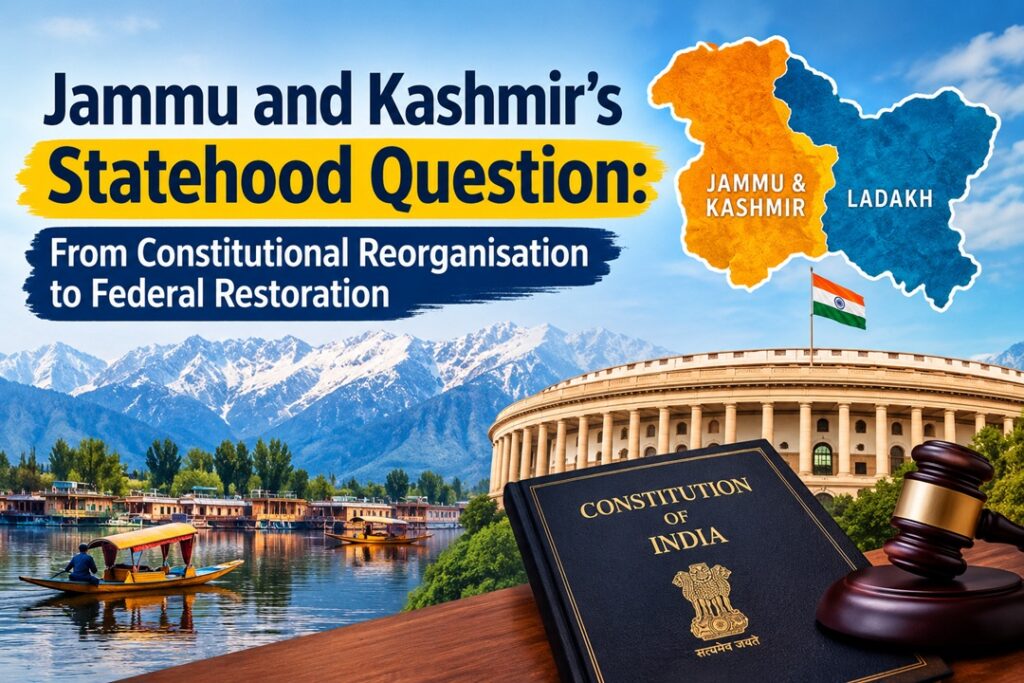
Jammu and Kashmir’s Statehood Question: From Constitutional Reorganisation to Federal Restoration
Context
Jammu and Kashmir Chief Minister Omar Abdullah has introduced a resolution in the Legislative Assembly seeking the restoration of full statehood, bringing renewed focus on the Union Territory’s constitutional evolution since 2019.
Constitutional Evolution of Jammu and Kashmir
Jammu and Kashmir’s position within the Indian Union has undergone significant changes since Independence, moving from a constitutionally distinctive State to a Union Territory and now witnessing a political demand for restoration of statehood.
Accession and Early Constitutional Arrangement
Following the tribal invasion in 1947, Maharaja Hari Singh signed the Instrument of Accession on October 26, 1947, under which India assumed responsibility for defence, external affairs and communications.
The subsequent constitutional arrangement gave J&K a distinctive position within India. Article 370, introduced as a transitional provision, provided for limited application of the Indian Constitution, while the J&K Constitution, 1956 established a separate constitutional framework for the State.
The Delhi Agreement of 1952 further defined the relationship between the Union and J&K, while the 1954 Presidential Order extended several constitutional provisions and introduced Article 35A, which enabled the State legislature to define permanent residents and prescribe certain associated rights.
The Pre-2019 Federal Structure
Before 2019, J&K had several distinctive constitutional features:
- It had its own Constitution and a separate State flag.
- Parliament’s legislative powers over subjects beyond those covered by the Instrument of Accession were subject to the constitutional arrangement under Article 370.
- Article 35A enabled special provisions concerning land ownership, public employment and other rights of permanent residents.
- The State enjoyed a relatively higher degree of constitutional autonomy compared with other Indian States.
Thus, J&K represented an example of asymmetrical federalism, in which constitutional arrangements differed from those applicable to most other States.
The 2019 Constitutional Transformation
A major restructuring occurred in August 2019.
Through Constitutional Orders 272 and 273, the Union government altered the operation of Article 370 and made the Indian Constitution applicable to Jammu and Kashmir in its entirety. Article 35A consequently ceased to operate.
The Jammu and Kashmir Reorganisation Act, 2019 subsequently divided the former State into two Union Territories:
- Jammu and Kashmir, with a Legislative Assembly.
- Ladakh, without a Legislative Assembly.
This fundamentally changed the federal and administrative relationship between J&K and the Union.
Why Is Statehood Being Demanded?
The present demand for statehood is centred on restoring a fuller form of elected self-government.
Democratic authority:
Political representatives argue that restoration of statehood would strengthen the authority of the elected government and reduce the predominance of the centrally appointed Lieutenant Governor.
Control over key subjects:
A full State government would have greater constitutional authority over subjects such as police and public order, which currently remain significantly influenced by the Union framework applicable to the UT.
Local economic interests:
There are also demands for safeguards relating to land, employment and opportunities for local youth, particularly in the context of greater economic integration.
Constitutional commitment:
The issue is also linked to the Supreme Court’s December 2023 judgment on Article 370, in which the Union government stated that statehood would be restored at the earliest opportunity.
Significance of Restoring Statehood
Restoration would represent another important stage in J&K’s constitutional evolution. It could strengthen the role of elected institutions in governance and establish a clearer division of responsibilities between the Union and the State.
It could also shift political attention towards employment, investment, tourism, infrastructure and regional development, rather than continuing to centre governance debates primarily around the post-2019 constitutional transition.
At the same time, questions concerning security, institutional coordination, land policy and the precise framework for statehood would need to be addressed through constitutional and legislative processes.
Way Forward
- Establish a clear and time-bound institutional roadmap for restoration of statehood.
- Strengthen the functioning and accountability of elected representative institutions.
- Ensure effective coordination between the Union and the future State government on security-related matters.
- Examine constitutionally sustainable safeguards for land, employment and local economic interests.
- Maintain transparency and broad consultation while implementing further institutional changes.
Conclusion
Jammu and Kashmir’s constitutional journey has moved from special autonomy to Union Territory administration, creating a new phase in India’s federal evolution. The present statehood demand highlights the importance of balancing national integration, democratic representation and effective federal governance within the constitutional framework.
Soure : The Indian Express