
Rising Household Debt and the Challenge of Sustainable Consumption
Context
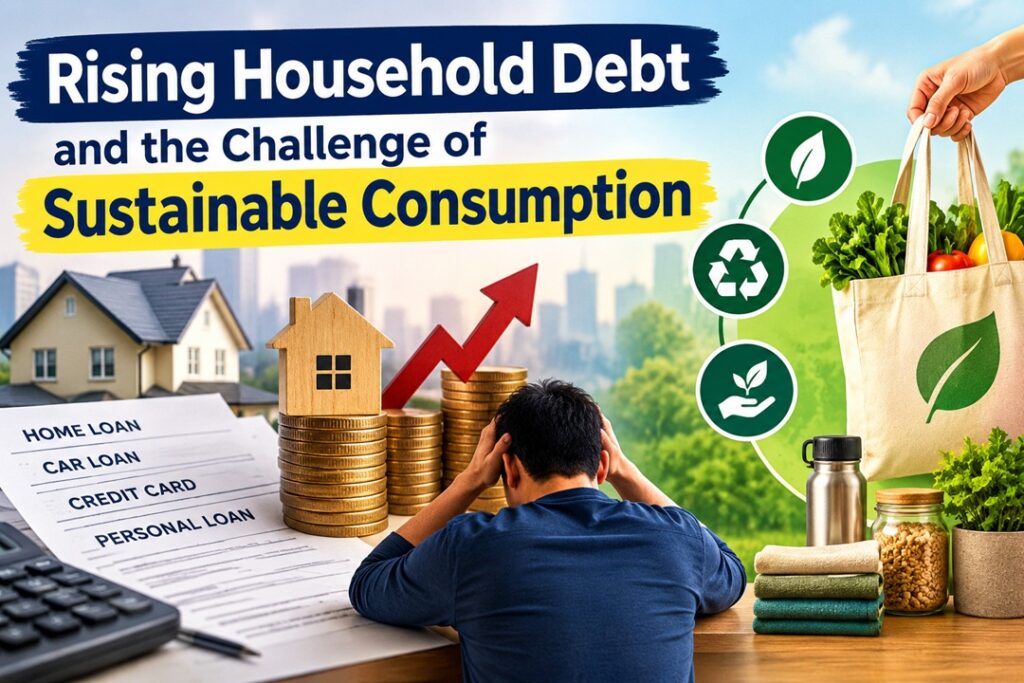
India’s household debt rose to 45.5% of GDP in September 2025, highlighting concerns over growing dependence on credit and household financial stability.
Rising Household Debt in India
Household debt increased from 42% of GDP in June 2023 to 45.5% in September 2025. At the same time, net household financial savings recovered to around 6% of GDP in 2024–25, after declining to 5.2% in 2023–24.
The expansion of formal banking, digital lending, personal loans and credit cards has made borrowing easier. While wider access to credit can help households manage temporary financial needs, excessive borrowing can increase repayment burdens.
Changing Pattern of Household Borrowing
Household consumption is increasingly being supported by credit rather than accumulated savings. Unsecured loans and digital credit allow households to meet immediate consumption needs without necessarily creating corresponding assets.
The impact is uneven across income groups. Salaried households with predictable earnings may find it easier to service loans, whereas informal workers and self-employed households with irregular incomes can face greater repayment risks.
Borrowing for essential expenses such as healthcare, education and housing also indicates the financial pressure created by rising costs and inadequate social protection.
Factors Behind Rising Household Debt
Easy Digital Credit: Instant loan facilities and simplified digital processes have lowered barriers to borrowing.
Uneven Income Growth: Irregular employment and wage growth can increase dependence on credit to maintain consumption.
Rising Essential Expenditure: Increasing healthcare, education and housing costs can push households towards borrowing.
Changing Consumption Aspirations: Consumer credit has enabled households to purchase durable goods and finance lifestyle-related expenditure.
Macroeconomic Implications
Supporting Economic Activity: Credit-financed consumption can increase aggregate demand and support short-term economic growth. Productive borrowing can additionally contribute to entrepreneurship, education and asset creation.
Household Financial Stress: Higher loan repayments reduce disposable income and can limit savings and future consumption.
Vulnerability to Economic Shocks: Employment losses, income fluctuations or higher interest rates can make highly indebted households more vulnerable to repayment difficulties.
Financial-System Risks: Significant deterioration in household repayment capacity could affect banks and other lending institutions, particularly where unsecured credit has expanded rapidly.
Widening Inequality: Better-off households generally have greater capacity to manage debt, while low-income households may borrow to meet basic needs and consequently face greater financial vulnerability.
Way Forward
Strengthen Income Security: Stable employment, better wages and stronger livelihood opportunities can reduce excessive dependence on household borrowing.
Promote Responsible Lending: Lenders should assess repayment capacity carefully and provide transparent information on interest rates, fees and repayment obligations.
Improve Financial Literacy: Households should be made more aware of borrowing costs, credit scores, multiple-loan risks and responsible use of digital credit.
Expand Social Protection: Affordable healthcare, education, housing and social-security mechanisms can reduce distress borrowing for essential expenditure.
Encourage Productive Credit: Greater access to affordable credit for entrepreneurship, education, housing and income-generating activities can shift borrowing towards asset creation.
Improve Debt Monitoring: Regulators should strengthen household-debt data and closely monitor unsecured and digital lending to identify emerging financial vulnerabilities.
Conclusion
India’s rising household debt reflects both greater access to finance and underlying pressures on household incomes and essential expenditure. Ensuring that credit supports productive activity, while strengthening savings, income security and social protection, is essential for sustainable consumption and financial stability.
Source : The Hindu