
National Strategy for Additive Manufacturing 2.0: Advancing India’s High-Tech Manufacturing Ecosystem
Context
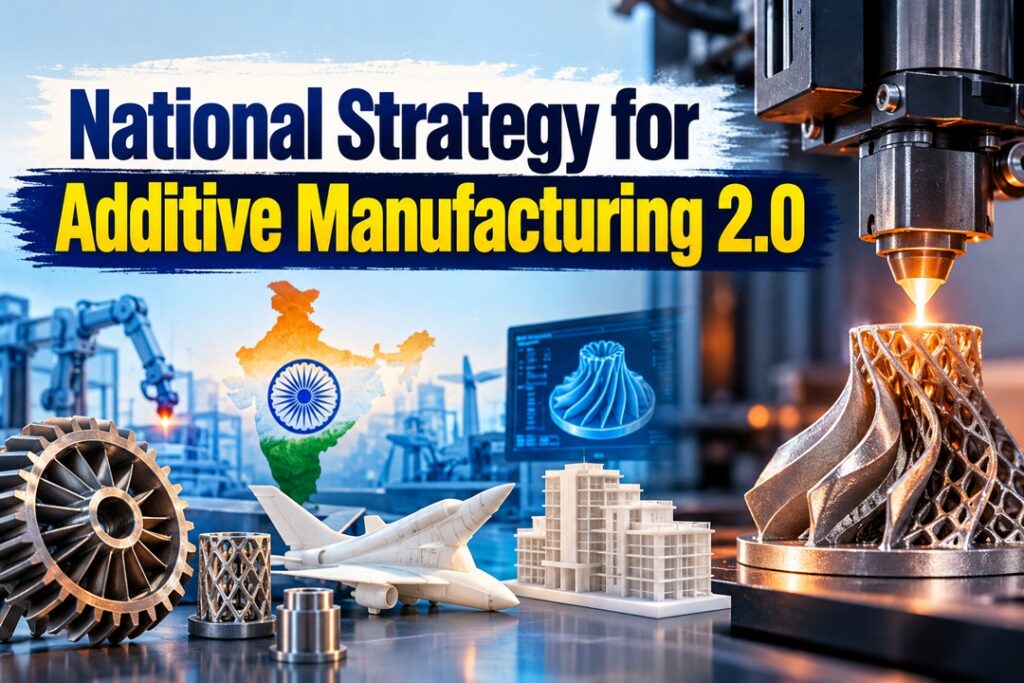
The Ministry of Electronics and Information Technology (MeitY) has initiated the rollout of the National Strategy for Additive Manufacturing (NSAM) 2.0, building on the framework introduced in 2022. The updated strategy seeks to strengthen domestic technological capabilities, promote indigenous innovation and accelerate the commercial adoption of 3D printing across critical industrial sectors.
Understanding Additive Manufacturing
Additive Manufacturing (AM), commonly known as 3D printing, is a production technique in which objects are created by depositing or solidifying materials layer by layer using digital designs. Unlike conventional manufacturing, which often removes material from a larger component, this method can minimise waste, reduce tooling requirements and enable the production of intricate structures.
The process generally involves creating a three-dimensional model through Computer-Aided Design (CAD), converting it into a machine-readable format, dividing it into successive layers and fabricating the object using suitable materials and printing technologies. Post-processing is then undertaken to achieve the required strength, accuracy and surface quality.
India’s Progress and Global Opportunities
Additive Manufacturing is emerging as an important component of advanced manufacturing, with applications extending from industrial machinery to healthcare, electronics and construction. The global market presents substantial opportunities for countries capable of developing specialised materials, equipment and design software.
India’s initial NSAM framework established targets for expanding its global market presence, developing indigenous technologies, supporting startups and creating new products. The reported achievements include:
- Skill development: More than 1.54 lakh individuals have received training in additive manufacturing-related skills.
- Startup support: 56 startups have received funding to develop innovative applications and commercial solutions.
- Indigenous innovation: 65 domestic technologies have been developed across seven national centres.
- School-level exposure: Atal Tinkering Labs are promoting design thinking and 3D-printing skills among school students.
- Sustainable construction: 3D-printed concrete structures offer the potential to reduce construction costs and material-related emissions, depending on the application and production method.
These developments indicate progress in building a domestic ecosystem, although scaling industrial adoption and translating research into commercially competitive products remain important priorities.
Major Applications Across Strategic Sectors
1. Aerospace and Space Technology
Additive Manufacturing enables the production of complex, lightweight components with fewer individual parts and reduced dependence on specialised tooling. These capabilities are particularly valuable in aerospace, where weight reduction, precision and component reliability are critical.
For instance, Agnikul Cosmos has demonstrated the potential of 3D printing through its Agnibaan-SOrTeD launch vehicle, which uses a single-piece, 3D-printed semi-cryogenic engine.
2. Defence and Military Logistics
The technology can support the rapid production of protective structures, specialised equipment and replacement components in remote or operationally challenging locations. This can reduce dependence on lengthy supply chains and improve the maintenance and repair capabilities of the Armed Forces.
The Indian Army’s use of 3D-printed defence structures in eastern Ladakh illustrates the potential of additive manufacturing in difficult terrain. The technology can also support faster construction of certain buildings and infrastructure.
3. Healthcare and Biomedical Engineering
Patient-specific implants, prosthetics and anatomical models can be manufactured using digital scans and biocompatible materials. This enables better adaptation to individual anatomical requirements and may reduce dependence on imported specialised medical devices.
Indian innovators are also exploring advanced bone scaffolds and bioceramic implants, creating opportunities for domestic medical-device manufacturing and personalised healthcare.
4. Electronics and Photonics
Additive Manufacturing can facilitate the fabrication of conductive structures, antennas, electronic components and photonic devices. Its ability to integrate multiple functions into compact structures makes it relevant to next-generation electronics.
Research institutions, including the Indian Institute of Science (IISc), Bengaluru, are exploring additive techniques for photonic integrated circuit building blocks. Greater domestic capability in this field could strengthen India’s electronics and semiconductor ecosystem.
5. Construction and Infrastructure
Three-dimensional printing can automate the production of selected building components and structures, potentially reducing construction time, material wastage and labour requirements. Its application in infrastructure and housing could be particularly useful where conventional construction is expensive or logistically difficult.
However, wider adoption will depend on structural safety, durability, regulatory approval and suitability for local environmental conditions.
Key Features of NSAM 2.0
The second phase aims to move beyond research and initial technology development towards wider industrial deployment and commercialisation.
- Indigenous intellectual property: Encouraging domestic patents, proprietary materials, machine designs and manufacturing software to retain technological value within India.
- Integrated research infrastructure: Connecting research laboratories, testing facilities and manufacturing centres through a coordinated digital network.
- Commercialisation of Indian technologies: Supporting the transition of domestically developed prototypes into market-ready industrial products.
- Affordable access for MSMEs: Promoting shared manufacturing facilities and industrial clusters to reduce the cost of adopting advanced printing equipment.
- Domestic electronics manufacturing: Expanding capabilities in printed electronic components, antennas, passive devices and photonic circuits.
- Defence preparedness: Strengthening on-site component production, maintenance capabilities and rapid infrastructure deployment.
- International standards alignment: Improving domestic testing and certification systems to facilitate the adoption of Indian-manufactured components in global supply chains.
Challenges Facing India’s Additive Manufacturing Ecosystem
1. Dependence on Imported Materials
Many advanced applications require specialised metal powders, engineering polymers, resins and bioceramics. Dependence on foreign suppliers for high-quality feedstock can increase production costs and expose Indian manufacturers to supply-chain disruptions.
For example, aerospace-grade titanium alloys require stringent material specifications and certification, making the development of reliable domestic supplies particularly important.
2. High Capital Investment
Industrial-grade metal printers and other advanced systems involve substantial initial expenditure. Smaller enterprises may find it difficult to invest in equipment, maintenance, skilled personnel and supporting software, restricting adoption beyond large manufacturers and research institutions.
3. Gaps in Standards and Certification
Critical components used in aircraft, defence equipment, medical implants and infrastructure require rigorous validation. Inconsistent testing procedures and the absence of comprehensive, application-specific standards can delay commercialisation and weaken confidence in domestically manufactured products.
4. Dependence on Foreign Software
Several industrial design tools, slicing engines and machine-control systems are controlled by overseas companies. This dependence can restrict customisation, increase recurring costs and create vulnerabilities in strategically important manufacturing processes.
5. Limited Commercial Scale
Successful prototypes do not automatically translate into mass production. Manufacturers must demonstrate consistent quality, repeatability, cost competitiveness and long-term reliability before additive manufacturing can replace or complement established production techniques at scale.
6. Shortage of Advanced Skills
The sector requires interdisciplinary expertise in materials science, mechanical engineering, digital design, robotics and quality assurance. Training must therefore progress beyond basic 3D-printing familiarity towards specialised industrial applications.
Way Forward
- Develop domestic feedstock industries: Support the production of high-quality metal powders, specialised polymers, technical resins and bioceramics to reduce import dependence and strengthen supply-chain resilience.
- Establish Common Facility Centres: Create shared additive manufacturing facilities in industrial clusters, enabling MSMEs to access advanced equipment through affordable, pay-per-use arrangements.
- Strengthen standards and certification: Accelerate the development of application-specific quality codes, testing protocols and fatigue-performance benchmarks in coordination with relevant regulatory and standards bodies.
- Promote indigenous software and machinery: Encourage research and private-sector investment in design platforms, slicing software, machine controllers and domestically manufactured printers.
- Integrate AM with semiconductor initiatives: Support research into printed electronics, embedded sensors and photonic components to complement India’s broader electronics and semiconductor manufacturing ambitions.
- Expand industry–academia collaboration: Link universities, national laboratories, startups and established manufacturers to facilitate technology transfer and commercial production.
- Build specialised human capital: Expand advanced training programmes, industry-linked curricula and hands-on exposure to industrial-grade additive manufacturing.
- Adopt sector-specific implementation plans: Prioritise applications where the technology offers clear advantages, such as complex aerospace components, customised medical implants, specialised defence parts and low-volume industrial production.
Conclusion
Additive Manufacturing represents a shift towards flexible, digitally driven and resource-efficient production. For India, its strategic importance lies not merely in adopting 3D printers but in developing the complete domestic ecosystem of materials, machinery, software, skilled workers and certification systems. Effective implementation of NSAM 2.0 can strengthen industrial competitiveness, support Make in India, improve strategic self-reliance and contribute to the technological transformation envisioned under Viksit Bharat 2047.
Source : PIB