
Great Indian Bustard Conservation: From Captive Breeding to Rewilding
Context
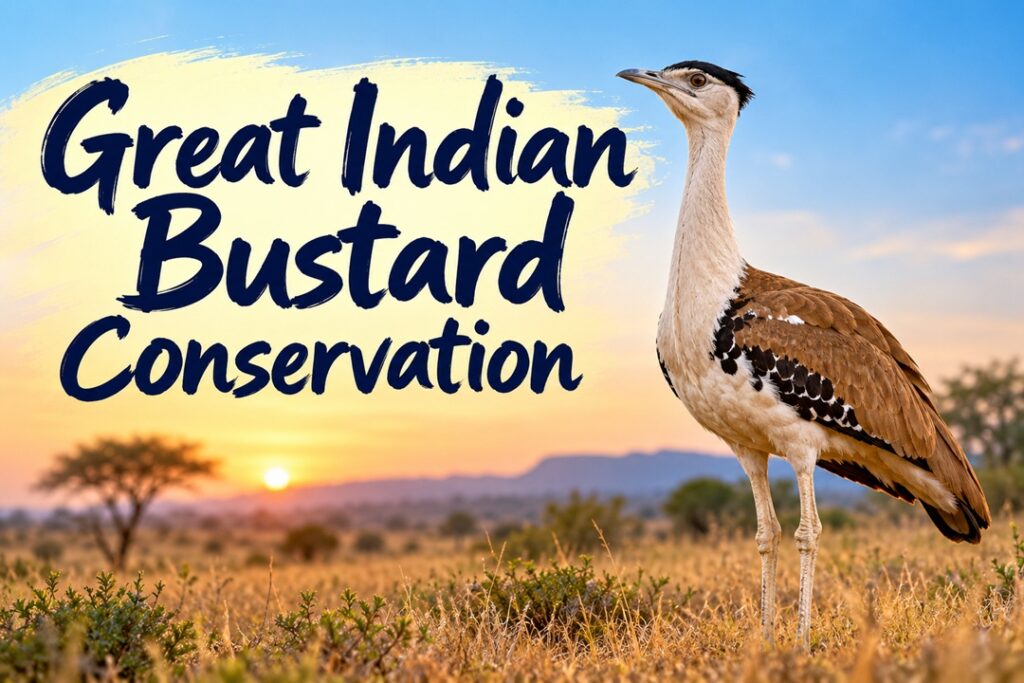
For the first time, two captive-bred Great Indian Bustards (GIBs) have been released into the wild in Rajasthan, marking a significant development in India’s efforts to prevent the extinction of this critically endangered bird. The initiative seeks to restore a viable wild population through captive breeding, habitat protection and scientific monitoring.
Great Indian Bustard: Key Features and Population Status
The Great Indian Bustard is a large, ground-dwelling bird associated with dry grasslands, open savannahs and semi-arid landscapes. It plays an important role in grassland ecosystems and serves as an indicator of the ecological health of these habitats.
- Shrinking geographical range: Historically, the species occurred across 11 Indian states, from Haryana to Tamil Nadu and from Rajasthan to Odisha. Habitat degradation and human activities have significantly reduced its distribution.
- Declining population: The population, estimated at around 1,260–1,400 birds in the early 1970s, has fallen to approximately 150 individuals in the wild, with Rajasthan supporting the largest share.
- Conservation initiative: The Centre, the Wildlife Institute of India (WII) and the governments of Rajasthan and Gujarat initiated a dedicated conservation programme in 2012–13, with specialised breeding facilities developed subsequently.
- Captive-breeding success: Eggs collected from the wild, particularly from Desert National Park, were artificially incubated at breeding centres in Sam and Ramdevra. The programme has produced 98 captive-bred birds, creating a potential foundation for population recovery.
Recent Rewilding Initiative: A Major Milestone
The release of two captive-bred male bustards into the natural habitat of Desert National Park near Jaisalmer represents a transition from breeding in controlled environments to survival in the wild.
- Pilot release: The initial release is intended to assess whether captive-bred birds can adapt to natural conditions. Eleven additional birds have been identified for subsequent releases.
- Pre-release adaptation: Young chicks are transferred to specialised rewilding aviaries and soft-release facilities at around three to four months of age. This process helps them develop natural behaviour while reducing excessive familiarity with humans.
- Satellite-based tracking: Transmitters fitted to the released birds provide location and movement information several times a day, enabling conservation teams to monitor their adaptation, habitat use and survival.
- Scientific evaluation: Observations from the pilot phase can help refine future release protocols, identify ecological risks and improve the chances of establishing a self-sustaining wild population.
Major Threats to the Survival of the Species
Despite progress in captive breeding, the long-term recovery of the Great Indian Bustard depends on addressing threats within its natural habitat.
1. Collisions with Power Transmission Lines
Overhead power lines, including those associated with renewable energy infrastructure, are a major cause of mortality. The bird’s large body, limited frontal vision and flight characteristics make it particularly vulnerable to collisions with cables.
2. Degradation of Native Grasslands
Grasslands are sometimes treated as wastelands or landscapes requiring afforestation. Tree plantations and inappropriate habitat interventions can alter the open terrain required by the bustard for feeding, breeding and movement.
3. Habitat Loss and Fragmentation
The conversion of grasslands and arid scrublands into agricultural fields, industrial areas and mining sites reduces the availability of suitable habitat. Fragmentation also isolates small populations, restricting movement and opportunities for breeding.
4. Mining and Infrastructure Pressure
Proposed limestone mining near the northern boundary of Desert National Park raises concerns about disturbance and habitat degradation in areas important for conservation and rewilding.
5. Vulnerability of a Small Population
The survival of such a limited number of birds remains sensitive to accidental deaths, poor breeding success and the loss of individual breeding adults. Captive breeding alone cannot ensure recovery if these pressures persist in the wild.
Judicial and Policy Measures for Conservation
Legal protection and coordinated habitat management are necessary to complement breeding and reintroduction efforts.
- Implementation of Supreme Court directions: The Court accepted expert recommendations identifying priority areas of approximately 14,013 sq km in Rajasthan and 740 sq km in Gujarat for addressing power-line threats. The prescribed measures include undergrounding identified critical power lines between 2027 and 2028 and developing dedicated transmission corridors.
- Recognition of grasslands as distinct ecosystems: State governments should strengthen the legal and administrative protection of grasslands instead of classifying them as degraded or unproductive land.
- Protection of core habitats: Mining, industrial development and infrastructure projects in and around sensitive habitats should undergo rigorous ecological assessment.
- Expansion across the historical range: Following scientific evaluation in Rajasthan, rewilding could be extended to suitable habitats in Gujarat, Maharashtra, Karnataka, Madhya Pradesh and other former range areas.
- Community participation: Local communities, pastoralists and land managers should be involved through awareness programmes, livelihood support and incentives for protecting wildlife habitats.
- Long-term monitoring: Satellite tracking, field surveys, reproductive assessments and periodic population estimates should guide decisions on further releases and habitat management.
Way Forward
India should adopt a landscape-level conservation approach that integrates captive breeding, rewilding and the restoration of natural grasslands. Future releases should be based on scientific evidence regarding survival, adaptation, food availability and breeding potential rather than the number of birds released alone.
A coordinated mechanism involving the Union government, state governments, scientific institutions and local communities is essential. Power-line mitigation, protection of breeding grounds and prevention of habitat fragmentation must proceed alongside the release programme.
Conclusion
The first release of captive-bred Great Indian Bustards into the wild marks an important step in species recovery, but it is only the beginning of a longer conservation process. The ultimate measure of success will be the establishment of a self-sustaining wild population supported by secure grasslands, safer infrastructure and effective long-term protection.
Source : The Indian Express