
Stubble Burning in North India: Addressing the Structural Causes of Seasonal Air Pollution
Context
As winter approaches, deteriorating air quality across northern India has renewed concerns over stubble burning in Punjab and Haryana. Despite stricter enforcement and reported declines in fire incidents, farmers continue to burn paddy residue because of narrow sowing windows, economic incentives favouring rice cultivation, and the high cost of alternative residue-management methods.
The issue highlights the need to integrate agricultural policy, groundwater conservation, and air pollution control rather than relying exclusively on penalties.
Understanding Stubble Burning
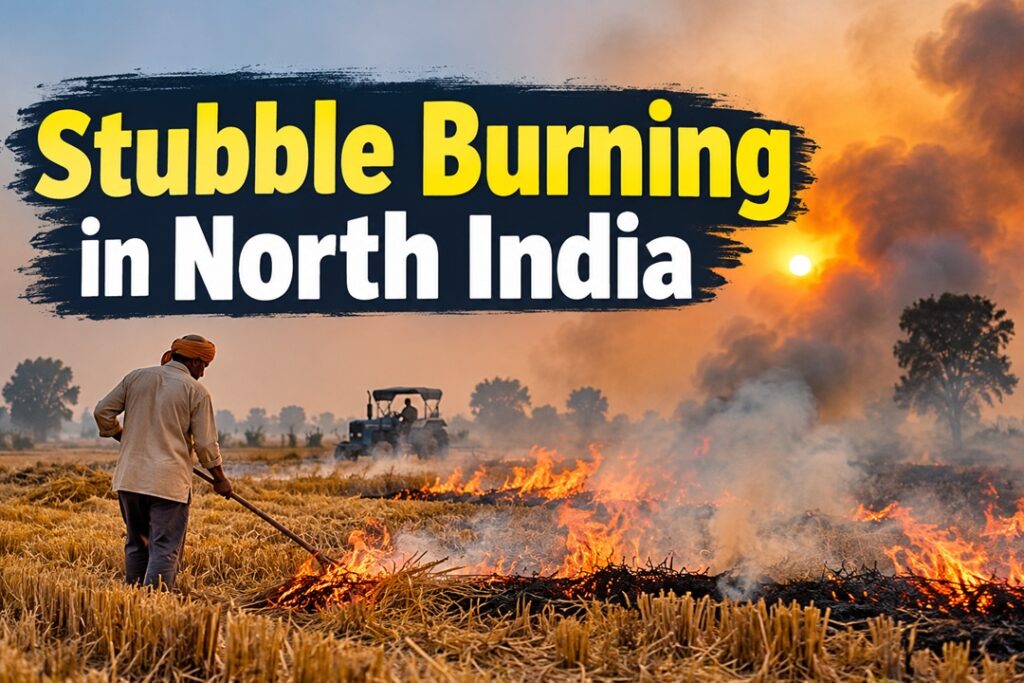
Stubble burning refers to the deliberate burning of crop residues left in agricultural fields after harvesting, particularly paddy straw. It is widespread in northwestern India during October and November, when farmers prepare their fields for the next wheat crop.
- Scale of the problem: Punjab and Haryana together generate approximately 29 million metric tonnes of paddy straw annually.
- Reported versus actual reduction: Official figures indicate a substantial decline in recorded fire incidents between 2022 and 2025, while satellite-based estimates of the area burned suggest a comparatively slower reduction.
- Agricultural significance: Farmers often consider burning the quickest and least expensive method of clearing fields before the next sowing cycle.
Why Does Stubble Burning Persist?
1. Compressed Agricultural Sowing Window
The Punjab Preservation of Sub-Soil Water Act, 2009, restricted early paddy transplantation to reduce groundwater depletion. However, delaying transplantation also delayed harvesting, leaving farmers with limited time to prepare their fields for wheat cultivation.
Long-duration paddy varieties, such as PUSA-44, further extend the harvesting period, sometimes leaving only 10–15 days for clearing residue and sowing wheat.
2. Mechanised Harvesting and Residue Accumulation
Combine harvesters reduce harvesting time and labour requirements but leave substantial quantities of straw and rooted stubble in the field.
Manual removal is often expensive and difficult because of labour shortages. Burning therefore becomes an attractive short-term option for farmers facing tight sowing deadlines.
3. Agricultural Incentives Favouring Paddy Cultivation
Minimum Support Price (MSP)-based procurement and subsidised electricity have encouraged the cultivation of paddy in regions where groundwater resources are under severe pressure.
- Assured procurement: Between 2012 and 2024, the proportion of paddy production procured by public agencies was substantially higher in Punjab and Haryana than the national average.
- Low-cost irrigation: Subsidised electricity reduces the immediate cost of groundwater extraction.
- Limited alternatives: Farmers may hesitate to switch to maize, pulses or oilseeds when procurement arrangements, prices and market access are less certain.
These incentives reinforce paddy cultivation and indirectly contribute to the recurring problem of residue disposal.
4. High Cost of Crop Residue Management
Technologies such as Happy Seeders, Super Seeders and other crop residue management (CRM) machines can help farmers manage straw without burning it.
However, these machines require powerful tractors, and seasonal hiring charges can be substantial. Small and marginal farmers may also face long waiting periods during the short interval between harvesting and sowing.
5. Gaps in Monitoring and Enforcement
Satellite-based monitoring may fail to capture every fire because of observation schedules, cloud cover and the timing of burning. Fires occurring outside satellite observation windows can remain undetected.
Consequently, a decline in recorded fire incidents does not necessarily translate into an equivalent reduction in the total area burned or the amount of residue combusted.
Measures Taken to Address the Problem
- Enforcement and monitoring: Central Pollution Control Board (CPCB) flying squads and directions from the Commission for Air Quality Management (CAQM) seek to improve compliance in identified pollution hotspots.
- Crop Residue Management subsidies: Punjab supports access to specialised machinery through subsidised equipment and Custom Hiring Centres.
- Financial incentives in Haryana: State-level assistance has included incentives for residue management, direct-seeded rice and crop diversification.
- Judicial interventions: The National Green Tribunal and the Supreme Court have addressed stubble burning through directions concerning enforcement and disincentives for non-compliance.
These measures have expanded the policy response, but their effectiveness depends on affordable machinery, credible monitoring and economically viable alternatives for farmers.
Implications of Stubble Burning
1. Deterioration of Air Quality
Burning paddy residue releases fine particulate matter, carbon monoxide, volatile organic compounds and other pollutants. Under winter conditions, including temperature inversions and weak atmospheric dispersion, these emissions can contribute to severe smog across the National Capital Region and neighbouring states.
2. Decline in Soil Fertility
High temperatures can destroy organic matter and affect essential soil nutrients, including nitrogen and sulphur. Repeated burning may increase dependence on chemical fertilisers and weaken long-term soil health.
3. Loss of Soil Moisture and Beneficial Microorganisms
Surface fires damage soil organisms and reduce the organic matter that supports moisture retention. Continued degradation can affect soil structure and agricultural productivity.
4. Public Health Burden
Exposure to polluted air aggravates respiratory and cardiovascular conditions. Children, older people, outdoor workers and individuals with pre-existing illnesses face particular risks during periods of intense pollution.
5. Pressure on Water and Agricultural Sustainability
The economic preference for paddy cultivation, combined with intensive groundwater extraction, places additional pressure on already stressed aquifers. Stubble burning is therefore connected to a wider pattern of resource-intensive agricultural practices.
Way Forward
1. Align Agricultural Policy with Groundwater Conservation
Crop diversification should be supported through assured procurement, price support and accessible markets for maize, pulses and oilseeds. Farmers are more likely to shift away from paddy when alternative crops provide dependable returns.
2. Promote Short-Duration Paddy Varieties
Encouraging suitable short-duration varieties, such as PR-126 where agronomically appropriate, can advance harvesting and create a longer interval for residue management and wheat sowing.
3. Make Residue Management Affordable
Custom Hiring Centres should provide timely access to CRM machinery at affordable rates. Panchayats, Farmer Producer Organisations (FPOs) and cooperatives can pool equipment and coordinate field-level services, particularly for smallholders.
4. Develop Markets for Paddy Straw
A reliable market for agricultural residue can transform straw from a disposal problem into an economic resource.
- Expand the use of paddy straw in compressed biogas and second-generation bioethanol plants.
- Improve collection, transportation, storage and aggregation facilities.
- Explore assured prices for collected straw to compensate farmers and supply-chain operators for handling costs.
5. Strengthen Satellite-Based Monitoring
Combining observations from polar-orbiting and geostationary satellites can improve the detection of fires occurring at different times of day. Satellite findings should be cross-checked with ground-level inspections to distinguish genuine improvements from gaps in reporting.
6. Shift Towards Cooperative Compliance
Enforcement remains necessary, but penalties alone cannot resolve the underlying economic constraints. Policies should combine credible monitoring with technical assistance, timely subsidies and viable alternatives, while ensuring that reported progress reflects actual reductions in burning.
Conclusion
Stubble burning is not merely an environmental compliance problem; it is closely linked to agricultural procurement, groundwater depletion, mechanisation costs and the narrow interval between paddy harvesting and wheat sowing. Sustainable progress requires coordinated reforms that make residue management affordable and crop diversification economically attractive. By aligning farm incentives with ecological needs, India can reduce seasonal air pollution while protecting farmers’ livelihoods, soil health and water resources.
Source : The Hindu