
Poverty Reduction as a Pathway to Forest Conservation
Context
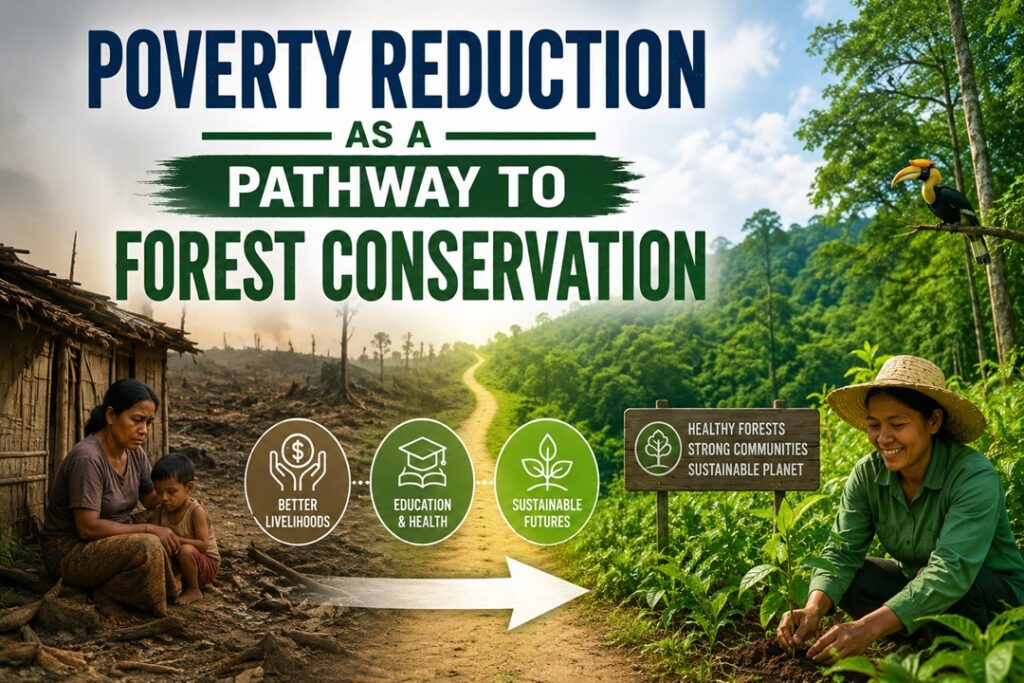
A recent international research paper published in Nature Sustainability has highlighted that improving rural livelihoods can significantly enhance forest biodiversity, challenging the long-standing belief that strict exclusion of local communities is the most effective conservation strategy.
Poverty Reduction as a Pathway to Forest Conservation
What is the Study About?
- Researchers used data from the International Forestry Resources and Institutions (IFRI) network to examine 322 community-managed tropical forests across 15 countries over a period spanning 1993–2017.
- The study assessed the relationship between socio-economic conditions and tree species diversity, a key indicator of ecosystem health, resilience, and sustainability.
- Findings revealed a strong connection between improved livelihood opportunities and healthier forest ecosystems.
Major Findings of the Study
Livelihood Insecurity Drives Resource Pressure
- The study found that biodiversity decline is not caused by poverty alone.
- Rather, limited access to employment and income opportunities forces communities to depend heavily on forests for fuel, fodder, and other daily necessities.
- Such dependence increases pressure on natural resources and accelerates ecological degradation.
Declining Diversity in Highly Exploited Forests
- Forests located near economically disadvantaged and densely populated settlements showed lower levels of tree species diversity.
- Reduced biodiversity weakens ecosystem stability and decreases the ability of forests to withstand environmental stress.
Alternative Livelihoods Strengthen Ecosystems
- Communities with access to farming, small businesses, and non-forest occupations were associated with forests possessing greater biodiversity.
- Diversified income sources reduced extraction pressure and contributed to long-term ecological health.
Limitations of Protection-Centric Conservation
- Traditional conservation policies have largely emphasized strict protection and restrictions on human activities.
- While effective in safeguarding certain endangered species, such approaches often create isolated protected areas surrounded by heavily exploited landscapes.
Threats to Ecological Connectivity
- Forest patches outside protected areas support the livelihood needs of millions of people and serve as important wildlife movement corridors.
- Continuous extraction and degradation in these regions can disrupt habitat connectivity and species migration.
Successful Community-Based Conservation Models
Community Stewardship for Hornbill Protection
- Conservation initiatives in Arunachal Pradesh have engaged local tribal communities as habitat guardians and nest protectors.
- These efforts have improved bird conservation while generating local employment opportunities.
Participatory Mangrove Management
- Coastal villages in Maharashtra have combined mangrove conservation with sustainable fisheries, aquaculture, and eco-tourism activities.
- The model demonstrates how environmental protection can coexist with economic development.
Snow Leopard Conservation Through Local Incentives
- Community-led tourism ventures and livestock insurance programs in Ladakh have reduced conflicts between humans and wildlife.
- Local participation has strengthened support for conservation efforts.
Clean Energy Access Around Forest Landscapes
- Distribution of LPG connections, energy-efficient stoves, and cleaner heating solutions has reduced dependence on fuelwood in several forest regions.
- Such interventions help lower pressure on surrounding ecosystems.
Key Challenges
Uncertain Financial Support
- Many livelihood and welfare programs face irregular funding, affecting their long-term sustainability.
Uneven Community Engagement
- Adoption of conservation-linked livelihood alternatives varies across regions due to differing social and economic conditions.
Limited Benefit Sharing
- Revenue generated through nature-based tourism often does not adequately reach communities living near protected areas.
Underutilization of Indigenous Knowledge
- Traditional ecological practices and local knowledge systems remain insufficiently integrated into conservation planning.
Way Forward
Expand Clean Energy and Livelihood Support
- Extend fuel-substitution schemes and livelihood programs beyond protected areas to villages located along critical ecological corridors.
Ensure Fair Sharing of Conservation Benefits
- Create mechanisms to channel a larger share of eco-tourism earnings directly to local communities.
Promote Participatory Forest Governance
- Encourage collaborative management frameworks that provide local communities with decision-making roles and sustainable resource-use rights.
Replicate Successful Local Models
- Scale up proven community-based initiatives involving eco-tourism, sustainable fisheries, conservation enterprises, and biodiversity stewardship across forest-dependent regions.
Conclusion
The findings of the Nature Sustainability study suggest that environmental conservation and socio-economic development are mutually reinforcing goals. Strengthening livelihood security, expanding economic opportunities, and empowering local communities can simultaneously reduce poverty and improve forest biodiversity, making conservation efforts more effective and sustainable in the long run.
Source : The Hindu